International Women’s Day in Design
Female Architect on Mentorship, Multifamily Design, and Building Inclusive Communities
Liz Peabody
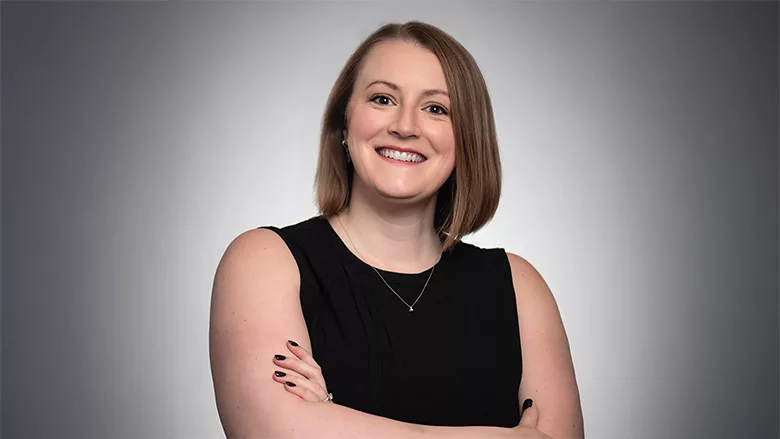

Liz Peabody
The Architectural Team
What initially inspired you to pursue a career in architecture, and who or what influenced you most along the way?
My father is not a trained engineer or architect, but he designed the house we grew up in. He and my grandfather helped build it. I knew this as a child, and that knowledge made architecture seem like something that was completely achievable. As cliché as it may sound, there was never a moment in my household where there was an ounce of doubt that I or my brothers could be literally anything we set our minds to. Between that confidence, my love of the arts, and desire to leave a lasting impact with my work, I knew architecture was the right fit for me.
Can you share a project you’re especially proud of and explain what made it meaningful—either professionally or personally?
When I first entered this field I thought I would focus on single-family residential projects, but I’ve found myself drawn to working at a larger scale. Being a part of mixed-use developments and innovative multifamily projects has helped me realize that I find the greatest sense of pride in addressing the biggest challenges.
My most rewarding project to date has been Alexan Harrison, a two-building, 450-unit development in Westchester County outside of New York City. With structured parking, multiple finish schemes and intricate construction detailing, this was by far the largest and most challenging project I’ve worked on at TAT. At the same time, it was a very collaborative endeavor with the client and the broader design team, and by working well together we were able to think creatively and deliver a community that outperformed everyone’s expectations.
For me, the excitement of problem-solving is what makes this work interesting, and it’s what keeps projects that might look similar from the outside, or have the same underlying construction type, from becoming monotonous. Every project has unique challenges to figure out, and solving these puzzles is what keeps me driven to do more.
How do you see diversity and inclusion influencing better design outcomes in architecture today?
The more diversity of thought and experience you have, the less you miss, the more tailored your solutions can be to your end user.
Have you had mentors or advocates who played a key role in your career growth, and how important is mentorship for women entering the field now?
I have had mentors and advocates in my career, and I frankly owe everything I know to them. Architecture is an on-the-job-training industry. No amount of schooling will educate you enough to succeed in the day-to-day of an architect. They taught me what risk management means to an architect. How to find the answers to questions I have on my own. The reality is that without mentors, women are especially likely to leave the field. Without seeing a clear path forward for themselves through leadership who looks and lives like them, compounded by lack of mentorship, it can be challenging to find reasons and resources to develop and advance your career.
How do you balance creativity with the technical, regulatory, and business demands of architecture?
I think the most successful architects are the ones who have a deep working knowledge of all our constraints and thrive on finding the creative solution that respects those constraints (or, creatively breaks them when applicable!). I find it an exciting challenge and one that keeps me grounded – without some working boundaries, limitless creativity is a recipe for stalled progress and results that lack context and direction.
What changes have you seen for women in architecture over the course of your career, and where do you think progress is still needed?
My answer here is similar to my perspective on sustainability—there is incremental progress and it’s never as much as one would want. How do we make the top half of our industry the same as the bottom half, diversity wise? Graduating classes have reached fantastic parity between genders, and have held that parity for a long time. The profession as a whole is significantly unbalanced, though – closer to 75 percent male and 25 percent female at the top leadership levels. We seem to be stuck here. Better support for working parents (this includes fully paid parental leave for all parents, birthing and non-birthing), more acknowledgement of the benefits of diversity, I think would both go a long way towards making progress.
How do you see the conversation on sustainability going in our industry?
I actually see conversations around sustainability and global warming following a similar trajectory to those around gender parity and equity. Big societal problems are always marked by incremental progress. You take steps forward, but there are tradeoffs and it’s never as much as you want. And I think with any big problems like these, that’s the only way forward.
If we push major changes too fast, development stalls for either true cost reasons or perception of cost. If we make incremental progress, people can adjust, get their feet wet, find out it’s not so scary, maybe see the short-term benefits firsthand, and we can set ourselves up for a more sustainable future. I think one of the biggest challenges for our industry, beyond simply keeping up with the education and changes, is developing the language to communicate these benefits to our clients. How do we illustrate these short-term benefits in terms that make sense to their bottom line, that make them excited to pursue sustainable strategies? That’s our charge as architects.
What has been the most fulfilling moment of your career so far, and how did it shape your professional journey?
The most fulfilling aspect of my career has not come as one big moment but rather many small moments. TAT has, intentionally or not, given me access to many young rising female architects, and mentoring them the way I was mentored by my male colleagues before me is highly satisfying. I have not had any female mentors in this field, though I’ve had plenty of female contemporaries. It has been rare, and often fleeting, for me to work with any women who have more experience than I do. That really startles me sometimes to think about. I aim to be the change I want to see. There are many reasons women leave a firm or an industry. I want to show women all the reasons to stay, and I want to leave a legacy of highly competent, effectual, creative, and empathetic female architects behind me before I’m gone.
What advice would you give to young women or girls who are considering a career in architecture or the broader AEC industry?
You cannot achieve goals you do not set for yourself. You are limited only by your own aspirations. Plan for your future. Spend time thinking about what you want your life and your role in this industry to look like. Then spend time planning how to get it. You might not find a mentor that looks just like you, or has had your exact lived experience. Seek out mentors anyway, and ask for help and guidance. Return the favor by being the most curious, dedicated architect you can be, and eventually by paying it forward.
During International Women’s Month, what does recognition like this mean to you, and how can the industry continue to better support and elevate women’s voices year-round?
Nothing will grow or change without opportunities like this to express our perception of this industry. My hope is that the industry starts to better understand and embrace the value of having a diversity of thought leadership. You cannot be successful, in the long term, if the perspectives of an entire gender are sequestered in entry and mid-level positions. There is value in intentionally mentoring people who are different from you, and helping them grow into leadership positions.

















Looking for a reprint of this article?
From high-res PDFs to custom plaques, order your copy today!

.webp?height=740&t=1767036885&width=auto "Header - BE 1170x658 (002).png")

.webp?height=740&t=1755781744&width=auto "KEE(2).png")