
DEXcell® Roof Boards are trusted by those who live by the specs – roofing consultants, architects and professionals who demand performance. Designed for the entire spectrum of commercial roofing applications, DEXcell® Roof Boards strengthen commercial roof assemblies from the inside out.


Designing Low-Slope Roofs for Resilience
Why cover boards have become essential to meeting modern wind, hail and fire standards and protecting long-term roof assembly performance
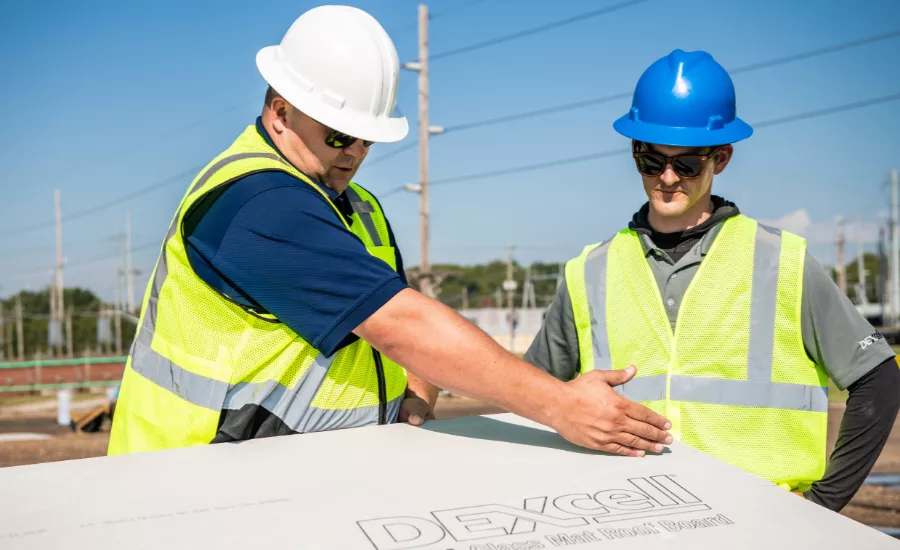
Resilience in low-slope commercial roofing is no longer a forward-looking concept. It’s a current design requirement. For architects, consultants and specifiers, the definition of a high-performance roof assembly has expanded beyond code compliance to include long-term durability, risk mitigation and validated performance under real-world conditions. Changing weather, increased rooftop utilization and evolving code expectations are all placing greater demands on roofing systems. While membranes and insulation often receive the most attention, building enclosure professionals understand that performance is determined by how the entire assembly works together. At the center of that system is one often overlooked, but essential, layer: the roof cover board.
Resilience Is a System Outcome, Not a Product Selection
Specifier Checklist
When to Include a Cover Board
Cover boards will always enhance a roof system. Its inclusion, though, is a necessity when these conditions apply:
- Required for FM 4470 VSH assemblies
- Needed to achieve higher FM uplift ratings
- Necessary for UL Class A fire-rated assemblies
- Recommended in high-traffic or equipment-heavy roofs
- Critical where insulation compressibility is a concern
- Beneficial in hail- and wind-prone regions
Standards for commercial roofing reinforce a fundamental principle of enclosure design: assemblies, not individual components, are what perform. FM 4450 evaluates wind uplift and fire resistance at the system level. FM 4470 Very Severe Hail (VSH), introduces impact resistance into that equation. These standards simulate how real-world forces act on a fully constructed system (deck, fasteners, insulation, cover board and membrane) because each layer influences the result.
This aligns with a broader shift: performance is no longer assumed based on material selection alone. It must be demonstrated through how assemblies behave under the stresses of wind loading, thermal cycling, impact and fire exposure.
The Critical Interface Between Thermal and Structural Performance
As energy codes and design priorities drive higher R-values, roof assemblies are becoming thicker and more layered. Insulation is optimized for thermal performance, but not always for compressive strength or durability. In applications such as roof assembly systems, that creates a gap between thermal design intent and structural performance. Cover boards address that gap by providing a rigid, stable interface between insulation and membrane, and in doing so, they:
- Create a uniform substrate for membrane attachment
- Reduce variability caused by insulation compressions
- Support consistent fastening and adhesion performance
- Protect underlying layers from damage during and after installation
Without that stabilizing layer, the performance of the entire assembly becomes more dependent on materials not designed to carry those loads.
Defending Against Changing Elements
The roof system protects the people and equipment below it. Best practices guide specifiers to consider any potential impact and specify to the key standards that assure the integrity of the roof system. Among those considerations are natural elements that impact the roof – wind, hail and fire.
1. Wind Uplift: Designing for Load Transfer.
Wind uplift design is about load transfer. Under FM 4450, uplift pressures are applied across the full assembly, with peak forces occurring at corners and perimeters. Cover boards play a key role in managing the load paths, distributing forces more evenly across insulation layers and reducing stress at the fasteners. This becomes increasingly important as coastal conditions move further inland and projects are expected to meet higher FM ratings. A hard cover board often determines whether an assembly can achieve the higher wind uplift ratings.
2. Hail and Impact: Designing Beyond Historical Risk Maps.
FM 4470 VSH testing requires assemblies to withstand repeated simulated hail impacts without failure (compromised waterproofing performance). Cover boards contribute to that performance by introducing a high-strength layer beneath the membrane, reducing the membrane’s puncture risk. Without that layer, impact energy is transferred directly to the insulation, increasing the risk of damage. As the hail region expands, geographies that didn’t historically require VSH criteria now need to meet new performance factors.
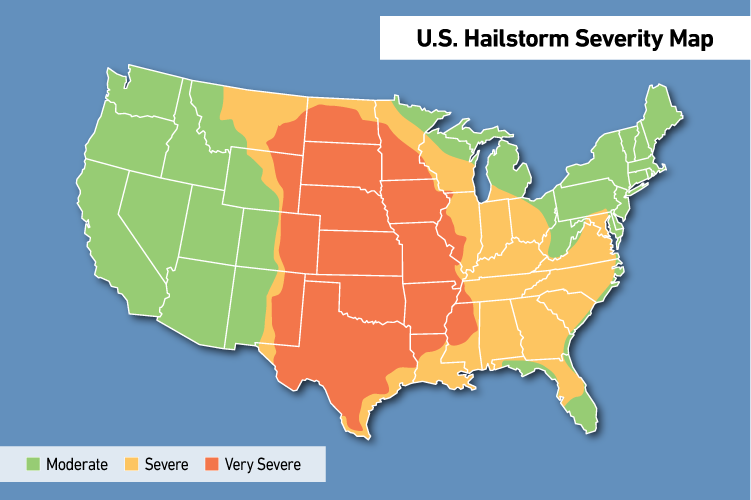
Image: National Gypsum Company
3. Fire Performance: Supporting Assembly-Level Compliance.
UL 790 evaluates external flame spread, exposure and penetration to determine fire resistance in roof assemblies. Glass mat gypsum and cement cover boards help assemblies achieve Class A ratings by acting as a noncombustible layer within the assembly. This performance isn’t inherent to a single product but rather the complete assembly.
Materials Standards and Moisture
While overall performance determines system standards, each component meets baseline criteria for specific performance characteristics. For example, ASTM C1177 guides requirements for glass mat gypsum panels to meet moisture resistance and dimensional stability. Using cover boards in the roof assembly, and selecting cover boards that meet these standards, helps ensure the interface between insulation and membrane remains stable under varying environmental conditions like moisture.
Different environmental and performance impacts necessitate different material types and standards. Technical guides, such as the DEXcell(R) Roof Board technical guide, offer guidance on materials and applications.
Designing Rooftops for Real-Use Conditions
While weather can be a damaging element to rooftops, human activity can have a comparable negative impact. Modern commercial roofs are active environments, supporting mechanical systems, solar equipment and routine maintenance foot traffic. This equipment and human impact all introduce concentrated loads on the roof.
When integrated into a roof assembly, hard cover boards distribute these loads and protect the insulation from damage. Left unprotected, insulation damaged by real-use conditions can allow moisture to enter the building enclosure, reduce R-value and reduce roof short-term performance and long-term durability overall.
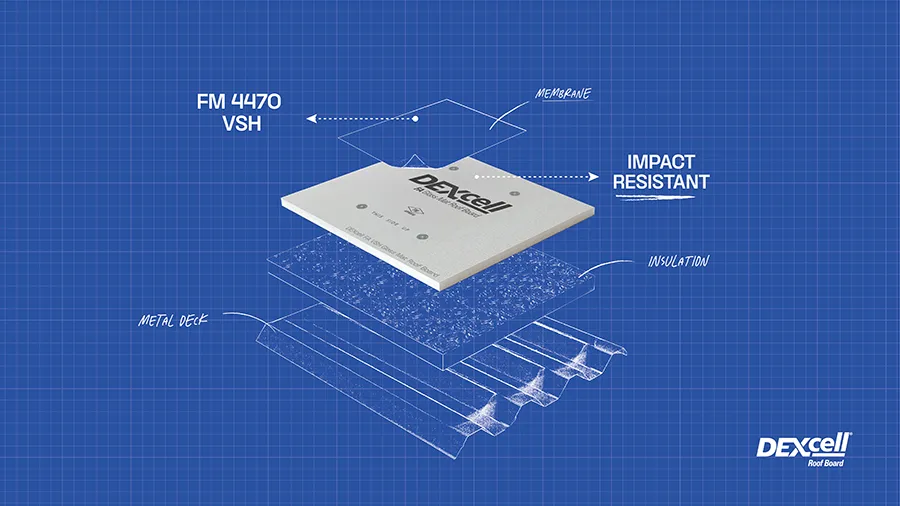
Image: National Gypsum Company
Assembly Integrity, Approvals and Risk Management
System approvals such as FM 4450 and FM 4470 VSH apply to tested combinations of materials. In many cases, cover boards are required to achieve those approvals or to maintain manufacturer warranties.
Omitting this layer may reduce initial cost, but it introduces risk:
- Failure to meet required approvals
- Reduced resistance to wind, hail and fire
- Increased likelihood of membrane damage
- Shortened service life
As climate conditions evolve, codes advance and building performance expectations increase, cover boards have moved from optional upgrade to essential component. For those who design by the standards, the conclusion is clear: the most critical layer in high-performance roof assemblies is often the cover board, ensuring everything above it performs as intended so everything below it is protected.
 Warren Barber is Senior Manager, Gypsum and Specialty Systems/DEXcell for National Gypsum Company. He is a LEED Green Associate, CSI CDT, with specialties in product development, claim mitigation and resolution and sales and marketing to the AEC community.
National Gypsum Company is the exclusive provider of DEXcell®. DEXcell® gypsum roof board products are manufactured by Gold Bond Building Products, LLC. DEXcell® cement roof board products are manufactured by PermaBASE Building Products, LLC.
Looking for a reprint of this article?
From high-res PDFs to custom plaques, order your copy today!
.webp?height=740&t=1767036885&width=auto "Header - BE 1170x658 (002).png")

.webp?height=740&t=1755781744&width=auto "KEE(2).png")