Open-Cell vs. Closed-Cell Spray Foam
Start with the Building, Not the Product
.webp?t=1783080870)
Key Takeaways
- Choosing foam by climate and assembly prevents costly moisture problems and improves long-term building performance
- Installation quality impacts energy efficiency and durability as much as insulation product selection
- Moving beyond R-value and price leads to smarter, more resilient building envelope decisions
Spray foam insulation has become a larger part of building envelope conversations over the last decade, but the discussion around open-cell versus closed-cell foam is still often oversimplified.
Too many conversations start and end with price, R-value, or product preference.
That is usually the wrong starting point. The building itself has to come first.
The more effective approach is to evaluate how the building is expected to perform, what climate it operates in, how moisture will move through the assembly, and what conditions the insulation system will actually face over time. Open-cell and closed-cell spray foam both have advantages. They also both have limitations. The right choice depends on where and how they are being used.
For builders, architects, contractors, and owners, the goal should not be selecting a preferred foam product. The goal should be selecting the right solution for the assembly.
How “Building Performance” has changed the conversation
Modern buildings are expected to do more than simply stay warm or cool. Energy efficiency requirements are tighter. Air leakage expectations are stricter. Moisture management has become more important. Occupant comfort and long-term durability are now central parts of enclosure design.
For many people, this has changed the fundamental way insulation is viewed.
Spray foam is often discussed as just another insulation product, but in practice it is usually part of a broader Building Performance strategy involving everything from air control and vapor management to thermal performance and assembly durability.
That distinction matters because insulation decisions made without considering the rest of the building system can create problems that have nothing to do with the insulation material itself.
Many insulation failures are actually failures of moisture management, unseen air leakage, or problems that could have been solved before installation even began.
The most important factor: climate and vapor drive
Before comparing open-cell and closed-cell foam, the question to ask is not which product performs better. The question is what does the building need its insulation system to do.
From there, location becomes one of the most important factors. Climate affects vapor drive, condensation risk, drying potential, and humidity exposure, which means it can significantly influence whether open-cell or closed-cell foam is the better fit for the assembly.
In colder climates, buildings spend much of the year with warm, humid interior air pushing outward toward colder exterior surfaces. If moisture migrates into a wall or roof assembly and reaches a cold condensing surface, long-term moisture problems can develop inside the enclosure.
That is one reason closed-cell foam is commonly used in colder climate zones and high-moisture assemblies. Its lower permeability and vapor-retarding characteristics help limit moisture migration through the assembly.
Mixed climates often present a different set of conditions. Buildings may experience both heating and cooling seasons with alternating vapor drive throughout the year. In many of those assemblies, drying potential becomes an important part of long-term performance, which is where open-cell foam can become a strong solution when properly applied.
This is where many generalized arguments and pro/con debates start to fall apart. A recommendation that makes sense for a Wisconsin winter may not make sense in Tennessee or coastal Florida.
Building science does not work universally across every assembly and every climate. The conditions matter.
Understanding open-cell foam
Open-cell spray foam is a lower-density material that expands significantly and creates an effective air seal when properly installed.
Its vapor permeability can be an advantage in mixed and warmer climates where assemblies benefit from drying potential. The key question is whether the assembly has a reliable drying path.
Open-cell foam can also support sound attenuation because of its softer, less dense structure.
Risk increases in high-moisture assemblies such as crawl spaces or metal buildings, where condensation or water intrusion can turn vapor permeability into a liability.
Open-cell foam should be evaluated by assembly, climate, and moisture behavior, not broad assumptions about the product itself.
Understanding closed-cell foam
Closed-cell spray foam is a higher-density material with higher R-value per inch and significantly lower vapor permeability.
Its impact comes by delivering improved structural strength while solving specific enclosure problems, especially where vapor control, condensation risk, limited cavity depth, or moisture exposure are central concerns.
It is often used in cold climates, crawl spaces, exterior assemblies, transition areas, and commercial details where air leakage and condensation are difficult to control.
That does not make it the right choice everywhere. In some assemblies, its vapor-retarding properties may not be necessary, and open-cell foam may provide sufficient performance at a lower cost.
Closed-cell foam should be selected when its characteristics match the enclosure challenge, not simply because it offers higher R-value per inch.
Installation quality still determines outcomes
One of the more persistent myths surrounding spray foam is that product performance is automatic once the material is installed.
In reality, performance depends heavily on installation quality, field conditions, and how the overall building envelope is managed.
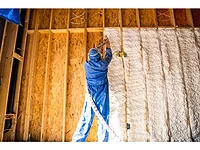
Substrate conditions, temperature, humidity, equipment calibration, lift thickness, mixing ratios, and installer experience all affect the final result. Two projects can use the same product and deliver very different outcomes.
That makes contractor evaluation part of the performance decision. Owners, builders, and design teams should understand who is applying the material, what conditions are required for proper installation, how thickness and coverage will be verified, and how the installer will account for moisture, temperature, ventilation, and other surrounding conditions.
When properly installed, both open-cell and closed-cell foam can become high-performing components within the building envelope. When improperly installed, either product can create long-term problems or fail to solve the problems they were meant to fix.
Materials matter. Execution and training matter more.
Why the “Best Product” debate misses the point
One of the more unproductive habits in insulation planning is treating spray foam selection like a product competition.
Experienced professionals focused on delivering Building Performance Solutions start with the building, not the product. They evaluate:
- assembly design
- cavity depth
- climate zone
- drying potential
- humidity exposure
- long-term durability expectations
- occupancy conditions
- sound requirements
- vapor drive
Those conditions should determine the recommendation. If a recommendation starts and ends with a preferred product or the lowest price, it is probably not accounting for the full performance picture.
There are projects where closed-cell foam is clearly the more appropriate solution. There are also projects where open-cell foam may be the more practical and better-performing choice within the assembly.
Neither product should be treated as universally superior.
In most projects, there is more than one way to improve performance. The right recommendation is the one that fits the assembly, climate, budget, and long-term performance goals without creating avoidable risk.
Final thoughts
Construction has become more technical, and enclosure performance expectations continue to increase across commercial and residential projects alike.
This is why insulation selection becomes more important than simply comparing products by cost or an advertised R-value.
Open-cell and closed-cell spray foam each serve important purposes within modern building assemblies. The challenge is not deciding which product wins the argument. The challenge is understanding how climate, moisture behavior, assembly design, and installation quality influence long-term performance.
When spray foam decisions are made through that lens, the conversation becomes less about product preference and more about building durability, efficiency, and performance over time. Those are the factors that determine whether insulation supports the building as a system, not just whether a product checks a box.
Looking for a reprint of this article?
From high-res PDFs to custom plaques, order your copy today!
.webp?height=740&t=1767036885&width=auto "Header - BE 1170x658 (002).png")

.webp?height=740&t=1755781744&width=auto "KEE(2).png")