Acoustics and Aesthetics: The Value of Integrated Opening Systems
While acoustic design impacts all occupancy types, it has elevated importance in health care
Key Takeaways
- Better acoustic design can improve patient recovery, staff focus and overall healthcare outcomes
- Sound-control strategies help protect patient privacy and support HIPAA compliance throughout healthcare facilities
- Coordinated envelope and interior design can reduce noise without sacrificing daylight, visibility or occupant comfort
Building acoustics are a crucial design concern for all projects. Strategies for ensuring a sonically comfortable environment extend from the building’s exterior to deep within its interior, and often elements of these strategies must work together. For example, a curtain wall designed for sound attenuation supports and is supported by interior openings that can dampen sound transfer. The wall and interior systems work together to ensure rooms and corridors are not only free from noise but do not bleed sound from one space to another.
While acoustic design impacts all occupancy types, it has elevated importance in health care. These spaces can be located in busy areas that create large volumes of exterior noise. Within them, ambient noise from alarms, moving equipment, provider meetings, incoming patients and more can elevate ambient sound to 50 – 60 weighted decibels (dB(A)), according to a study conducted at John Hopkins Hospital. This exceeds the World Health Organization’s (WHO) recommendations of 35 – 45 dB(A) during the day and 20 – 35 dB(A) at night. Exterior and interior noise can disturb patient rest, disrupt provider meetings and breaks, cause alarm fatigue, lead to less optimal patient outcomes and much more.
Further, sound attenuation strategies can be crucial to a robust approach to guidelines from the Health Insurance Portability and Accountability Act (HIPAA). For these reasons, it is important to consider the role of sound when designing a health care facility—a consideration that starts with the building envelope and stretches into patient rooms and provider spaces.
Where are Acoustic Designs Most Beneficial for Health Care Projects?
When planning a new medical center or renovating an existing building, project teams are encouraged to consider how sound travels into and out of different areas. This includes patient and exam rooms, provider spaces, lobbies and waiting areas, shared corridors and more. While multiple areas of the built environment can be enhanced with improved sound attenuation, there are a few key areas that consistently drive project value: the building envelope, patient rooms and provider spaces. When these three location groups are designed to block inbound and outbound sound transfer, they can help project teams plan more functional and occupant-focused interiors.
This is not to say that acoustic design in stairways, corridors, waiting areas and other spaces within a medical facility would not improve the overall occupant experience. Strategizing ways to mitigate noise transfer in these areas is important, too. That said, when the façade, patient rooms and provider spaces are planned with acoustics in mind, they can mitigate sound transfer where occupants most benefit from acoustic isolation.
The challenge here is to coordinate not just the acoustic performance of the walls and openings in these components of the built environment but also their aesthetics. Doing this often takes a coordinated approach to design, one that understands the relationship between a building’s exterior and its interior.
Exterior Considerations: Glass, Louvers and More
Acoustic design begins with the façade. Optimizing daylight access and quality views of the surrounding area also begins at the building envelope. The challenge here is that opaque materials like concrete, stone and brick, composites, metal panels and more often have higher acoustic ratings than transparent glass. This seems to create a zero-sum game where transparency comes at the expense of acoustics and vice versa. However, design teams have several options for balancing sound and vision at this crucial juncture.
The first solution is channel glass. This type of glass wall system is built with self-supporting glass cast into U-shaped channels and held within an extruded metal perimeter frame. As a system, it can achieve Sound Transmission Class ratings (STC) between 42 dB and 44 dB, which is comparable to several opaque materials. While channel glass can provide daylight access and sound attenuation, its surface texture will often obscure views.
When visual connection to the outside world is a priority, designers can specify transparent glazing assemblies with integrated louvers. These systems hermetically seal extruded aluminum louvers between two lites of glass. Because they can be up to 68 inches in length, premium integrated louvers can be specified in openings and curtain walls alike.
In both assembly types, occupants can adjust the level of daylight access and acoustic privacy to suit their needs. Fully open louvers allow natural light to flow into a space, while fully closed louvers help enhance privacy and support sound reduction. Rather than being limited to a fixed setting, users can fine-tune the louvers to achieve the right balance of daylight, privacy, and acoustical control—a balance that may shift depending on the season, time of day, or activity within the space.
Interior Options: Doors, Windows and Cohesive Aesthetics
While a well-planned envelope is important for acoustic design, it will only mitigate sound transfer from exterior sources. For health care environments, much of their ambient sound occurs within the built environment, so an acoustic design will likely need to incorporate a strategy in which exterior facing elements and interior ones work in tandem to create a sonically comfortable interior.
Both channel glass and glazing with integrated louvers can be specified for building interiors. That said, due in part to its width, channel glass is not appropriate for most door systems or interior windows. Considering these openings have a high potential for negating the acoustic performance of interior walls, it is important to design them with acoustics in mind. To that point, STC can be applied to walls, windows and doors, but with openings it can be more beneficial to understand how a window or door works with other elements for sound attenuation. In these instances, Noise Isolation Class ratings (NIC) may provide more relevant information since the test measures acoustic performance when a system is installed in the field.
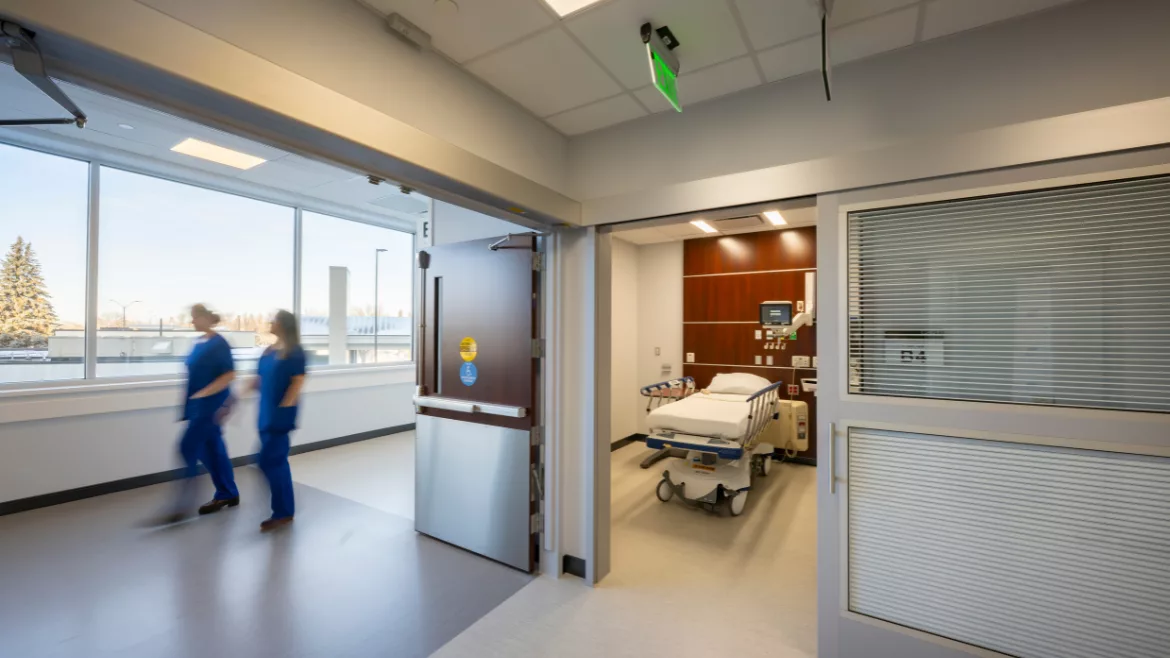
Leading commercial sliding glass doors and other flexible opening systems can achieve NIC ratings up to 39, meaning they block up to 39 decibels of sound when installed. For example, ExamSlide™ from AD Systems features a heavy gauge frame, silicone perimeter and drop-down seals. These features enhance the acoustic performance this sliding door provides. Further, when these doors are specified as full-lite sliding glass doors, they can incorporate integrated louvers to support both sound attenuation and adaptable visual connection.
Interior doors and windows with integrated louvers can contribute to more acoustically minded interiors. They can also work with exterior systems to create more occupant-focused buildings by optimizing the built environment for comfort and functionality. Finally, when exterior and interior systems incorporate integrated louvers, they also contribute to a cohesive building aesthetic and improve building safety and hygiene by eliminating exposed cords and difficult to clean mechanisms and materials.
Two Examples of Blending Acoustic Design with Visual Connectivity
Understanding how to blend acoustic design with visual connectivity can be difficult to parse in the abstract, making it important to explore projects solved challenges for both design goals. Altru Health System recently completed a hospital in Grand Forks, North Dakota. The project includes several sliding glass doors and windows with integrated louvers. Both opening types strengthen the visual connection between patients and providers as well as among staff across different areas. Their transparency allows providers to monitor patient needs more effectively and coordinate care seamlessly. Because the louvers are easily adjustable, patients and providers can customize the level of visual connection at any given time—adapting to both privacy and connectivity needs.
These opening systems also contribute to acoustic privacy. Their high NIC ratings help minimize alarm fatigue and limit disturbances to resting patients. Caregivers can focus on critical tasks without distraction, while sensitive conversations remain private, supporting HIPAA compliance.
Although Altru’s hospital did not include louver systems in exterior glazing assemblies, other health care projects have. For instance, Holyoke Center for Behavioral Health at Holyoke Medical Center includes 70 exterior window units that incorporate integrated louver systems. Not only do these openings give occupants agency to adjust for daylight access and privacy, but they also keep patients safe with impact-resistant components tested in accordance with American Architectural Manufacturers’ Association (AAMA) 501.8 performance standards and ligature-resistant louver operators.
Together, these two projects demonstrate the multiple points of value flexible opening systems offer in terms of acoustic performance and contributions to both privacy and lighting strategies.
Opening Designs for Form and Functionality Starts with Collaboration
While designing for acoustics and daylighting can be as simple or complex as a project will allow, there is one near constant: finding the balance between multiple project goals and ensuring several applications work together can be more efficient with a collaborative approach to design. This is because flexible and adaptable designs will likely need several systems to achieve their desired outcomes.
When a design requires multiple systems for a specific set of results, it is important for all stakeholders to be on the same page to ensure every detail is in order—from components being compatible to systems working in harmony. Doing so can streamline the planning and specification process and reduce instances of reworks.
This was the case for Altru’s Grand Forks hospital. In this project, the design team collaborated with manufacturers that utilized integrated teams, meaning each point of contact was familiar with most opening systems and components and had good working relationships across the board. Not only did this make specification more efficient, but it also simplified points of contact. When a team can easily field a question or connect with another manufacturer to find an answer, it supports designers in creating more ambitious projects. It also supports facility managers in planning routine maintenance and repairs across the entire built environment.
When a project starts collaboratively, stakeholders can expect improvements in immediate functionality and long-term viability, whether that is through acoustic design and daylighting or any other complex project goal.
Looking for a reprint of this article?
From high-res PDFs to custom plaques, order your copy today!
.webp?height=740&t=1767036885&width=auto "Header - BE 1170x658 (002).png")

.webp?height=740&t=1755781744&width=auto "KEE(2).png")
.webp?height=200&t=1689862206&width=200 "Project 5 White Plains NY office (002).jpg")