


Pushing the Envelope
Lighter, Prefabricated Building Skins Reduce Risks and Total Costs
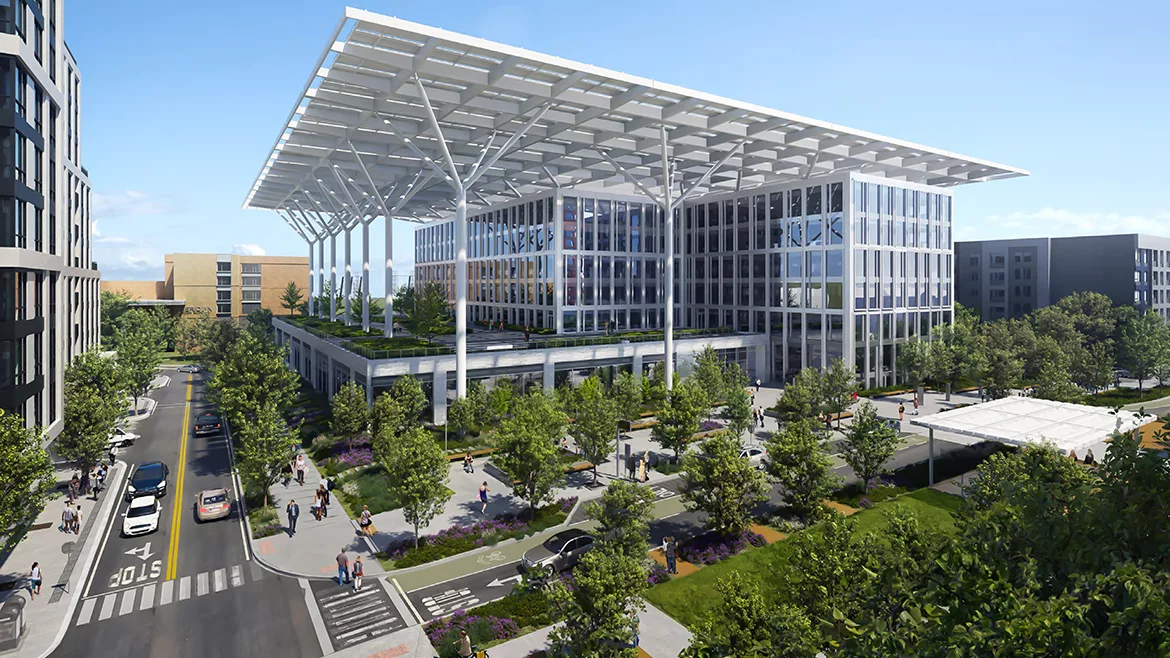
Using the lightweight HyperWall™ building enclosure system on the HITT Construction headquarters project has enabled a design that could not have been achieved with traditional formats.
Closing a building’s exterior is one of the most expensive and time-consuming jobs on a construction site. It also needs to be done right; any flaw in the building envelope can lead to costly warranty claims, even decades later.
As pressure grows to control costs, build more sustainably, and reduce the number of on-site trades, the built industry is looking for ways to work more efficiently. Architects, developers, contractors and building owners recognize the need for innovation.
Two trends are emerging in parallel to achieve these goals. Lighter-weight formats that offer comparable or superior traits compared to traditional materials are seeing increasing use. In addition, interest is growing in building envelope components that can be prefabricated off-site.
Lightening the Load
Lighter materials offer several significant advantages over traditional formats:
- Easier transportation with fewer vehicles — Less weight makes materials easier and less expensive to handle and transport. More items can be loaded onto each truck, reducing the total number of vehicles needed.
- Greater equipment flexibility — Lighter-weight panels give you more options when it comes to moving them on a job site. Contractors can use less expensive and lighter-weight cranes. For example, tower cranes could be used instead of rough terrain (RT) or crawler cranes. The flexibility these alternatives provide can free up higher-demand equipment to focus on different priorities and keep other trades working.
- More sustainable projects — Lighter load weights and fewer total shipments reduce fuel consumption, costs and emissions. Less congestion minimizes truck idling and associated emissions, especially in hot or cold weather. Lighter building panels might also use fewer materials for fabrication. All these advantages add up to less embodied carbon for the job and may help with LEED certification.
- Lower costs — In addition to the cost-saving advantages already mentioned, lightweight panels ease site logistics, lower accident risks, and enable more panels to be erected per day.
The Promise of Prefabrication
Lighter-weight prefabricated panel systems are emerging as a solution to multiple construction challenges. They make job sites safer by significantly reducing the need for high-risk labor on elevated scaffolds and bucket lifts. Contracting companies also benefit from lower costs and greater scheduling flexibility, since fewer trades are needed on-site. The most compelling advantage, however, is speed: some panel systems allow buildings to be closed up to 50% faster.
Despite these benefits, the complexity of some prefabricated building skin options can increase your risks. Multiple assemblies and components make performance highly dependent on fabrication quality. Any flaws can leave the system vulnerable to leaks, mold, mildew, condensation and other damaging conditions. In addition to triggering expensive warranty claims, these issues can be difficult to troubleshoot and repair if they’re sealed inside an assembly.
Monolithic Simplicity
A simpler design that reduces or eliminates these risks is to cast panels as single pieces. The resulting panels, sometimes referred to as monolithic, provide seamless structures for enhanced strength and durability.
Although this approach has been used with concrete for some time, the weight of precast panels limits their uses and benefits. The HyperWall™ panel system from Building Composites® LLC, however, replaces heavy concrete with lightweight structural composites (aka fiber-reinforced polymers). The result is a monolithic panel that’s 25 to 33% the weight of precast.
Building enclosures made from structural composites take all the advantages previously listed to a much greater degree. They’re significantly lighter than traditional materials such as steel and concrete, even though they provide comparable or superior strength. They’re intrinsically impermeable to water and air, corrosion-resistant, and offer a built-in vapor barrier and higher R-values than concrete alternatives. Lower embodied carbon is another advantage, especially for projects seeking LEED certification. Glazing can also be preinstalled at the factory, eliminating the need for another on-site trade.
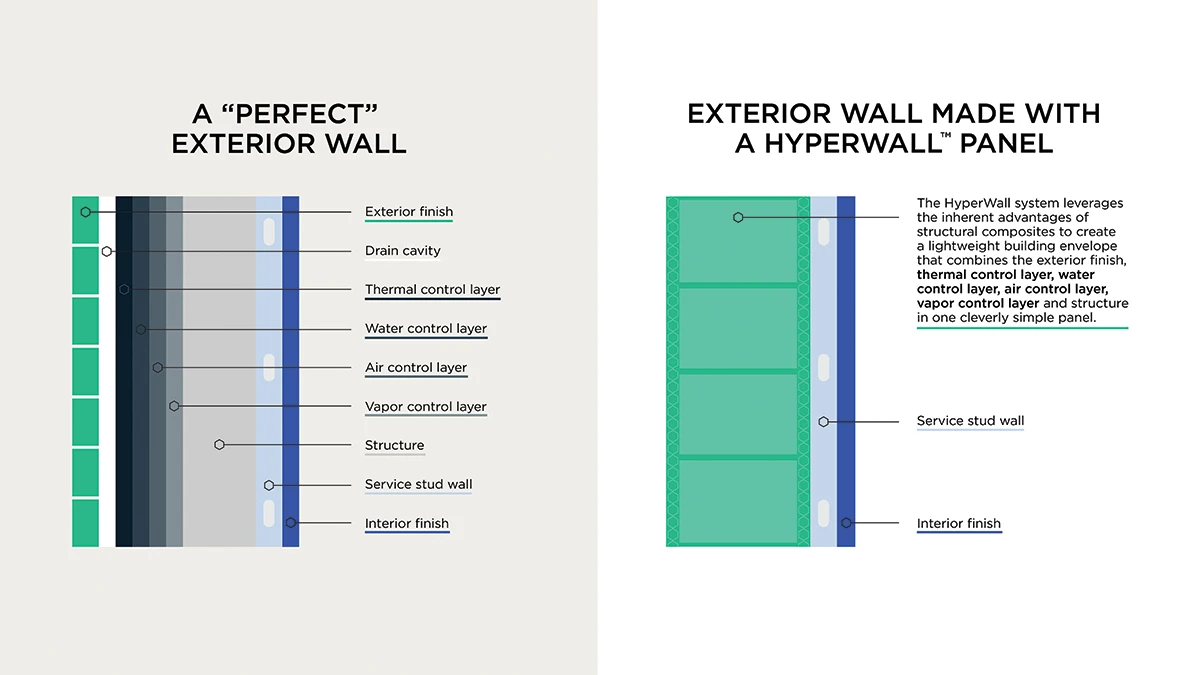
To protect the building structure, an exterior wall must have four critical control layers: thermal, water, air and vapor. In traditional constructions, those control layers are often provided by different products. Made of an advanced structural composite, the HyperWall building enclosure system cleverly combines all four critical control layers into one lightweight panel.
Graphic: Building Composites® LLC
The HyperWall system provides new levels of creative freedom that allow architects and designers to think in completely different ways than ever before. They provide more structural versatility, a much wider range of standard and mica-filled colors, the ability to attach secondary architectural elements, and other visual customization options.
Even “normal” buildings can be more elaborate and creative than a typical “glass box”. Design columns can be smaller; beams can be farther apart. The weight is so much lower that architects can use connections that mimic those used for curtain walls, enabling the visual effects of more traditionally skinned buildings, which would be prohibitively heavy in other formats. HyperWall panels are designed to hang off the exterior of a building. Their high R-value allows for thin infill walls on the interior, which can increase the rentable square footage.
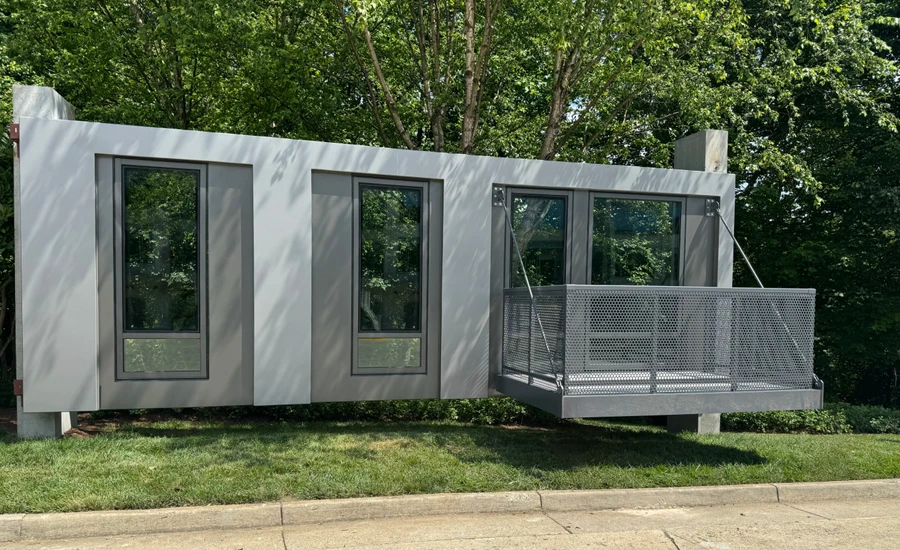
The high strength-to-weight ratio of this structural composite panel allows a balcony unit to be suspended from the panel itself.
Photo: Building Composites® LLC
Beyond the benefits they offer to new construction projects, lightweight monolithic panels are ideal for retrofitting and remodeling jobs, where upgrading the building enclosure is a cheaper and more sustainable option than replacing the entire building and the building’s structure may not be able to support heavier options. Additionally, structural composite panels can be molded into virtually any shape or size, ensuring a perfect fit every time. This approach can enhance the aesthetics of the facade and improve the R-value of the building envelope, making older structures more energy efficient.
The Bottom Line
Every advantage derived from lightweight and prefabricated building envelope designs delivers potential savings, reducing your cost basis. At the same time, they unlock a level of creative freedom that simply isn’t possible with other materials, including greater structural versatility and aesthetic potential. From lower total costs and reduced risks to flexibility, easier scheduling, safety, sustainability and more, simple and lightweight building skin solutions can deliver a competitive edge from start to finish.
Looking for a reprint of this article?
From high-res PDFs to custom plaques, order your copy today!

.webp?height=740&t=1767036885&width=auto "Header - BE 1170x658 (002).png")

.webp?height=740&t=1755781744&width=auto "KEE(2).png")