Record-Breaking Tornado Activity in Illinois Signals New Challenges for Architects
State surpasses annual tornado record before the halfway point of 2026, highlighting growing importance of resilient building design
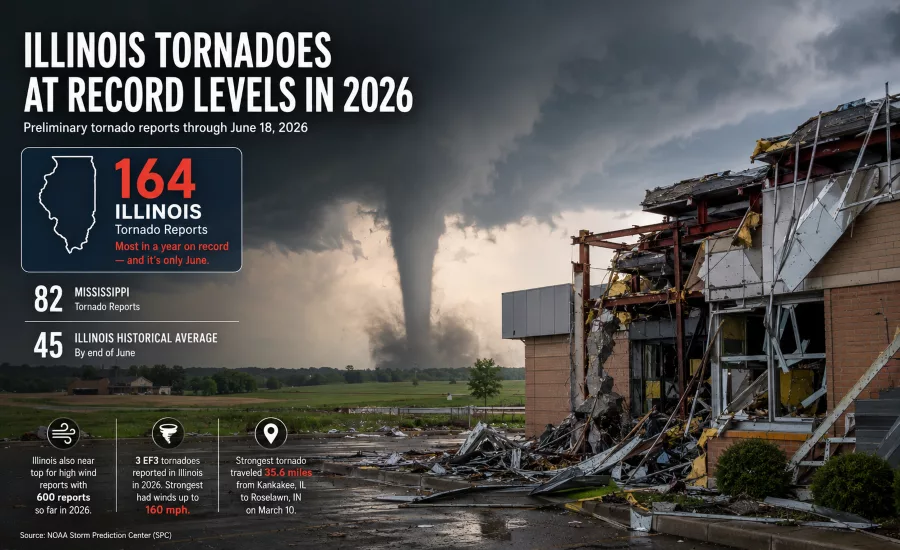
Illinois has already recorded more tornadoes in 2026 than in any previous year on record, underscoring the need for architects, engineers, developers and building owners to rethink how structures are designed to withstand increasingly severe weather events.
According to data from NOAA's Storm Prediction Center, Illinois had recorded 164 preliminary tornado reports as of June 18, surpassing the state's previous annual record with more than six months remaining in the year. The figure is nearly four times the state's historical average of approximately 45 tornado reports by the end of June.
The surge follows multiple tornado outbreaks in March, April and June, positioning Illinois far ahead of every other state in the nation. Mississippi ranks second with 82 tornado reports—exactly half of Illinois' total.
Traditionally, states such as Texas, Oklahoma and Kansas lead the nation in tornado activity by midyear. However, meteorological conditions in 2026 have shifted severe weather farther north into Illinois and the Midwest.
"The dynamics this year have favored Illinois, with storms staying to the north of Texas and Oklahoma," AccuWeather Meteorologist Peyton Simmers noted. "Additionally, drought conditions in the western U.S. have helped limit severe weather activity across parts of the traditional Tornado Alley region."
Beyond tornadoes, Illinois has also experienced unusually high levels of damaging wind events, recording approximately 600 wind reports this year, among the highest totals in the country.
Among the most significant storms was an EF3 tornado on March 10 that traveled 35.6 miles from Kankakee, Illinois, into Roselawn, Indiana, producing wind speeds of up to 160 mph and causing extensive structural damage. Three EF3 tornadoes have been reported statewide so far in 2026.
Why This Matters for the Building Industry
The record-setting tornado activity raises important questions about how buildings are designed, constructed and maintained throughout the Midwest.
Historically, many communities outside traditional Tornado Alley have not faced the same frequency of severe tornado events as regions farther south and west. As weather patterns evolve, however, architects and engineers may need to place greater emphasis on resilience strategies that address high winds, flying debris and prolonged power disruptions.
Key considerations include:
- Enhanced roof attachment systems and wind-resistant building envelopes
- Improved protection for glazing, curtain walls and exterior cladding
- Designated storm shelters and safe rooms in schools, healthcare facilities and public buildings
- Stronger structural connections between foundations, walls and roofs
- Resilient community planning that incorporates emergency response and post-disaster recovery
- Evaluation of building codes and standards in regions experiencing increasing tornado activity
For building owners and facility managers, the trend also highlights the growing importance of risk assessments, maintenance programs and insurance planning as severe weather events become more frequent and geographically widespread.
A Shift in Risk Geography
The extraordinary number of tornadoes reported in Illinois during the first half of 2026 serves as a reminder that severe weather risks are evolving. For architects, engineers and developers, understanding these changing patterns is becoming increasingly important when planning projects intended to remain safe, operational and resilient for decades to come.
As communities across the Midwest continue to experience more frequent extreme weather events, resilient design is moving from a best practice to a critical component of long-term building performance.
Looking for a reprint of this article?
From high-res PDFs to custom plaques, order your copy today!

.webp?height=740&t=1767036885&width=auto "Header - BE 1170x658 (002).png")

.webp?height=740&t=1755781744&width=auto "KEE(2).png")

.webp?height=200&t=1752167980&width=200 "IPAL(1).png")
.webp?height=200&t=1754332546&width=200 "Untitled design(43).jpg")