Industrial Buildings Abandon the Industrial Look Through IMPs
In terms of aesthetics, IMPs are highly configurable. Manufacturers typically offer a variety of finishes for IMPs to add architectural interest without extending the construction timeline
.webp?t=1781524207)
Manufacturing facilities, distribution centers and warehouses are going up rapidly around the country. With the demand for same-day delivery and fast production rising, industrial buildings are becoming more populous and inching closer to residential areas. Per Cushman & Wakefield, demand for industrial buildings soared in the second half of 2025, with deals over 500,000 square feet up 32% year over year, and companies absorbed 113 million square feet of space in newer, larger warehouse and logistics facilities last year.
No longer are manufacturing facilities a box on the edge of town. With their encroachment into more populated areas, industrial buildings have been getting a design upgrade. Now, they’ve donned the sleek appearance of an office building complex right near the city center, offering a greater convenience for consumers by enhancing production and distribution speed, while blending in well enough to become an aesthetically pleasing local landmark rather than an eyesore.
As these buildings scale up and gain greater visibility, the building enclosure carries more weight. That weight is pushing architects and developers toward materials that deliver design flexibility alongside performance.
Greater Demand, Great Pressure on Building Envelopes
Companies that once occupied multiple small, outdated facilities are searching to consolidate locations and pour resources into newer state-of-the-art facilities that can accommodate modern demands. Many companies are building facilities to suit specific needs rather than identifying preexisting warehouses to lease.
In building new construction, many companies must consider not only its long-term operating costs, but also ever-tightening energy codes and corporate decarbonization goals that require new construction to adhere to green building practices. Additionally, builders and architects must consider how the construction schedule and aesthetics impact local communities so as not to sour residents’ opinions of the project before its completion.
All of these pressure points converge onto one item: the modern industrial building envelope. A high-performing building envelope can address each of these tedious pressures, from lowering a carbon footprint to meeting the construction timeline.
Insulated metal panels (IMPs) are increasingly being chosen to meet this demand. IMPs offer continuous insulation and strong thermal performance. For facilities spanning hundreds of thousands of square feet, a building envelope of IMPs can improve thermal efficiency with fewer material layers. When installed correctly, IMPs help deliver continuous insulation with fewer opportunities for thermal bridging.
For behemoth buildings, speed to weathertight construction is important to meeting deadlines. The quicker a large building is enclosed, the faster interior trades can begin work within. IMPs help compress the timeline to a weathertight enclosure by offering structure, finish and insulation in one component. Builders no longer need to reconsider a construction timeline while waiting for one of those materials when they instead come in one panel.
In terms of aesthetics, IMPs are highly configurable. Manufacturers typically offer a variety of finishes for IMPs to add architectural interest without extending the construction timeline. For example, IMPs with ribbing, texture and integrated glazing bring rhythm and shadow to a flat, repetitive elevation without additional bolt-on cladding systems.
The H&M Distribution Center in Ajax, Ontario, Bombardier Global Manufacturing Center near Toronto Pearson Airport, Smith Brothers Farms in Washington, and Browns Shoes Distribution Center in Montreal illustrate how IMPs solve everyday construction challenges for industrial buildings.
Bombardier Global Manufacturing Center
Thermal efficiency drove the envelope on this 770,000-square-foot aerospace manufacturing facility near Toronto Pearson Airport. The owner had clear goals for reducing energy consumption and greenhouse gas emissions. NEUF architect(e)s specified more than 200,000 square feet of IMPs across the exterior, delivering continuous insulation and strong thermal performance with fewer materials and fewer chances for thermal bridging than a multi-layer assembly.
The site also sits along a major transportation corridor, so the building is highly visible. A wide range of panel profiles created subtle shadow lines and a polished, linear appearance at a massive scale — proof that a high-performance industrial envelope can be a composed one, too.
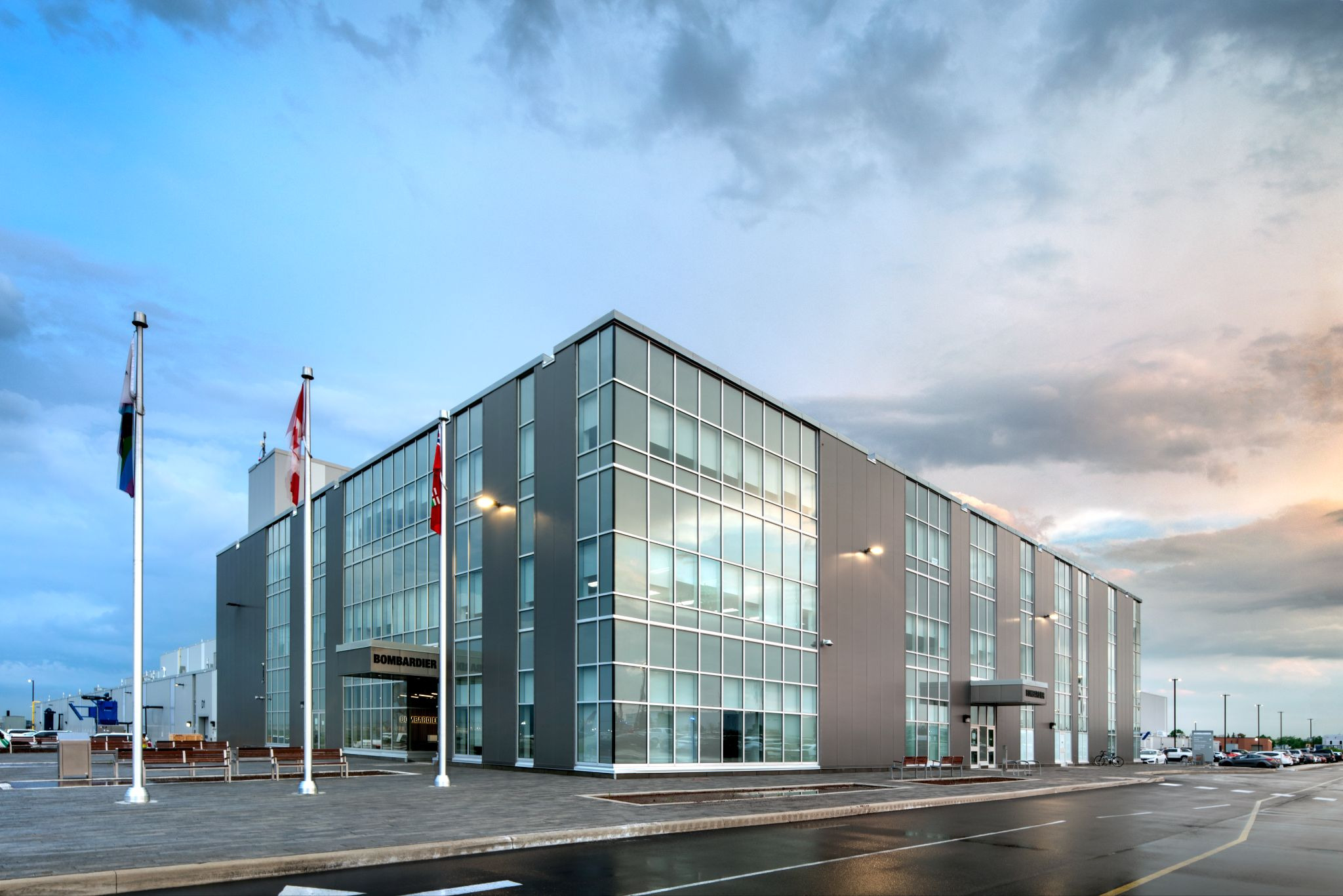
Bombardier Global Manufacturing Center required materials that would increase energy efficiency, so NEUF architect(e)s turned to IMPs. (Kingspan)
Browns Shoes Distribution Center
This 190,000-square-foot distribution center shows how an industrial building can read more like a corporate campus than a conventional warehouse. GKC Architecture & Design paired IMPs with a complementary façade for a refined, two-toned layered exterior with a textured diamond pattern contrasting against sleek charcoal paneling. The modern structure’s expanse is made smaller through texture and visual interest, defining it as an architectural landmark more than a distribution center.
Speed was the other deciding factor. On a distribution project, the building has to be closed in quickly, so interior work can continue, and the schedule can be maintained. Because the panels arrive as a single component combining insulation and finished face, they helped the team reach a weathertight envelope faster than a built-up wall would have allowed. That combination of speed, thermal efficiency and design flexibility is valuable on distribution projects, where size, schedule pressure and operating costs all shape material decisions.
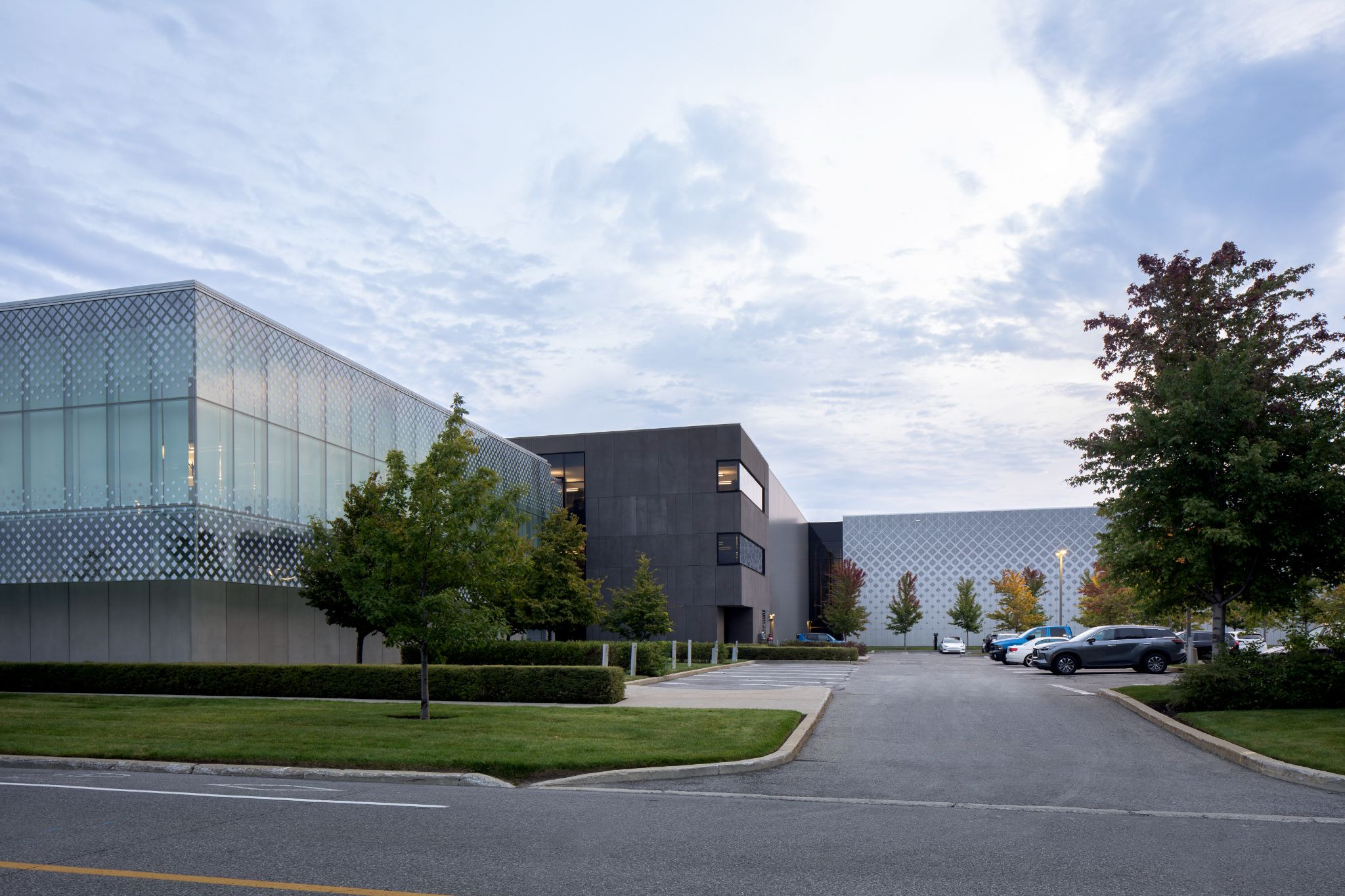
Browns Shoes Distribution Center in Montreal, Quebec was completed in April 2024 and incorporated IMPs along with a complementary facade for a textured effect. (Kingspan)
H&M Distribution Center
At this 716,000-square-foot logistics facility, the design team wanted to move away from the expected warehouse look and give a major distribution center a clean, modern exterior. Baldassarra Architects used more than 115,000 square feet of IMPs to build a minimalist, corporate aesthetic, breaking up the long elevations with 6-inch Accent Fins that de-emphasize the building's length and add visual rhythm. Vision and spandrel glazing integrated into the panel system pulled daylight into the interior.
This project also highlights a quieter advantage of an envelope of IMPs. On tenant-driven developments, final layouts and openings often shift as the project moves forward, and a modular system absorbs those late changes without forcing a redesign of the wall assembly.
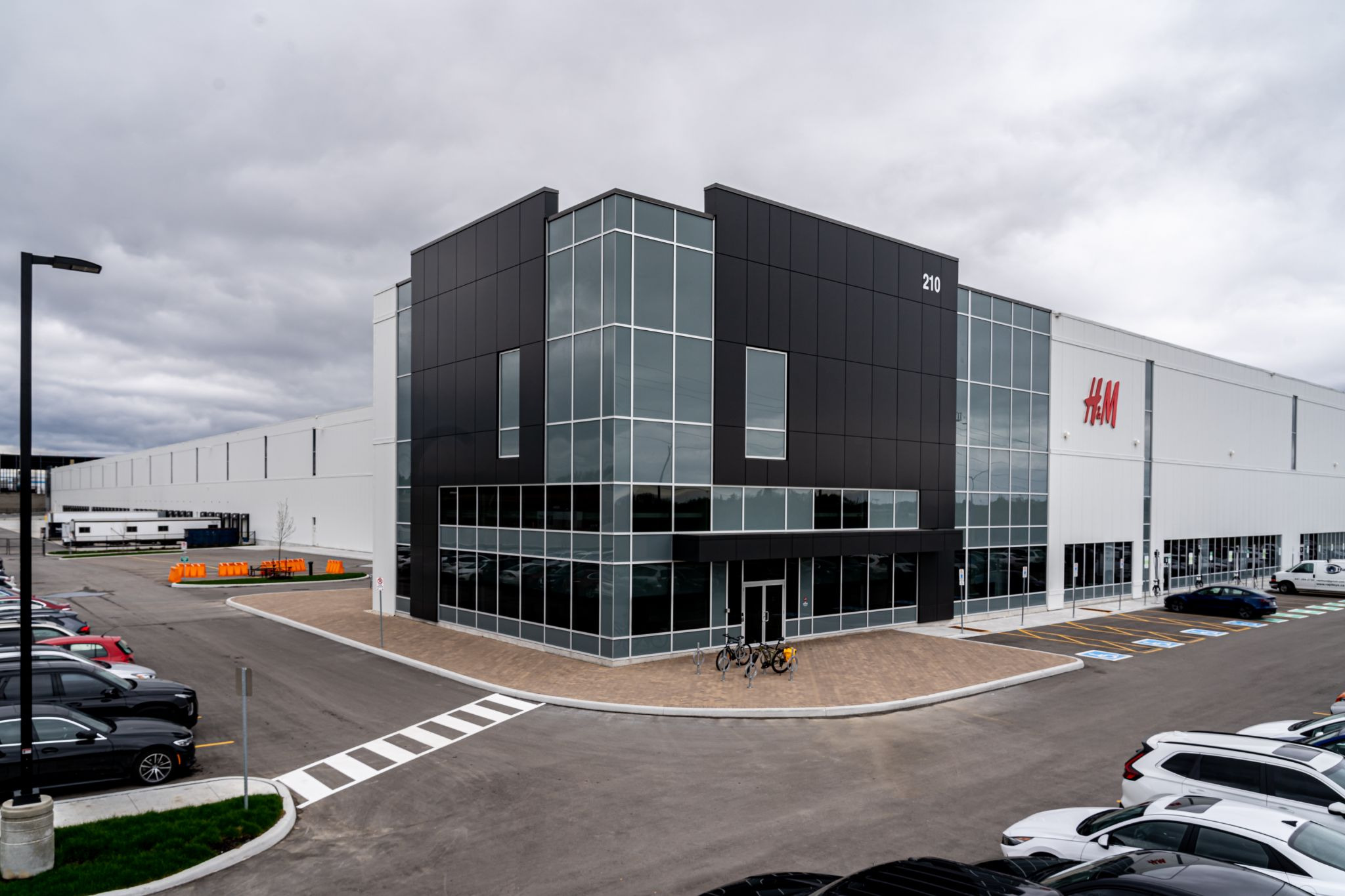
Baldassarra Architects utilized IMP accent fins to deemphasize the sheer size of the H&M Distribution Center in Ajax, Ontario. (Kingspan)
Smith Brothers Farms
Smith Brothers Farms needed nearly four times the refrigerated space of its former warehouse to keep pace with demand across the Pacific Northwest. The new 20-acre site pairs a 40,000-square-foot distribution warehouse with added office space. As an added challenge, the owner wanted the building to read like an architectural landmark rather than a massive cold storage box.
IMPs answered both the demand for design and scale at once. More than 88,500 square feet of IMPs, in neutral white and warm red-brown tones, gave the facility a sleek, modern face, while a single installer kept the envelope moving. The panels help carry the thermal load refrigerated distribution requires, maintaining controlled temperatures across the warehouse through continuous insulation with no thermal breaks. The building performs as a cold storage facility while maintaining a visually aesthetic appearance.
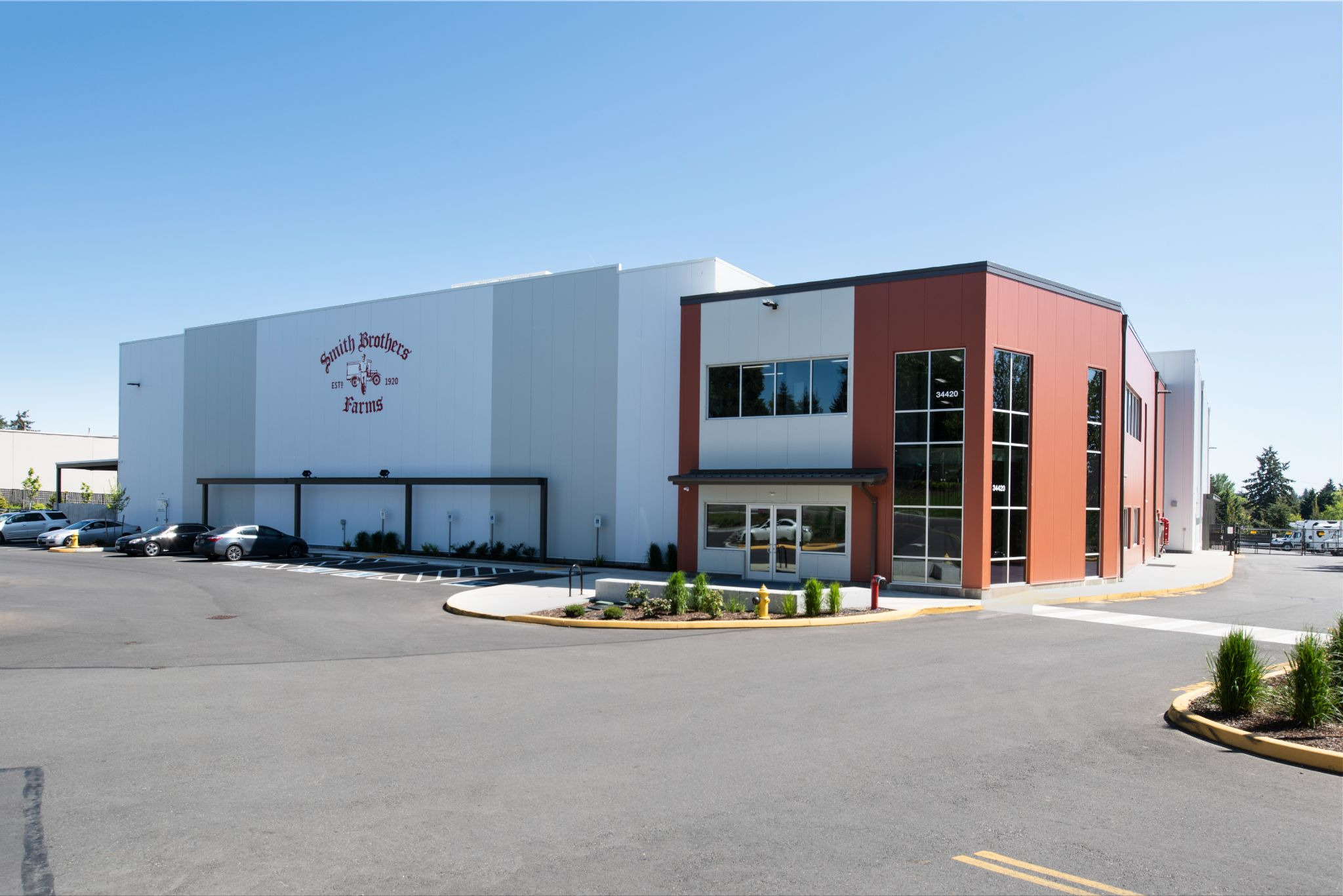
The Smith Brothers Farms required a fully functional refrigerated space and turned to IMPs to make the functional building visually appealing. (Kingspan)
A New Standard for Construction
Industrial buildings still have to weather the activity of the manufacturers and distributors that occupy them. While new construction continues to demand the same structural integrity and wear-and-tear-proof characteristics of older industrial buildings, there is a new standard for construction: quality design. As industrial buildings become neighbors in communities, the building envelope is the place where performance and presence converge.
IMPs fold insulation, structure and finish into a single component to meet those competing demands and support the increase in industrial building construction activity.
Looking for a reprint of this article?
From high-res PDFs to custom plaques, order your copy today!

.webp?height=740&t=1767036885&width=auto "Header - BE 1170x658 (002).png")

.webp?height=740&t=1755781744&width=auto "KEE(2).png")

.webp?height=200&t=1729004742&width=200 "Kingspan(2).png")
.webp?height=200&t=1763388744&width=200 "YMCA(1).png")