International Women’s Day in Design
Designing Across Cultures: An Architect Shaping Homes, Cities, and the Future of Leadership
Kyung Sook Gemma Kim
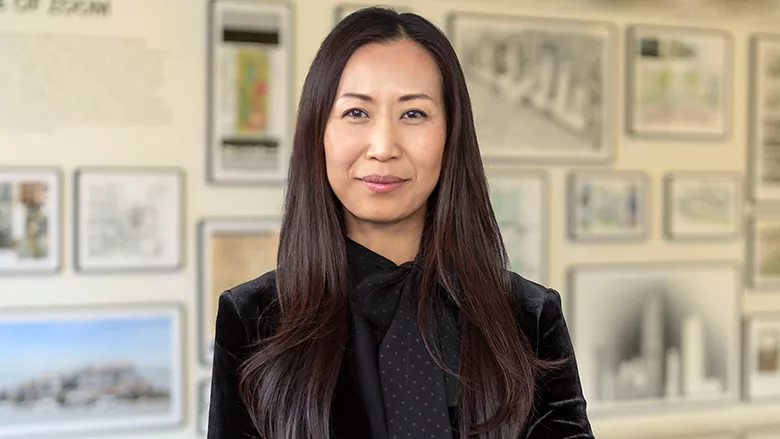

Kyung Sook Gemma Kim
RAMSA (Robert A.M. Stern Architects)
What initially inspired you to pursue a career in architecture, and who or what influenced you most along the way?
I’ve always been passionate about art and had early aspirations of becoming a painter or working in fashion, which I knew my parents wouldn’t support. It wasn’t until I took a stage design course in high school that I began to think about architecture. I fell in love with building physical models and exploring spatial relationships and the geometries of space. As a career, architecture became a way to balance my artistic passions and my parents’ expectations.
As far as influences, my colleague and mentor at RAMSA, Dan Lobitz, and our firm’s late founder, Bob Stern, have had the greatest impact on me. Dan’s mentorship helped shape the way I see and understand architecture. Working alongside Dan and Bob on some of the firm’s most iconic apartment buildings and mixed-use developments, I fell in love with designing spaces for people to live in. Bob always had a keen focus on unit layouts and how residents experience and move through their space, not just in their homes but from the moments they first arrive at their buildings. That really intrigued me.
Can you share a project you’re especially proud of and explain what made it meaningful, either professionally or personally?
Each project I’ve worked on has been unique and formative, but the Shinsegae Namsan project in Seoul was a turning point in my career. It was RAMSA’s first built in Korea, making it personally and professionally significant. Being a Korean speaker, I became a key client-facing lead, presenting, translating and managing communications. The experience challenged and stretched me and helped fuel my professional growth.
Design-wise, the building—which houses corporate offices, retail and a multipurpose performance venue—blends contemporary design with traditional architectural language. It incorporates intricate brick patterns and responds to a complex site with curved forms that enhance the overall composition.
How do you see diversity and inclusion influencing better design outcomes in architecture today?
Diversity and inclusion are critical to better design outcomes, particularly in multifamily residential work. Understanding different cultures, lifestyles and family structures allow us to design spaces that best serve the residents who live in them. Working internationally further reinforces this importance. For example, in Korea, building orientation and cultural expectations significantly influence design decisions. Diverse project teams also lead to better design outcomes, as team members of different ages, backgrounds, and experiences contribute varied perspectives.
Have you had mentors or advocates who played a key role in your career growth, and how important is mentorship for women entering the field now?
When I started my career, there weren’t official mentorship programs like there are now—and it’s crucial, especially for women entering the field, to have a supportive mentor that can provide guidance, advocacy, and both professional and personal support.
At RAMSA, we are fortunate to have a female CEO and CFO, and several female senior partners, but across the AEC industry, women remain underrepresented in leadership. Over the years, I’ve met a lot of talented women in the industry who ended up leaving because of family obligations or other reasons. When I’m in meetings, there are still more men than women.
I’ve been very fortunate to have Dan as a mentor. His influence helped shape me as an architect, but his support extended beyond professional development. He has always been thoughtful about the challenges of being a woman and mother of three, helping me navigate the challenges of career growth and family life.
How do you balance creativity with the technical, regulatory, and business demands of architecture?
We don’t view technical or regulatory issues, such as zoning or building codes, as limitations, but rather as tools for creativity. Understanding these constraints early on in a project, allows them to be integrated into the design process, often strengthening creativity rather than lessening it. Combining design intent with regulation can lead to more thoughtful and resilient architecture.
What changes have you seen for women in architecture over the course of your career, and where do you think progress is still needed?
Significant progress has been made through formal mentorship programs and organizations like ULI’s Women’s Leadership Initiative (WLI). RAMSA has its own WLI committee where we showcase our accomplishments, cultivate mentorships, and work to empower women at the firm to achieve professional growth.
Industry-wide, though, leadership representation remains a challenge. While many women enter the field, fewer remain or advance to leadership levels—often due to the demands of balancing home life and career. Throughout my career, managing that balance has been my biggest challenge, even at a supportive firm like RAMSA.
How do you see the conversation on sustainability going in our industry?
Sustainability has become a foundational responsibility in architecture. In some circles, architects are looking for solutions that go beyond formal certifications. At RAMSA, we take a holistic approach that balances established strategies with cutting-edge building technologies. Our multifamily residential projects integrate sustainable design strategies with contextually responsive architecture, resulting in buildings that are efficient, resilient and beautiful. Our broader portfolio meets and exceeds global standards, including LEED, SITES, Net Zero, Haute Qualité Environnementale (HQE), and Passive House.
What has been the most fulfilling moment of your career so far, and how did it shape your professional journey?
One of the defining moments of my career was returning to RAMSA after graduate school. I worked at the firm for three years before leaving to study architecture at Yale. At that point, I thought I wanted to go out and pursue my own design path. A lot of RAMSA’s work is classical and traditional and when I left for graduate school, I thought I might want to move into a more contemporary direction, design-wise. Going back to school was sort of a personal test. In the end, my time at Yale reinforced my belief in timeless, contextual architecture rooted in proportion and spatial clarity.
Toward the end of my last year at Yale, Bob Stern, who was the dean of the architecture school, asked me if I would be interested in coming back to RAMSA. I said, “of course.”
What advice would you give to young women or girls who are considering a career in architecture or the broader AEC industry?
Don’t be afraid to step out of your comfort zone and find your own voice. Advocate for yourself and your ideas. Don’t be scared to speak up when you’re at a table full of men.
During International Women’s Month, what does recognition like this mean to you, and how can the industry continue to better support and elevate women’s voices year-round?
Recognition during International Women’s Month is meaningful, and my hope is that the industry continues to provide sustained support for women year-round, whether it’s mentorship and advocacy, leadership that understands work-life balance challenges, or pathways that allow women to remain and advance in the profession.
I love telling my story to young women because I want to be a source of encouragement. It can be hard to find people to talk to about the challenges of a demanding job, long hours and balancing family responsibilities. Having that understanding of what someone else is going through can make a difference.

















Looking for a reprint of this article?
From high-res PDFs to custom plaques, order your copy today!

.webp?height=740&t=1767036885&width=auto "Header - BE 1170x658 (002).png")

.webp?height=740&t=1755781744&width=auto "KEE(2).png")
.webp?height=200&t=1766073423&width=200 "Vectorworks(12).png")