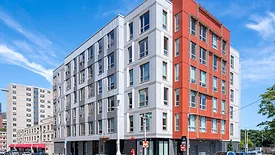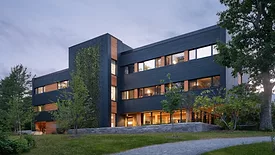
The 11,700-square-foot building is set to be net-zero in energy usage and is designed with an unwavering approach to maximize total decarbonization across all assemblies and systems
May 6, 2026
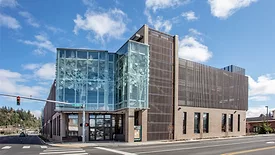
The design team selected an all-mass timber structure, paired with wood infill walls, and wood fiber insulation; an all-wood assembly, sequestering biogenic carbon, at Passive House level energy performance; one of the first of its kind.
HKP Architects sets a new standard for sustainable architecture in a small Washington State community
June 3, 2025
Designed by local firm HKP Architects, the new public library, parking garage, and community center are all electric and house the largest public EV charging station in the country.
To minimize the resulting effect of full sun on the south side of the building, the project team introduced sunshades along the lengths of 13 floors. Each 100 foot-long sunshade, however, presented a potential thermal bridge where it attaches to the interior building slabs via steel brackets. The team avoided the problem by specifying structural thermal breaks.
In many cases, building envelope design is mostly a matter of aesthetics and costs. As attention to environmental issues grows, however, sustainability and energy-related concerns play an increasing role in these decisions. The push to reduce urban heat island effects is one of the most prominent of these concerns.
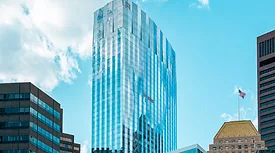
A typical building loses up to 25 percent of its heat through the roof. Industry-leading Elevate roofing and insulation systems by Holcim were thus instrumental in the construction of the world’s largest Passive House-certified office building: the Winthrop Center in Boston.
Although both wet-bulb globe temperature and Heat Index take into consideration dry-bulb temperature and relative humidity, Heat Index is calculated specifically for outdoor shaded areas and does not consider conductive heat transfer from wind speed or the heat stress added by direct sun exposure.
Sto Corp., the innovative world leader in complete single-sourced solutions for the building envelope, has teamed up with Pratt Institute and Passive House for Everyone as an advocate sponsor for the first-ever US Collegiate Designed and Built rendition of the International Passive House Ice Box Challenge.
With increasing evidence of a shifting climate, many building project teams are confronting the compounded threat of increasingly severe heat waves and the vulnerability of our country's electrical grid.