Reducing Urban Heat Island Effects with Reflective Surface Innovations
In many cases, building envelope design is mostly a matter of aesthetics and costs. As attention to environmental issues grows, however, sustainability and energy-related concerns play an increasing role in these decisions. The push to reduce urban heat island effects is one of the most prominent of these concerns.
Why Is Reducing the Urban Heat Island Effect Important?
The urban heat island effect is a phenomenon where metropolitan areas become far hotter than their surroundings. Paving materials like asphalt retain a considerable amount of solar energy, releasing this heat into their environment throughout the day. As a result, they can reach peak temperatures around 150 degrees Fahrenheit in the summertime.
These city hot spots are concerning for a few reasons. In the short term, they make urban areas less comfortable, both inside and outside commercial buildings, as the enclosures emit heat in both directions. In extreme cases, these high temperatures can cause health and safety issues.
In the long term, heat islands carry significant environmental and economic concerns. HVAC systems have to work harder to maintain lower temperatures, as heat islands radiate stored solar energy. Air conditioning and ventilation account for 14 and 18 percent of electricity in commercial buildings, respectively. Consequently, these heavier HVAC workloads contribute to substantial power expenditures and related emissions.
Over time, reflected temperatures from urban heat islands can intensify the effects of climate change. This, in turn, creates a cycle of electricity consumption and rising temperatures, so building enclosures must address this issue.
How to Reduce Urban Heat Island Effects
Architecture and construction firms have several options to reduce the urban heat island effect. Here are six of the most promising solutions businesses can capitalize on today.
Incorporate Greenery
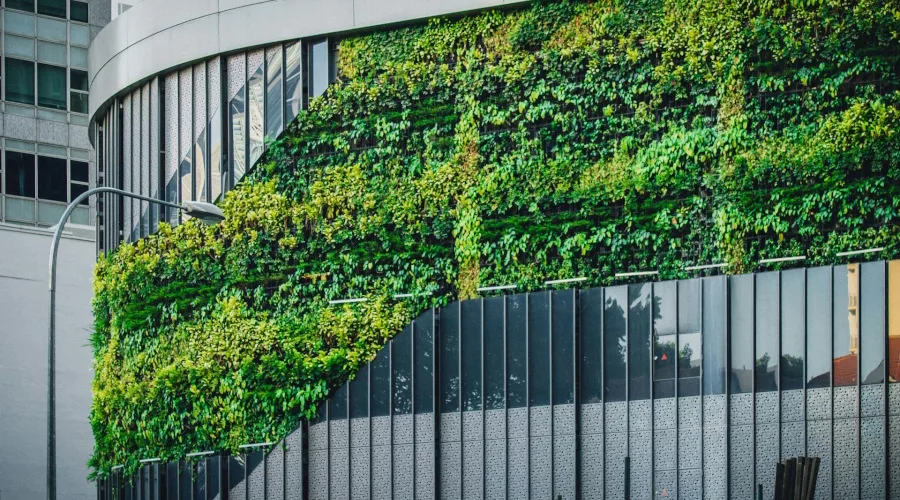
Urban forestry is one of the most effective yet simplest ways to combat urban heat islands. This practice refers to incorporating plant life into commercial building design, such as growing vines along exterior walls or placing gardens on rooftops.
Plants absorb sunlight and provide shade, counteracting concrete’s pattern of heat absorption and release. This approach has other environmental benefits, too. Urban greenery removes carbon dioxide and increases oxygen density through photosynthesis. As a result, pollution-heavy commercial districts can achieve better air quality and reduce their carbon footprints.
Growing plants along buildings does entail some unique considerations. Architects must find a way to fight pests and keep plants watered. However, if they can do this, urban forestry is a highly effective option.
Use Lighter Paints and Concrete
Another straightforward but impactful way to reduce urban heat island effects is to use lighter pigments. Whites, soft blues and similar colors absorb less solar radiation, so they have less heat to release over time. Consequently, commercial buildings can reduce relative temperatures by avoiding dark exterior paints.
Lighter-colored concrete has a similar effect where paint may not fit into project designs or budgets. Using white cement, adding pigments to the mixture or employing a higher water-to-cement ratio can all lighten the finished concrete. However, businesses must consolidate their mixture to remove air. Any air pockets will make concrete more likely to crack, especially in a high-water ratio.
Apply Retro-Reflective Materials
A more innovative solution is to incorporate retro-reflective surfaces into a building envelope. Retro-reflective materials redirect solar energy in the exact direction they receive it. By reflecting sunlight more directly, they produce more significant heat reductions.
Covering a building with retro-reflective materials can reduce its surface temperature by 36F and cool the surrounding air by 5˚ F. These heat reductions, in turn, minimize the structure’s HVAC needs and maximize occupant comfort.
Construction firms have many retro-reflective materials to choose from. Mixing glass or ceramic beads into paint is a common and cost-effective approach. However, glass prisms provide the highest reflective properties, so they are the ideal choice where budgets allow.
Capitalize on Passive Design
More complex design considerations can further reduce the urban heat island effect. Passive building envelopes — which use unique structures to foster airflow and cooling — are an excellent way to prevent heat radiation and minimize energy consumption.
Undulating facades are a common example. The uneven surfaces in these exteriors provide natural shade to prevent pockets of heat buildup. They also disrupt the wind to distribute it across the building. As a result, they increase the natural ventilation wind provides to fight rising temperatures.
Other passive designs use a series of pores and pipes to collect and distribute rainwater to cool buildings or water green surfaces. Thermal chimneys take advantage of sunlight to provide energy-free ventilation. Whatever the specifics, these approaches require more careful planning but yield substantial results.
Construct Exteriors With Sustainable Materials
Similarly, architectural firms can construct their building envelopes with eco-friendly materials. While many of these options introduce higher upfront costs, the resulting energy-saving and environmental benefits can make up for this initial investment.
Wood, for example, does not absorb as much solar energy as concrete, so it radiates less heat. Commercial buildings may be unable to use wood as their primary building material given cost and longevity concerns, but they can use wooden facades. Bamboo — which grows quickly to offset deforestation — is even more valuable as a sustainable material.
As the name implies, urban heat island effects do not occur in nature. They are a metropolitan issue. Consequently, mimicking or turning to nature can help offset and prevent this problem.
Implement Solar Glass
Higher-budget projects can use solar glass to reduce urban heat island effects. Solar glass absorbs ultraviolet and infrared light and converts them to electricity. As a result, it lets visible light through like a normal window but generates emissions-free energy like a solar panel.
Solar glass has two primary advantages regarding urban heat islands. First, it reduces heat absorption and release because it redirects much of the solar power to electricity generation. Secondly, it minimizes heat islands’ impact on emissions by providing renewable electricity to power a building’s HVAC systems.
Replacing conventional windows with solar glass can reduce building energy costs by 30% in some cases. Those savings justify the higher costs of this technology.
Building Envelopes Must Address Urban Heat Island Effects
The urban heat island effect is so pervasive that it can feel inevitable. However, it is a solvable issue if engineers consider innovative design options.
As climate concerns and demands for energy efficiency grow, reducing the urban heat island effect will become increasingly important. Building envelopes must adapt to prevent these hot zones and minimize their impact.
