Companies can design their buildings to promote environmentally friendly transportation methods, lessening their contribution to ecological destruction.
When it comes to operational energy efficiency, the building design and construction industry continuously raises the ceiling through myriad collective avenues including the increased stringency of volunteer rating systems, monitoring-based commissioning, verified zero energy buildings, and much more
It is time for building design professionals to track and report the embodied carbon of their projects.
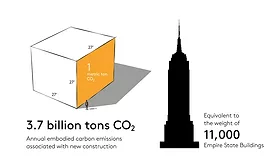
Embodied carbon refers to the carbon dioxide emitted during the manufacture, transport, and construction of buildings materials, together with end-of-life emissions
The study compares different wall systems and their impact on embodied carbon to help building owners and architects make more informed materials selection
Study conducted by architectural firm KieranTimberlake finds Kingspan QuadCore panels contain
far lower levels of embodied carbon than concrete, mineral wool alternatives.
Unlike operational carbon, which can be reduced throughout a building’s lifetime, embodied carbon is locked in as soon as a building is constructed. As such, tracking embodied carbon is critical
The design team, consisting of ZGF Cotter Architects, Fast + Epp structural engineers, and ITC Construction Group, paid close attention to energy-saving measures at the building envelope to minimize costs and carbon footprint, and improve occupant comfort
The buildings sector has accounted for 66 percent of the total decrease energy-related U.S. CO2 emissions. Much of the decrease is attribute to the electric power sector’s decrease in carbon intensity of generation as well as increased energy performance of our building stock