Companies have several options for decarbonizing cement. About 20 percent of the reduction will come from improved operational measures such as energy efficiency. The rest of the reductions will come from technological innovation.
We have a carbon equivalent of an EUI. Now, we need to be more aware, explicit, and consistent regarding the units we are using for operational and embodied carbon.
Over 1,100 firms have joined the AIA 2030 Commitment to date. According to AIA's latest annual report AIA, 417 firms submitted data on 20,652 projects, accounting for a 50 percent decrease in predicted energy use intensity.
Governments and legislative bodies are targeting net zero carbon emissions in building operation and construction. For architects, targeting net zero carbon means that analyzing projects’ environmental footprints is more important now than ever.
The Georgia-Pacific gypsum plant Sweetwater West, located in Sweetwater, Texas, recently completed board drying equipment enhancements that are anticipated to result in CO2 reduction, energy savings, and the lowering of resource consumption.
Project teams are considering additional dimensions of carbon emissions resulting from a building project, including carbon emissions from water consumption, waste generation, occupant transportation, and the embodied carbon of materials used to build the project.
Trackunit CEO Soeren Brogaard has urged the construction sector to take stronger action on 2050 decarbonization targets after the UN said CO2 emissions in the industry hit an all-time high in 2021.
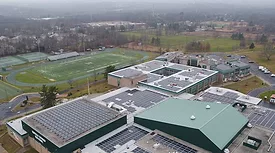
Montville Township Public Schools in New Jersey is joining the net-zero revolution by installing solar modules on six schools in Morris County. Set to save almost $1 million in energy costs over the next 15 years, the systems are forecast to generate 1.84 MW of solar energy annually and will reduce carbon emissions by the equivalent of 1,500 tons of coal burned or 171 homes’ electricity use per year.
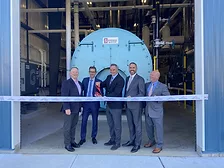
Saint-Gobain has started up operations at its new electrical powerhouse on its flagship manufacturing campus in Worcester, Massachusetts, which is projected to reduce the site’s carbon dioxide emissions by 50%.





.webp?height=168&t=1671198966&width=275 "Dean%20Frank%20Jan%202016 (002).jpg")