Building Enclosure logo
search
cart
facebook twitter linkedin youtube instagram Spotify Podcasts Apple Podcasts Spotify Podcasts Apple Podcasts
  • Sign In
  • Create Account
  • Sign Out
  • My Account
Building Enclosure logo
  • NEWS
    • Breaking News
  • SECTIONS
    • Columns
    • Project Profiles
    • Trade Shows
    • Sponsor Insights
  • SYSTEM DESIGNS
    • Low-Slope Roofs
    • Pitched Roofs
    • Metal Roofing Materials
    • Waterproofing
    • Sustainability
    • Insulation
    • Exterior Claddings
    • Wall Systems
    • Building Envelope
  • BLOG
    • The BE Blog
  • MEDIA
    • Podcasts
    • Webinars
    • Quiz
    • Videos
    • Polls
    • Interactive Spotlights
    • Newsletter
    • Photo Galleries
  • DIRECTORIES
    • Directory: Blue Book
    • Directory: Roofing Resource
  • PRODUCTS
  • TECHNICAL
    • Codes
      • Waterproofing
      • Roofing
    • Details
      • Waterproofing
      • Roofing
  • CONTINUING ED
  • ABOUT
    • Advertise
      • Editorial Calendar
    • Contact
    • eMag Archive Issues
  • SIGN UP!
Sustainability

Going for Zero Carbon? Do Not Forget About Transportation

By Daniel Overbey
Header - BE 1170x658-carbon.jpg

Image courtesy of author.

November 25, 2022

The expanding definition of zero carbon buildings

One could define a "zero carbon" (or "zero net carbon") building as one in which carbon-based energy consumption is reduced first through building design strategies and energy conservation measures, then through on-site renewable energy generation, and finally through the procurement of locally produced off-site renewable energy and/or renewable energy credits and carbon offsets.

Increasingly, however, project teams are considering additional dimensions of carbon emissions resulting from a building project, including carbon emissions from water consumption, waste generation, occupant transportation, and the embodied carbon of materials used to build the project. 

For example, USGBC's LEED Zero Carbon certification program recognizes that a building "provides a transparent accounting of the balance of carbon caused from energy consumption and occupant transportation to carbon emissions avoided or offset..." 


Not an exact science, but we have to start somewhere

At a visceral level, we know that the combustion engines in our automobiles release greenhouse gas emissions. There are some great online resources (such as the EPA's Green Vehicle Guide) that allow anyone to quickly assess their personal carbon footprint from driving automobiles. 

Rare, however, is the presentation of a practical method for putting occupant transportation emissions into the context of a building project.

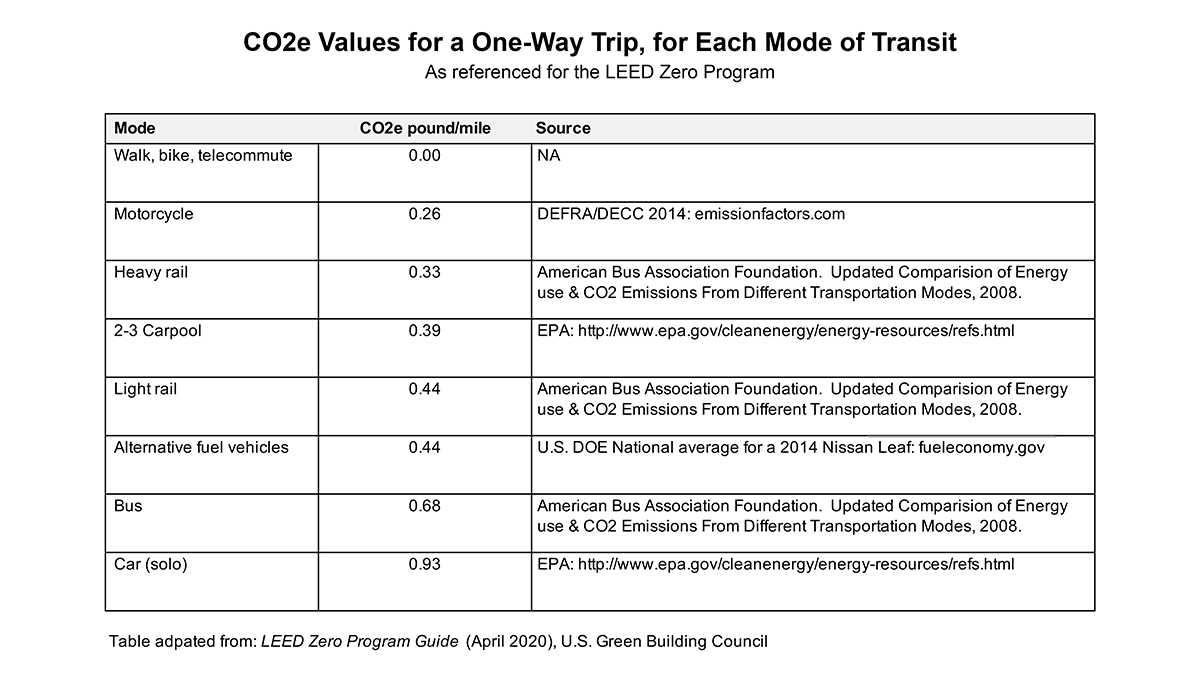
The LEED Zero Program Guide offers a broad-based method that can equate occupant survey data into annual pounds of CO2e emissions (the method uses carbon dioxide as a proxy for greenhouse gas emission). Based on miles traveled and the mode of transit, one may broadly assess the annual transportation carbon intensity of a building project.

NEWTable 1 - Transportation CO2e Values (1200p).png

Table: CO2e values for a one-way trip, for each mode of transit. Adapted from the LEED Zero Program Guide (April 2020) published by the U.S. Green Building Council. Table by Daniel Overbey.


Transportation carbon intensity is a moving target

Like a building's energy performance, transportation carbon intensity will change over time. Regular checks via occupant survey will allow a team to benchmark and improve upon the annual CO2e value for transportation.

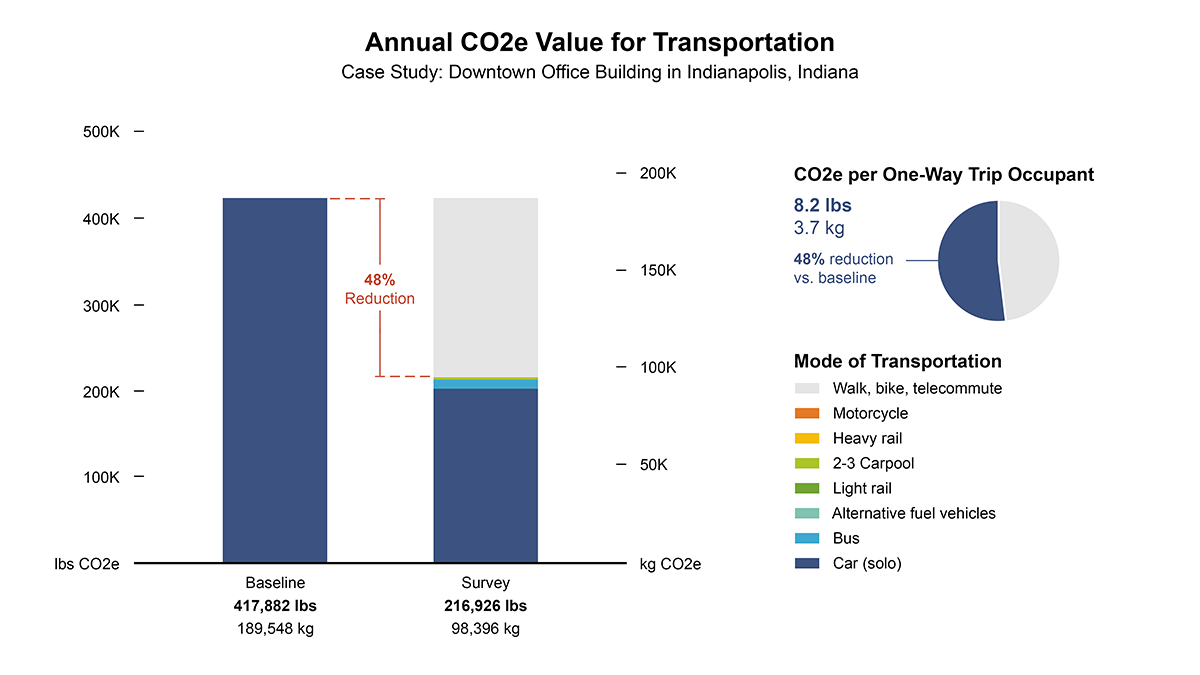
My firm recently assessed the transportation carbon intensity for a project in downtown Indianapolis. We achieved a 54% survey response rate and extrapolated the results to account for all occupants. Our baseline considered all transit miles in terms of single-occupant vehicles. The project is located in a dense, walkable urban environment and the company allows employees to work from home for two days out of the week.

The results of the survey revealed that walking, biking, and telecommuting combined for a 48% carbon reduction versus the baseline. It also revealed single-occupant vehicles as the dominant mode of transit. 

The data also brought into focus an emerging metric to help contextualize transportation carbon intensity: CO2e per one-way trip occupant. In this example, the survey data revealed 8.2 lbs (3.7 kg) of carbon emissions per one-way trip occupant. By comparison, another project located in the suburbs of Indianapolis exhibited 25.5 lbs (11.6 kg) of CO2e per one-way trip occupant - a roughly three-fold increase versus the downtown project.

Again, one should keep in mind that this information is developed via user survey and will change over time - as will the tabulated CO2e values per mode of transit reference in the LEED Zero program. Calculating a building's transportation carbon intensity is not an exact science - but we need to start somewhere.


NEWFigure 1 - Transportation Carbon Case Study (1200p).png

Figure 1: Case study of the annual CO2e value for transportation in an office building located in downtown Indianapolis, Indiana. Figure by Daniel Overbey.


Transportation carbon in the context of zero carbon building

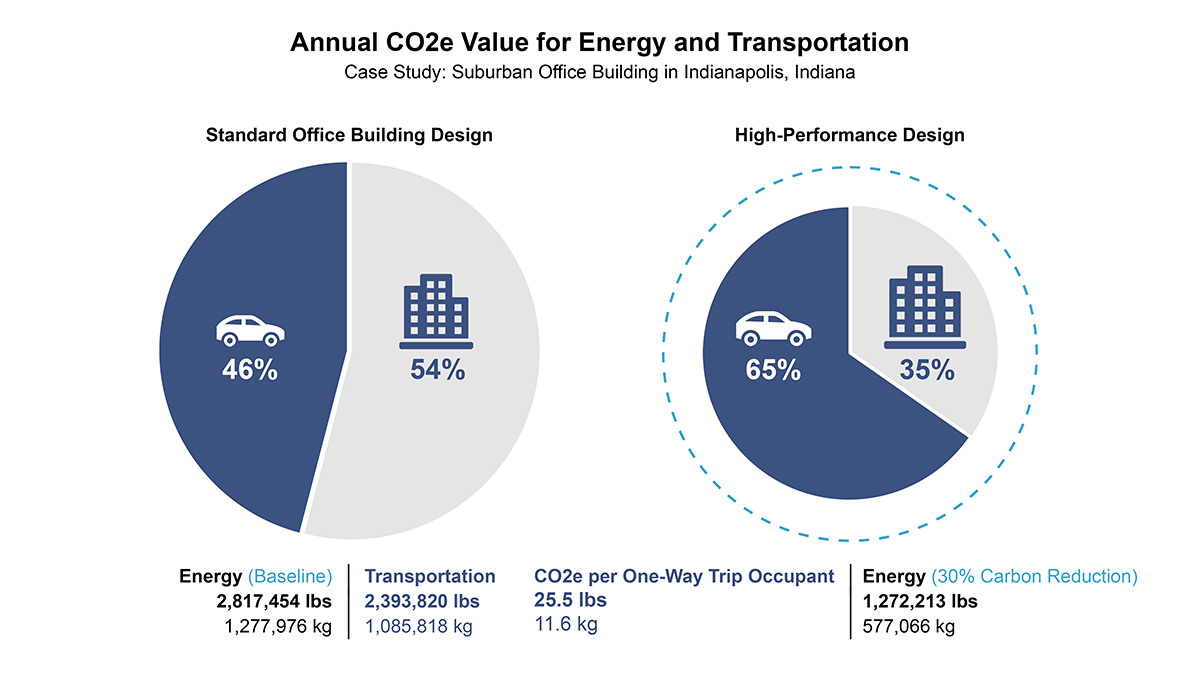
During the design development phases of a potential zero carbon project in the suburbs of Indianapolis, our project team assessed the building's transportation carbon intensity in the context of two design options: a standard office building designed to meet ASHRAE Standard 90.1-2010 (which is actually better than Indiana's 90.1-2007 based energy code) and a high-performance designed to reduce the project's EUI from 72 to 33 and achieve a 30% carbon reduction.

In the standard design, the transportation-related carbon accounted for 46% of the overall carbon intensity of the building. However, as the building design becomes more efficient, the greater the proportion of carbon resulting from transportation. In our high-performance design option, the transportation carbon accounted for nearly two-third of the annual CO2 value.


Figure 2: Case study of the annual CO2e value for energy in transportation in an office building located in the suburbs of Indianapolis, Indiana. Figure by Daniel Overbey.


The definition of a zero carbon building will continue to evolve. However, even with the emergence of electric vehicles in a broad consumer market, it is clear that any holistic assessment of a building's greenhouse gas emissions should include the CO2e value of transportation - a value that may proportionately increase as we decarbonize our building stock.

KEYWORDS: carbon reduction decarbonization energy efficiency LEED

Share This Story

Overbey   head shot 2020 3

Daniel Overbey, AIA, NCARB, LEED Fellow (LEED AP BD+C, ID+C, O+M), WELL AP is an Assistant Professor of Architecture at Ball State University and the Director of Sustainability for Browning Day in Indianapolis, Ind. His work focuses on high-performance building design and construction, environmental systems research, green building certification services, energy/life-cycle assessment modeling, and resilient design. He can be reached at djoverbey@bsu.edu.

Recent Comments

These are actually very helpful tips. It is...

This is the most beneficial blog for all...

This blog is a great resource for anyone...

Thank you for sharing this important information. I...

This is a very interesting subject of the...

Manage My Account
  • Sign up for the Newsletter
  • Online Registration
  • Manage My Preferences
  • Registration Customer Service

More Videos

Sponsored Content

Sponsored Content is a special paid section where industry companies provide high quality, objective, non-commercial content around topics of interest to the Building Enclosure audience. All Sponsored Content is supplied by the advertising company and any opinions expressed in this article are those of the author and not necessarily reflect the views of Building Enclosure or its parent company, BNP Media. Interested in participating in our Sponsored Content section? Contact your local rep!

close
  • 2 construction workers and a DEXcell panel
    Sponsored byDEXcell Roof Boards

    Designing Low-Slope Roofs for Resilience

  • Bell Bank headquarters in Fargo, North Dakota
    Sponsored bySto Corp.

    Drained and Back-Ventilated Rainscreens vs Pressurized-Equalized Rainscreens

  • A construction worker using DEXcell roof boards
    Sponsored byDEXcell Roof Boards

    The Hidden Strength of Low-Slope Roof Systems: Why Roof Cover Boards Matter

Popular Stories

construction industry workers in hard hats stand around a city scape

Construction Industry Revolts Over New CSI Licensing Plan

a man wearing a mask installs insulation into a wall system

Quiet Rooms and Healthier Air: A Second Look at What Goes Inside the Wall Cavity

Canalino Elementary School and Canalino Family School exterior

Daylighting Design to Support Rapidly Growing Trend in Modular Building Construction

Building Enclosure Newsletter

BE Poll

Events

June 17, 2025

Addressing Condensation in Low-Slope Roof Assemblies

Credits: 1 AIA LU/HSW; 0.1 ICC CEU; 1 IIBEC CEH; 0.1 IACET CEU

On Demand In modern roofing systems, vapor retarders and air barriers do more than just minimize air leakage—they’re essential to maximizing performance and longevity. This engaging course dives into the next generation of moisture control: permeable vapor retarders and air barriers. Discover how these cutting-edge technologies are transforming low-slope roofing assemblies by improving energy efficiency, managing moisture, and boosting wind uplift resistance.

April 9, 2026

Strategies for High-Performance Below-Grade Waterproofing

Credits: 1 AIA LU/HSW ; 1 IIBEC CEH; 0.1 IACET CEU

On-Demand Designing a high-performance building enclosure requires more than just surface-level protection; it demands a rigorous, performance-based mastery of below-grade water and gas mitigation. This discussion will provide an expert-level analysis of below-grade waterproofing within the comprehensive framework of the high-performance building enclosure.

View All Submit An Event

Products

Plaster and Drywall Assemblies Manual

Plaster and Drywall Assemblies Manual

This is a comprehensive manual that goes beyond codes and standards, providing expert guidance in design, detailing, material selection and troubleshooting for plaster and drywall.

See More Products
×

Enhance your expertise with unparalleled insights.

Join thousands of building professionals today. Shouldn’t you know what they know?

SUBSCRIBE TODAY!
  • RESOURCES
    • Advertise
    • Contact Us
    • Store
    • Want More
  • SIGN UP TODAY
    • Create Account
    • Newsletter
    • Customer Service
    • Manage Preferences
  • SERVICES
    • Marketing Services
    • Reprints
    • Market Research
    • List Rental
    • Survey/Respondent Access
  • STAY CONNECTED
    • LinkedIn
    • Facebook
    • Instagram
    • YouTube
    • X
  • PRIVACY
    • PRIVACY POLICY
    • TERMS & CONDITIONS
    • DO NOT SELL MY PERSONAL INFORMATION
    • PRIVACY REQUEST
    • ACCESSIBILITY

Copyright ©2026. All Rights Reserved BNP Media, Inc. and BNP Media II, LLC.

Design, CMS, Hosting & Web Development :: ePublishing