Building Enclosure logo
search
cart
facebook twitter linkedin youtube instagram Spotify Podcasts Apple Podcasts Spotify Podcasts Apple Podcasts
  • Sign In
  • Create Account
  • Sign Out
  • My Account
Building Enclosure logo
  • NEWS
    • Breaking News
  • SECTIONS
    • Columns
    • Project Profiles
    • Trade Shows
    • Sponsor Insights
  • SYSTEM DESIGNS
    • Low-Slope Roofs
    • Pitched Roofs
    • Metal Roofing Materials
    • Waterproofing
    • Sustainability
    • Insulation
    • Exterior Claddings
    • Wall Systems
    • Building Envelope
  • BLOG
    • The BE Blog
  • MEDIA
    • Podcasts
    • Webinars
    • Quiz
    • Videos
    • Polls
    • Interactive Spotlights
    • Newsletter
    • Photo Galleries
  • DIRECTORIES
    • Directory: Blue Book
    • Directory: Roofing Resource
  • PRODUCTS
  • TECHNICAL
    • Codes
      • Waterproofing
      • Roofing
    • Details
      • Waterproofing
      • Roofing
  • CONTINUING ED
  • ABOUT
    • Advertise
      • Editorial Calendar
    • Contact
    • eMag Archive Issues
  • SIGN UP!
Sustainability

Calculating Embodied Carbon
By Alex Altieri
building-ge25a6852a_1280.jpg
December 30, 2022

Governments and legislative bodies are targeting net zero carbon emissions in building operation and construction. Read more about sustainable architecture on AIA’s 2030 Commitment webpage.

For architects, targeting net zero carbon means that analyzing projects’ environmental footprints is more important now than ever.

To reach true net zero carbon emissions, you’ll need a way to calculate embodied carbon throughout the entire lifecycle of a project.

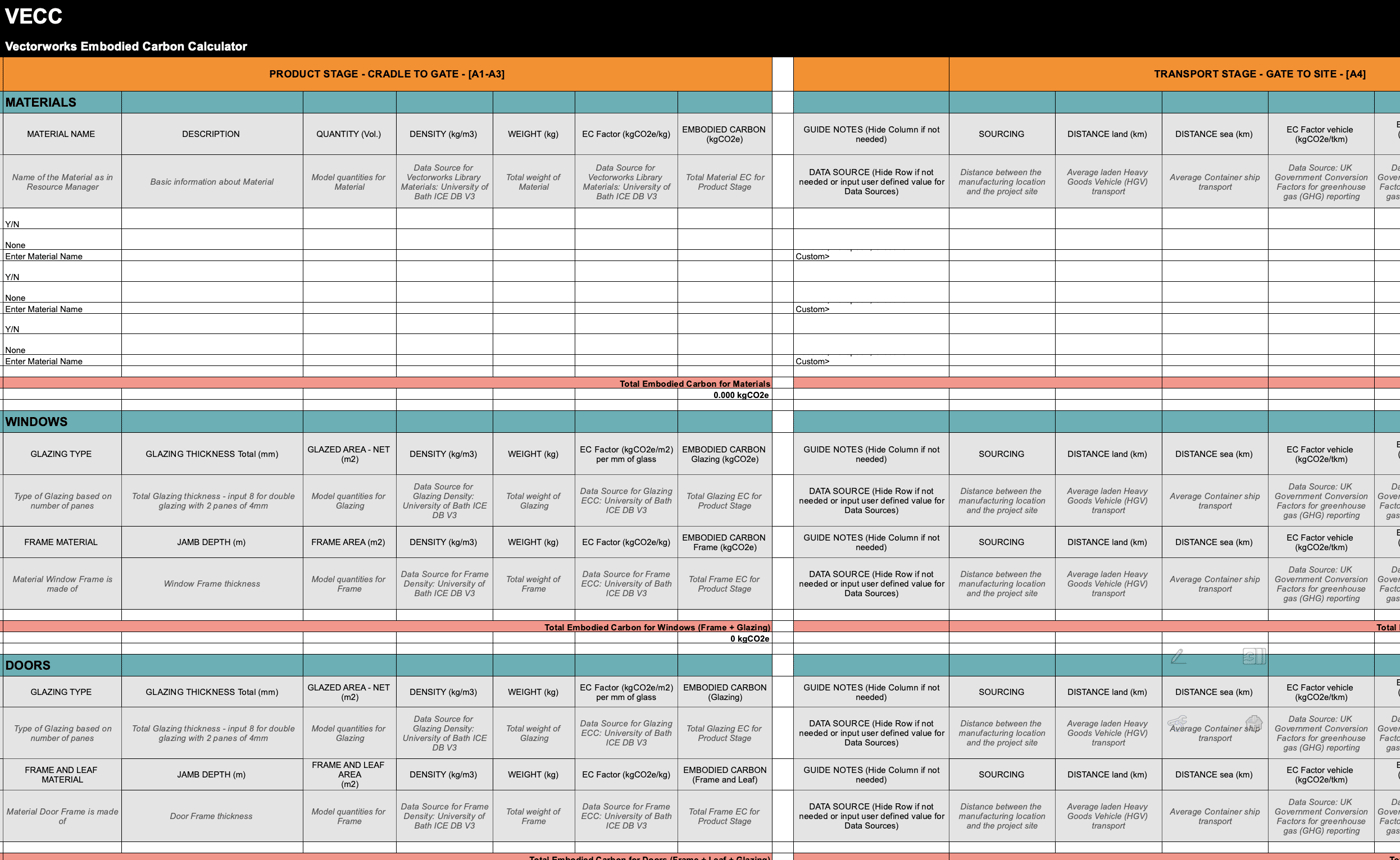
That’s where the Vectorworks Embodied Carbon Calculator (VECC) comes in — it's a custom worksheet that's pre-formatted to help calculate embodied carbon levels of a project. This blog will offer some details about the worksheet and provide you a link to download the file to use yourself. 

What Is Embodied Carbon?

Embodied carbon refers to the carbon emitted through the building’s materials and construction processes. Embodied carbon is responsible for about 11% of global CO2 emissions, and that number is expected to continue to rise.

Why Is Calculating Embodied Carbon So Important?

Embodied carbon is different from operational carbon, which concerns in-use operations like heating, cooling, lighting, and ventilation. The key here is that operational carbon can be reduced after a building is constructed; embodied carbon, on the other hand, is locked once the structure is built. It’s “embodied” in the building itself.

It’s therefore crucial to be thinking about net zero benchmarks from the very start of the design process, as you get one shot at delivering a project with low embodied carbon. There’s no making up for it after the fact.

The Vectorworks Embodied Carbon Calculator (VECC)

Designers using Vectorworks Architect will be pleased to know that there’s a tool created specifically for this purpose: the Vectorworks Embodied Carbon Calculator, or “VECC.”

The tool is a pre-formatted worksheet that has built-in formulas to calculate material embodied carbon emissions based on your inputs.
Screenshot 2022-01-21 at 16.07.07

The VECC is organized into columns corresponding to stages of the project’s lifecycle:

  • Product Stage – for tracking embodied carbon emitted from supply, transport, and manufacturing of selected raw materials.
  • Transportation Stage – for tracking carbon emitted from the transportation of products from the manufacturing plant to the project site.
  • Construction Stage – for tracking carbon emitted from any on- or off-site construction-related activities.
  • Replacement Stage – for tracking carbon emissions associated with anticipated replacement of building components.
  • Deconstruction & Demolition Stage – for tracking carbon emissions arising from any on- or off-site deconstruction and demolition activities.
  • Recovery/Recycling Stage – for tracking carbon emissions associated with treatment and processing of materials and components that’re intended to be recovered and reused after the end of the built asset’s lifecycle.
  • Disposal Stage – for tracking carbon emissions arising from disposal of materials and components not expected to be recovered and repurposed, but incinerated or disposed of at a landfill.

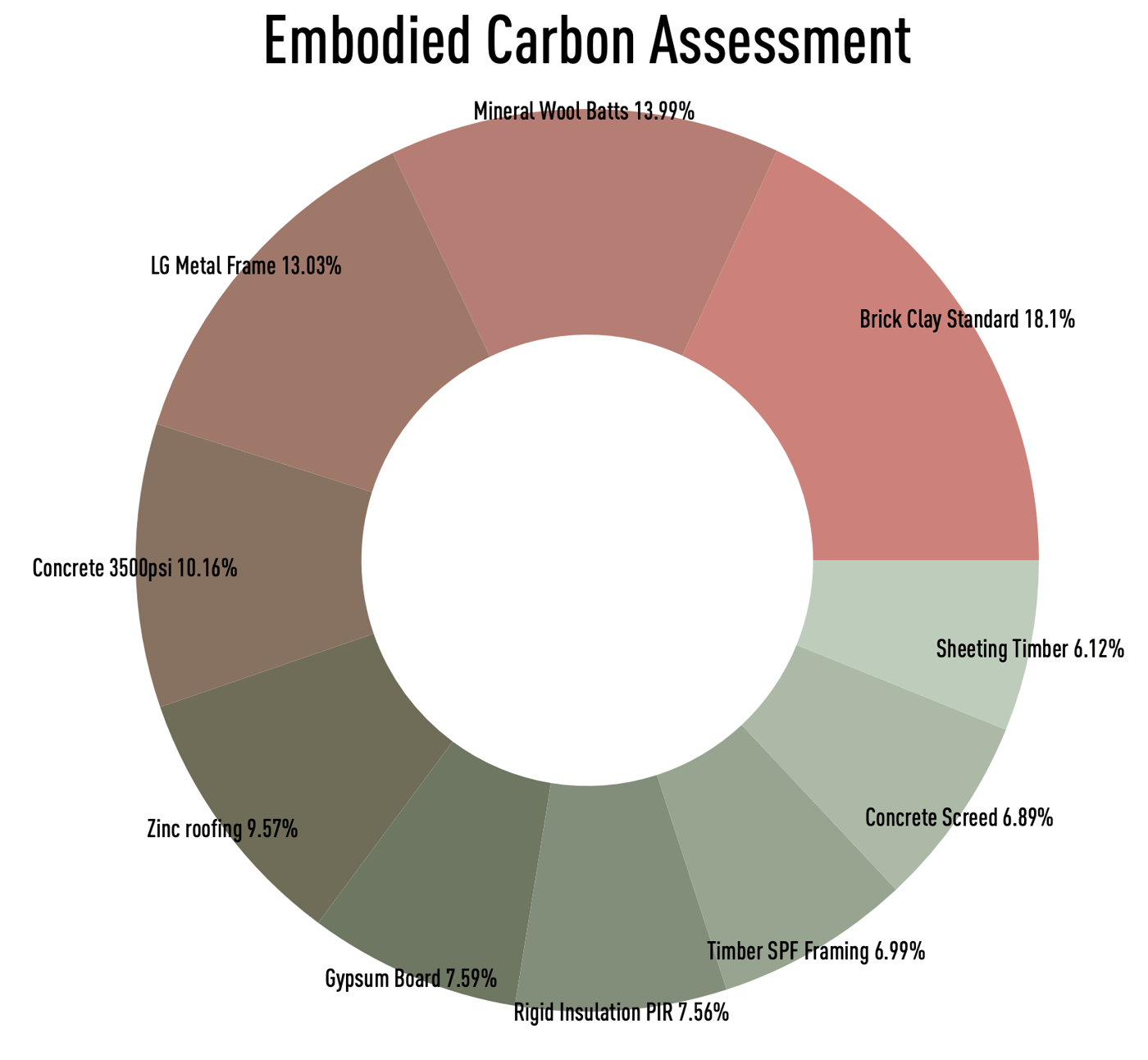
Using Marionette, Vectorworks' algorithms-aided design tool, you can extract data from the VECC to visualize it into a chart. This chart is connected to the data sheet above.
Screenshot 2021-12-08 at 11.48.17

With the VECC and Energos — which is used to calculate energy demand — you’re well set up to complete a holistic carbon emissions assessment.

Colin Davis of Studio Partington, one of the earliest adopters of the VECC, said:

"Studio Partington is passionate about designing buildings that take a conscious effort to minimize their impacts on the environment. The awareness of embodied carbon and the contribution it makes to a buildings overall carbon footprint is a new field to all designers. The VECC gives us the opportunity, from the earliest stages of a project, to quickly understand and analyze the amount of material and likely embodied carbon impacts of our proposals. This can feedback into the design process to lead to better and more responsible solutions."


Reducing the Embodied Carbon of Your Building Project

Here are a few ways to reduce a project’s embodied carbon levels.

  1. Re-use buildings instead of constructing new ones. Construction processes have a high carbon footprint. Renovating what’s already there instead of tearing everything down and starting over can greatly reduce a project’s embodied carbon levels. A renovation project can let you be just as creative as with a ground-up build.

As is the motto of 2021 Pritzker Prize -winning firm Lacaton & Vassal: “Never demolish, never remove — always add, transform, or reuse."

  1. Limit use of high-carbon materials like plastic, concrete, and metal. Wood is growing more and more popular as a building material due to its lower embodied carbon levels.

  2. Use recycled materials. Especially for high-carbon materials like aluminum, recycling can greatly reduce a project’s embodied carbon, because the carbon required to manufacture those materials has already been accounted for.

  3. Source materials locally. Instead of having materials shipped overseas, for example, look to source from your immediate area. This reduces carbon emissions from lengthy transportations.

  4. Create modular systems where possible. Modular structures are easier and faster to construct, reducing carbon emissions from the construction process.

Click below for more information, including a link to download the VECC file as well as a user guide.

DOWNLOAD THE EMBODIED CARBON CALCULATOR

KEYWORDS: BIM (Building Information Modeling) carbon reduction design software embodied carbon modular system

Share This Story

Me

Alex Altieri is a content writer with Vectorworks since early 2019, Alex comes from a background of journalism and philosophy. He believes that the AEC, landscape, and entertainment industries are filled with untold stories — stories about the most creative people in the world.

Recent Comments

These are actually very helpful tips. It is...

This is the most beneficial blog for all...

This blog is a great resource for anyone...

Thank you for sharing this important information. I...

This is a very interesting subject of the...

Manage My Account
  • Sign up for the Newsletter
  • Online Registration
  • Manage My Preferences
  • Registration Customer Service

More Videos

Sponsored Content

Sponsored Content is a special paid section where industry companies provide high quality, objective, non-commercial content around topics of interest to the Building Enclosure audience. All Sponsored Content is supplied by the advertising company and any opinions expressed in this article are those of the author and not necessarily reflect the views of Building Enclosure or its parent company, BNP Media. Interested in participating in our Sponsored Content section? Contact your local rep!

close
  • 2 construction workers and a DEXcell panel
    Sponsored byDEXcell Roof Boards

    Designing Low-Slope Roofs for Resilience

  • Bell Bank headquarters in Fargo, North Dakota
    Sponsored bySto Corp.

    Drained and Back-Ventilated Rainscreens vs Pressurized-Equalized Rainscreens

  • A construction worker using DEXcell roof boards
    Sponsored byDEXcell Roof Boards

    The Hidden Strength of Low-Slope Roof Systems: Why Roof Cover Boards Matter

Popular Stories

construction industry workers in hard hats stand around a city scape

Construction Industry Revolts Over New CSI Licensing Plan

graph shows green, orange and red dot lines going up

LEED v5 and the Cost Impacts of ASHRAE Standard 90.1-2019

2 construction workers and a DEXcell panel

Designing Low-Slope Roofs for Resilience

Building Enclosure Newsletter

BE Poll

Events

June 17, 2025

Addressing Condensation in Low-Slope Roof Assemblies

Credits: 1 AIA LU/HSW; 0.1 ICC CEU; 1 IIBEC CEH; 0.1 IACET CEU

On Demand In modern roofing systems, vapor retarders and air barriers do more than just minimize air leakage—they’re essential to maximizing performance and longevity. This engaging course dives into the next generation of moisture control: permeable vapor retarders and air barriers. Discover how these cutting-edge technologies are transforming low-slope roofing assemblies by improving energy efficiency, managing moisture, and boosting wind uplift resistance.

April 9, 2026

Strategies for High-Performance Below-Grade Waterproofing

Credits: 1 AIA LU/HSW ; 1 IIBEC CEH; 0.1 IACET CEU

On-Demand Designing a high-performance building enclosure requires more than just surface-level protection; it demands a rigorous, performance-based mastery of below-grade water and gas mitigation. This discussion will provide an expert-level analysis of below-grade waterproofing within the comprehensive framework of the high-performance building enclosure.

View All Submit An Event

Products

Plaster and Drywall Assemblies Manual

Plaster and Drywall Assemblies Manual

This is a comprehensive manual that goes beyond codes and standards, providing expert guidance in design, detailing, material selection and troubleshooting for plaster and drywall.

See More Products
×

Enhance your expertise with unparalleled insights.

Join thousands of building professionals today. Shouldn’t you know what they know?

SUBSCRIBE TODAY!
  • RESOURCES
    • Advertise
    • Contact Us
    • Store
    • Want More
  • SIGN UP TODAY
    • Create Account
    • Newsletter
    • Customer Service
    • Manage Preferences
  • SERVICES
    • Marketing Services
    • Reprints
    • Market Research
    • List Rental
    • Survey/Respondent Access
  • STAY CONNECTED
    • LinkedIn
    • Facebook
    • Instagram
    • YouTube
    • X
  • PRIVACY
    • PRIVACY POLICY
    • TERMS & CONDITIONS
    • DO NOT SELL MY PERSONAL INFORMATION
    • PRIVACY REQUEST
    • ACCESSIBILITY

Copyright ©2026. All Rights Reserved BNP Media, Inc. and BNP Media II, LLC.

Design, CMS, Hosting & Web Development :: ePublishing