Copper’s Renaissance: Enduring Performance Meets Modern Design
How a proven material continues to improve buildings, both new and old

From churches to schools and from manors to museums, copper embellishes prominent buildings around the globe with beauty and grandeur. With its durable qualities and malleable form, copper is currently experiencing a renaissance. Its ability to bridge historic restoration with contemporary design — and its unparalleled resilience — puts copper at the forefront of current architectural trends.
Old Meets New: Adaptability Renovations and Extensions
When today’s architects add to or adapt historical buildings, copper often becomes the material of choice to visually interconnect new and old. As copper is frequently a key feature of a site’s built heritage, its distinctive, naturally protective yet evolving finish or “patina” visually connects spaces of otherwise different design styles.
In expanding the New England Biolabs Facility, the architectural team at ARC aimed to acknowledge nearby historic structures while remaining relevant to modern design. In this case, they incorporated copper, treated with a custom pre-patination process to provide an elegant, timeless aqua-toned aged copper finish that subtly blends with its surroundings. The patinated copper will continue to grow in character as it ages, enhancing compatibility with original facility buildings. Architects value copper in adaptive-reuse projects for exactly this reason: It extends structures’ lives while knitting new with old.
“Because copper is long-lived, it’s pretty much unequal,” says Larry Kearns, FAIA, principal at Wheeler Kearns Architects, explaining that a well-designed copper addition to an older building won’t require frequent replacement or maintenance.
“The payoff in using copper is that a building is not knocked down – it’s just adapted for a new use,” adds Kearns, emphasizing that this contributes to copper’s sustainable qualities.
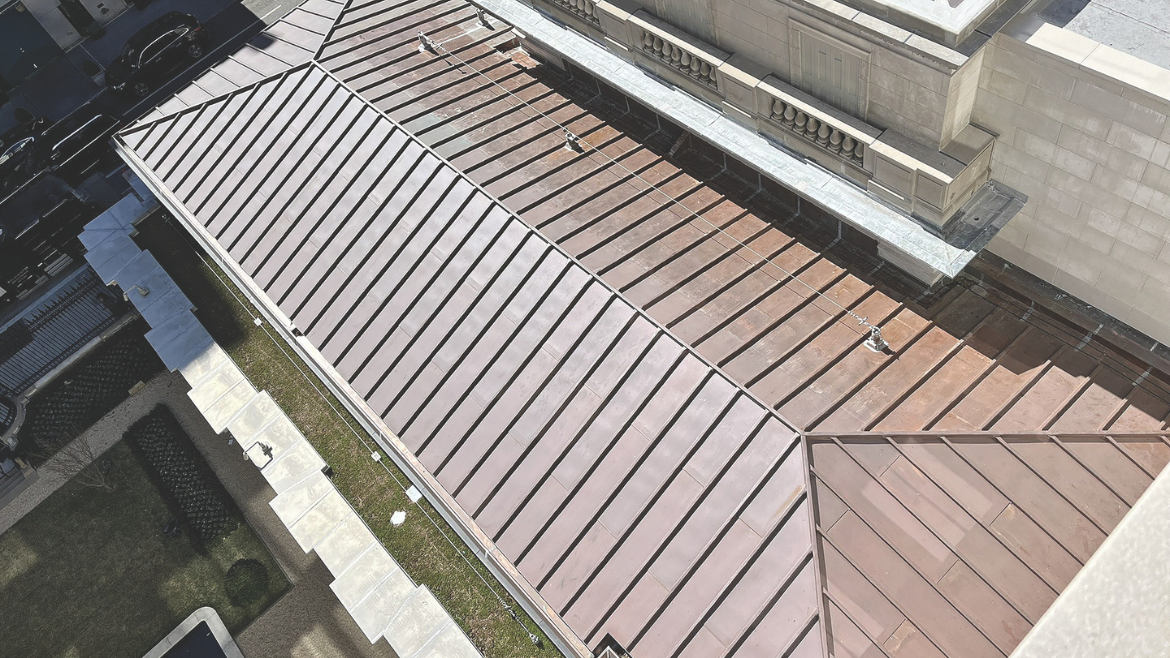
The Frick Collection Roof Replacement.
Photo Credit: Nicholson & Galloway
Sustainability that Lasts
In an era when green building certifications and climate-conscious design are coveted, copper is extremely durable, requires minimal upkeep, and is 100 percent recyclable. Many architects argue that true sustainability means building for the long term, and copper delivers on that front.
While trendy “green” materials might boast impressive initial properties, a material that lasts a century without replacement or maintenance provides lasting benefits. Unlike many building products that end up as demolition debris, copper also retains high value and is easily salvaged and reused. This circular lifecycle contributes to realistic lifecycle analysis, considering both recycled and recyclable materials.
“Copper could be up on a roof for more than a hundred years and still be completely recyclable,” says Tim Murphy of Revere Copper Products.
The Copper Development Association’s handbook, Building Better: A Guide to Copper in Green and Healthy Buildings, highlights the dynamic range of uses where copper can help achieve green building designations while also promoting occupant health. Some of these benefits are less visible but exceptionally important: copper’s superior electrical and thermal conductivity makes it a central component of efficient heating, cooling, and ventilation equipment. Its thermal properties efficiently transfer energy in water-saving, closed-loop, and air-cooled technologies. Thermal recovery heat exchangers also use copper to reduce water use in buildings and reclaim heat energy by efficiently transferring energy from one fluid, gas, or heated air to another.
Copper is an inherently low-emitting material, so with no Volatile Organic Compounds (VOC), it is safe for use in many decorative and interior applications.
Beyond increased efficiencies, a sustainable project is also an opportunity to improve quality of life. In building the Hillside Senior Apartments in New York City, architects incorporated a standing-seam copper façade that not only aims to meet Passive House standards for energy efficiency but also connects residents to the natural and beautiful aging of materials.
Sustainability isn’t just about metrics but about designing buildings that inspire and nurture their occupants. Over decades, this same façade will shift from bright metal tones to weathered grays and greens, an evolving aesthetic that feels poetic in a senior living facility and is achieved without any chemical paints or intensive maintenance.
Enduring Performance
Perhaps nowhere is copper’s reputation for reliability more established than in roofing. Generations of architects have crowned their buildings with copper, providing exceptional protection from the elements with exceptional longevity. Today, when these venerable roofs do require replacement, the restoration teams invariably choose copper again, knowing it will perform for another century.
For example, Temple Emanu-El in Birmingham, Ala., recently restored its 5,400-sq.-ft., 1912-dated copper dome. The improved design utilized a standing seam system with concealed cleats to ensure watertightness and longevity. While retaining its historic appearance, this religious landmark now has the weathertight protection.
Copper’s patina not only protects against corrosion — it also resists moss and fungal growth that plague some other materials. In harsh climates, copper roofs have proven they can withstand extreme snow, wind, and sun with minimal intervention. This durability underpins the trust architects place in copper for critical building envelope functions, such as flashing.
Beyond roofs, copper ventures down buildings’ sides as modern cladding and rainscreen systems. Its use on façades is expanding rapidly, in part due to advances in panel fabrication and mounting technology. Because copper is easily formable, it creates cladding that is both high-performing and visually distinctive.
Craftsmanship and Joinery: Tried and True Techniques
Many architectural copper systems rely on a proven toolkit of joinery methods. Generations of craftspeople developed ways to interconnect copper sheets in ways that result in remarkably resilient building enclosures.
On flatter surfaces, copper sheets can be soldered together to create a continuous, leak-proof “skin.” Soldering involves interconnecting copper seams with a metallic alloy of dramatically lower melting point. When done correctly, “it is a nearly impossible joint to fail,” says Kearns, adding that copper’s solderability is unique among other architectural metals. “I won't call it bulletproof, but it’s as near to bulletproof as you can get.”
On steeper pitches where soldered flat seams aren’t necessary, standing seam and batten seam systems take over. These methods involve folding adjacent copper panels together in raised interlocking seams, creating leak-resistant joints without any sealant; the slope combines with gravity to keep water out. Standing and batten seam copper roofs have protected structures large and small, from castles to capitols to contemporary residences and continue to be used in both restoration and new construction.
Both systems are designed to accommodate thermal expansion of copper sheets and are installed with concealed cleats to eliminate fastener penetrations.
Copper’s malleability allows it to be shaped into complicated forms, both to handle challenging conditions and create intricate designs. Its excellent formability allows architects to cover complex geometries with proven cladding such as flat seam or standing seam systems. The results are designs with both timeless appearance and performance.
Perforation: A New Design Frontier
While copper is steeped in tradition, today’s designers are also pushing its boundaries in creative ways. One of the most exciting trends is the use of perforated copper. By punching patterns of holes or slots into copper sheets, architects transform the metal into a translucent cladding regulating light, air, and heat – all while adding visual texture to a façade. These perforated copper systems can improve thermal performance by shading against solar gain, while creating a striking visual effect.
The Portsmouth Abbey School (Portsmouth, Rhode Island), includes a new student center enveloped in a copper brise soleil further shaded by a perforated pergola. Architect Joe Tattoni, design principal at ikon.5 architects, explains that with a perforated screen circling the top of the building, sunlight diffuses inside the space to create a serene atmosphere. This design not only reduces energy use in the building but also encourages a relaxed and inspiring atmosphere for generations of students to enjoy.
“We wanted to honor the past, while being optimistic about the future,” says Tattoni. “This needed to be something that went beyond 2025, but at the same time be a part of the campus language.”
Perforation allows copper to perform almost like a fabric by filtering light and air, yet it remains a durable metal that will withstand weather for decades. Some perforated copper panels are even engineered with parametrically designed hole sizes that respond to solar orientation, acting as a built-in sunscreen. Others use perforation purely for artistry, such as engraving cultural patterns or images into copper sheets. Perforation perfectly pairs form and function, aligning with passive cooling strategies and aesthetic goals simultaneously.
Mechanical engineer Francisco Duraes, senior associate at Kohler Ronan and consulting engineer and energy reduction expert, explains how in building the perforated cladding for the student center, he added external shades that effectively reflect the solar heat gain out. Two zones differentiate the needs of the building’s occupied and unoccupied spaces.
“Assuming there's heat transfer between the two, it allows the upper half to float at a higher temperature, absorb that heat, but then it’s not necessarily something I have to fully condition at all times,” said Duraes. “The copper paneling ultimately reduced solar heat gain into the space that the HVAC system had to contend with to maintain the space at comfortable temperatures.”
Timeless Metal for a Sustainable Future
In an age of smart materials and high-tech composites, copper’s enduring popularity in architecture might seem surprising. But as today’s leading architects are demonstrating, this timeless metal uniquely addresses contemporary needs. It offers a bridge between eras and is equally at home preserving the past or showcasing the future.
Copper’s adaptability lets modern additions respect historic character without imitation; its natural beauty and patina enable a dialogue between old and new. Structures with copper last and evolve rather than expend resources in constant replacement. Its strength and weathering capacity yield low environmental impact over a building’s full life cycle, and at the end of that life, copper is reborn through recycling.
Copper’s current resurgence in high-profile projects and awards — like the North American Copper in Architecture Awards — underscores that the material is a forward-looking choice. From small firms to big-name designers, professionals are embracing copper as reliable, beautiful, and sustainable. As we strive to design buildings that honor heritage, serve present needs, and safeguard the future, it’s fitting that one of the oldest construction materials around is leading the way.
The projects cited in this article are all winners of the 2025 North American Copper in Architecture Awards, an elite group of ten projects celebrated by the Copper Development Association. Find out more here.
You can download Building Better: A Guide to Copper in Green and Healthy Buildings.
Looking for a reprint of this article?
From high-res PDFs to custom plaques, order your copy today!
.webp?height=740&t=1767036885&width=auto "Header - BE 1170x658 (002).png")

.webp?height=740&t=1755781744&width=auto "KEE(2).png")