Modular Affordable Housing Experts Convene at AIA San Francisco
AIA San Francisco is hosting a group of experts in their design and use next Tuesday evening, July 22, starting at 5:30pm PT
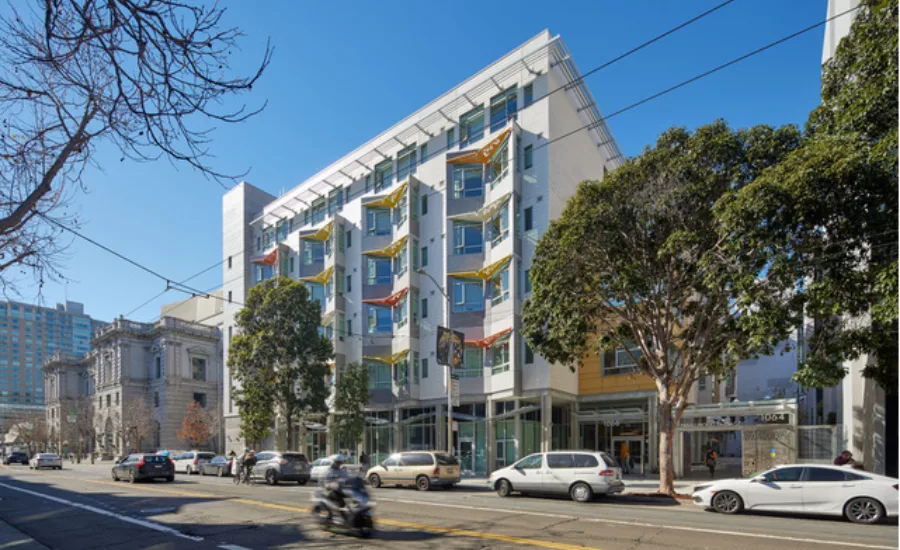
Image courtesy of AIA San Francisco
With a marked increase in applying modular construction systems for effective and design-focused housing solutions at a range of affordable price points, AIA San Francisco is hosting a group of experts in their design and use next Tuesday evening, July 22, starting at 5:30pm PT.
The program, “Lessons Learned, New Horizons” is the first in a series of three talks inspired by input from the Office of Charles F. Bloszies FAIA, whose principal will present a modular navigation center for formerly unhoused people. Joining the design-focused talk, moderated by architecture and design writer Lydia Lee, are Tom Bliska, AIA of David Baker Architects and Steven Rajninger, FAIA, principal of Herman Coliver Locus Architecture.
According to the American Institute of Architects (AIA) San Francisco’s Housing Knowledge Community, which is collaborating as event host, this will be “a timely discussion on architectural solutions, ranging from temporary to permanent – varied in process, structural approach, complexity, and formal expression.” There is more information on the program at this link: https://www.aiasf.org/events/modular-design-series-lessons-learned-new-horizons#overview
"The panel will explore a pressing question: is modular construction a promising path forward for America’s overburdened municipalities and under-resourced communities?” according to the organizers. Descriptions of the highlighted housing projects follow below.
Steven Rajninger:
HCLA designed 1064 Mission Street in San Francisco, the largest and most complex publicly funded, modular development of its kind dedicated to supporting people who’ve been chronically homeless. The project includes a pioneering convergence of program: 256 studio apartments and an array of shared indoor and outdoor supportive spaces for adults and seniors, the Maria X Martinez Health Resource Center, the San Francisco Homeless Outreach Team Headquarters and Episcopal Community Services’ CHEFS program, a social enterprise that trains formerly unhoused adults to be chefs in local commercial kitchens.
Tom Bliska:
Blue Oak Landing sets a new bar for performance, resourcefulness, and connection to place for permanent supportive housing in the Bay Area. The all-electric affordable building—on track for zero energy—was built with modular technology to streamline delivery of much-needed homes for unhoused residents near downtown Vallejo. It provides 75 supportive apartments in two four-story buildings linked by open-air circulation across a shared courtyard. A ground-floor services suite includes property management, case management, and social assistance for residents. The new community also offers a computer learning center, library, community room with a fully equipped kitchen, laundry facilities, courtyard with shared planting beds, and secure indoor bicycle parking—including electric bicycle charging. In a focused bid to speed provision of much-needed housing, this project was built with modules fabricated by a local factory on Mare Island, just three miles from the site in Vallejo. The distinctive sawtooth design is set off by articulated, perforated weathering-steel panels. The resilient design includes measures to mitigate water and energy use, including heat pump heating and cooling and centralized heat pump water heating.
Charles Bloszies:
The San Mateo County Navigation Center represents the first built instance of the Office of Charles F. Bloszies’s “Step(1)” interim supportive housing system, derived from the modular concept developed for the award-winning Mountain View Homekey facility. This project does not consist of “tiny homes” – the clients’ sleeping units are private quarters within the larger complex with shared amenities, services, and exterior spaces that comprise a supportive community. The navigation center serves roughly 260 formerly unhoused clients at a time, with anticipated stays of 3-6 months. The facility serves as a sanctuary for residents to recover from life on the street and successfully transition to stable housing. With this goal in mind, the site is designed to provide a balance between privacy and community.
Looking for a reprint of this article?
From high-res PDFs to custom plaques, order your copy today!
.webp?height=740&t=1767036885&width=auto "Header - BE 1170x658 (002).png")

.webp?height=740&t=1755781744&width=auto "KEE(2).png")