Building Enclosure logo
search
cart
facebook twitter linkedin youtube instagram Spotify Podcasts Apple Podcasts Spotify Podcasts Apple Podcasts
  • Sign In
  • Create Account
  • Sign Out
  • My Account
Building Enclosure logo
  • NEWS
    • Breaking News
  • SECTIONS
    • Columns
    • Project Profiles
    • Trade Shows
    • Sponsor Insights
  • SYSTEM DESIGNS
    • Low-Slope Roofs
    • Pitched Roofs
    • Metal Roofing Materials
    • Waterproofing
    • Sustainability
    • Insulation
    • Exterior Claddings
    • Wall Systems
    • Building Envelope
  • BLOG
    • The BE Blog
  • MEDIA
    • Podcasts
    • Webinars
    • Quiz
    • Videos
    • Polls
    • Interactive Spotlights
    • Newsletter
    • Photo Galleries
  • DIRECTORIES
    • Directory: Blue Book
    • Directory: Roofing Resource
  • PRODUCTS
  • TECHNICAL
    • Codes
      • Waterproofing
      • Roofing
    • Details
      • Waterproofing
      • Roofing
  • CONTINUING ED
  • ABOUT
    • Advertise
      • Editorial Calendar
    • Contact
    • eMag Archive Issues
  • SIGN UP!
Sustainability

Tax and Energy Savings with the Right Ceiling Solutions

New phase change material technologies can deliver up to 15 percent energy savings and 50 percent in tax credits
By Alex Waltemyer, Director of Energy Saving Ceilings
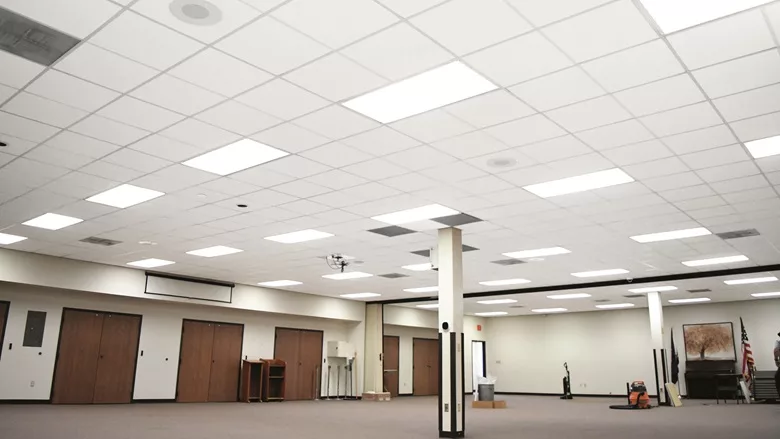
Raymond Frye Complex community center in Wellington, Kansas

Raymond Frye Complex community center in Wellington, Kansas

Classroom rendering
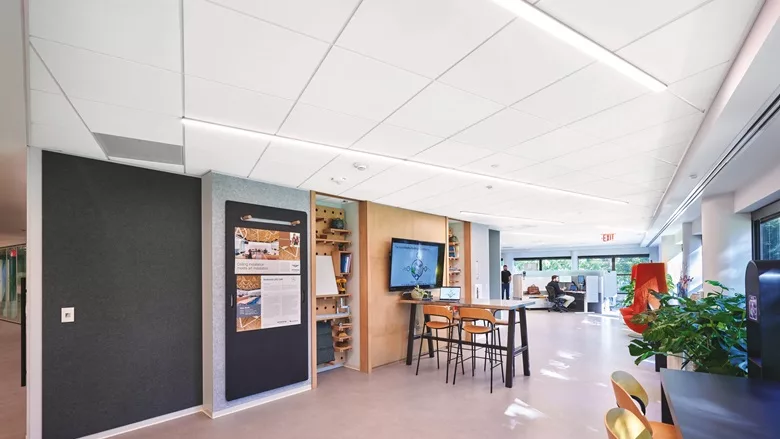
Living Lab” workspace located at the Armstrong corporate campus in Lancaster, Pennsylvania
Armstrong World Ind.

“Living Lab” workspace located at the Armstrong corporate campus in Lancaster, Pa.
Raymond Frye Complex community center in Wellington, Kansas
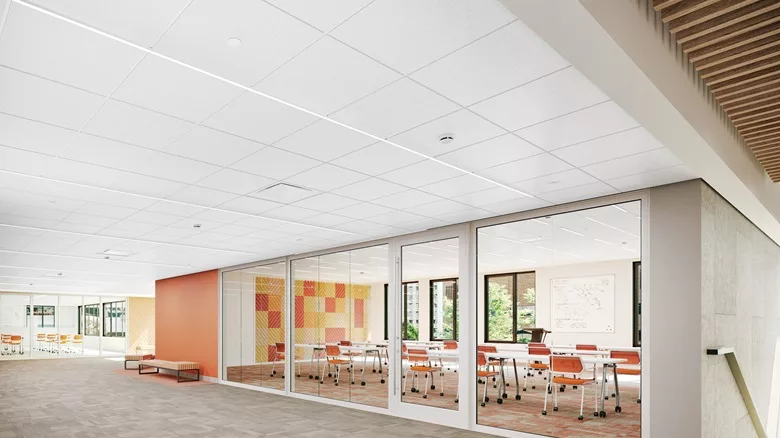
Classroom rendering
Living Lab” workspace located at the Armstrong corporate campus in Lancaster, Pennsylvania
June 27, 2025

Thanks to recent innovation pairing mineral fiber ceiling panels with phase change material technology, architects, designers, facility managers, and other key players in construction and renovation projects are re-thinking the role ceilings play in supporting environmental objectives—especially energy savings. As a space warms—typically during the day when it is occupied or receives sunlight—the crystalized PCM encased in the ceiling gradually dissolves, passively cooling the space while it absorbs heat. As the room cools at night or during low-occupancy times, the stored heat is released into the space and the PCM re-solidifies. In this way, heat transfers naturally into and out of the ceiling panels at 72 degrees, allowing it to be effective for both cooling and heating.

Energy Savings of up to 15 Percent

Advantages of PCM ceiling panels stem from the fact that they support thermal comfort with no mechanics, energy expenditure, or fossils fuels to burn! A valuable, sustainable solution for a world prioritizing decarbonization, ceiling panels with PCM technology can reduce energy costs and consumption by as much as 15 percent.* By enabling energy savings, these ceilings offer advantages including:

  • Reduced reliance on fossil-fuel powered HVAC systems
  • Less wear on HVAC systems—critical to facilities with aging systems and strict budgets
  • Improved thermal comfort—especially well-suited for changing climates or environments with daily hot-cold fluctuations
  • Ability to enhance indoor environmental quality with features like acoustical sound blocking and absorption
  • Easy installation and little-to-no maintenance

Energy saving ceiling products also fit into the thermal comfort portion of the WELL Building Standard and can contribute to energy and atmosphere credits for LEED.

Up to 50 Percent in in Tax Credits

While the above advantages can work to help a facility realize ongoing savings related to lower energy consumption and less reliance on mechanical heating and cooling—a project owner can get a “head start” on cost benefits because PCM ceiling panels qualify for certain tax credits. Projects utilizing energy-saving ceiling panels may qualify for Investment Tax Credit 48E, which was introduced under the Inflation Reduction Act of 2022 and offers tax incentives for investments in clean energy technologies. Because of their thermal energy storage properties, most projects using PCM ceiling panels may qualify:

  • Up to 40 percent federal tax credit
  • Additional 10 percent tax credit if the project is deployed in an “Energy Community.” (i.e., a Brownfields site or fossil-fuel-dependent community)

When investing in energy-saving ceilings for a project, consider a solution that helps you maximize tax savings opportunities. For example, when installing an Armstrong Templok Energy Saving Ceiling, the ceiling panels, and associated grid, trim, and labor all qualify for tax credits under ITC 48E. Moreover, these panels are made in the U.S.A. of domestic and global content, meeting a requirement for additional tax savings.**

Qualifying energy saving ceiling projects include those of taxpayers and non-taxpaying entities and span multiple sectors, including:

  • Public—such as government entities
  • Private—corporations, healthcare facilities and others
  • Education—K-12 and higher education
  • 501 (c)(3) charitable organizations

The list of ideal projects is extensive and includes K-12 schools, public and private universities, dorms, museums, hospitals, nonprofit offices/facilities, military bases, courthouses, faith-based buildings, convention centers, and arenas—to name a few. In addition to getting information from the ceiling manufacturer, it’s important to consult your tax advisor to confirm qualification of your project.

More Affordable, More Sustainable

Thanks to tax credits, the use of energy saving ceilings could make your next construction or renovation project more affordable. And, with PCM technology helping reduce energy costs, the impact on your bottom line won’t stop there. You can learn more about energy saving ceilings and related tax credits by visiting armstrongceilings.com/energysavingceilings.

Notes:

*Cooling energy savings according to research estimates measured in lab tests. Results may vary.

** This article lists various federal tax credits and deductions that your project may qualify for when purchasing Armstrong TEMPLOK Energy Saving Ceilings. Please consult your own tax attorney or advisor.

LEED is a registered trademark of the U.S. Green Building Council; WELL Building Standard is a trademark of the Well Building Institute.

This article was originally posted on www.wconline.com.
KEYWORDS: acoustics Armstrong Ceiling & Wall Solutions building standards ceiling panels ceilings energy efficiency LEED taxes

Share This Story

Looking for a reprint of this article?
From high-res PDFs to custom plaques, order your copy today!


Alexwaltemyer 03 900 x 550

Alex Waltemyer has been with Armstrong World Industries for almost a decade. As Director of Energy Saving Ceilings at Armstrong, her hands-on leadership is instrumental in the launch and growth of innovative ceiling solutions that advance company, customer, and global initiatives to decarbonize and engage in sustainable strategies that support healthier environments and a greener planet.

Recommended Content

JOIN TODAY
to unlock your recommendations.

Already have an account? Sign In

  • bar graph shows LEED v4/LEED v5/LEED v6 in various colors

    When Will LEED v4 / v4.1 and LEED v5 Expire?

    The latest version of the LEED rating system, LEED v5, is...
    Sustainability
    By: Daniel Overbey
  • Celebrating Women In AEC-2026

    Celebrating Women in The AEC Industry Part 1

    A round-up of women in the design, engineering and...
    Building Envelope
    By: Lindsay Lewis
  • KEE membrane application on a roof

    A Beginner’s Guide to Single-Ply Roofing Membranes

    While PVC and TPO appear extremely similar, the chemistry...
    Low-Slope Roofs
    By: Peter Gross
Manage My Account
  • Sign up for the Newsletter
  • Online Registration
  • Manage My Preferences
  • Registration Customer Service

More Videos

Sponsored Content

Sponsored Content is a special paid section where industry companies provide high quality, objective, non-commercial content around topics of interest to the Building Enclosure audience. All Sponsored Content is supplied by the advertising company and any opinions expressed in this article are those of the author and not necessarily reflect the views of Building Enclosure or its parent company, BNP Media. Interested in participating in our Sponsored Content section? Contact your local rep!

close
  • 2 construction workers and a DEXcell panel
    Sponsored byDEXcell Roof Boards

    Designing Low-Slope Roofs for Resilience

  • Bell Bank headquarters in Fargo, North Dakota
    Sponsored bySto Corp.

    Drained and Back-Ventilated Rainscreens vs Pressurized-Equalized Rainscreens

  • A construction worker using DEXcell roof boards
    Sponsored byDEXcell Roof Boards

    The Hidden Strength of Low-Slope Roof Systems: Why Roof Cover Boards Matter

Popular Stories

a man wearing a mask installs insulation into a wall system

Quiet Rooms and Healthier Air: A Second Look at What Goes Inside the Wall Cavity

construction industry workers in hard hats stand around a city scape

Construction Industry Revolts Over New CSI Licensing Plan

Canalino Elementary School and Canalino Family School exterior

Daylighting Design to Support Rapidly Growing Trend in Modular Building Construction

Building Enclosure Newsletter

BE Poll

Events

June 17, 2025

Addressing Condensation in Low-Slope Roof Assemblies

Credits: 1 AIA LU/HSW; 0.1 ICC CEU; 1 IIBEC CEH; 0.1 IACET CEU

On Demand In modern roofing systems, vapor retarders and air barriers do more than just minimize air leakage—they’re essential to maximizing performance and longevity. This engaging course dives into the next generation of moisture control: permeable vapor retarders and air barriers. Discover how these cutting-edge technologies are transforming low-slope roofing assemblies by improving energy efficiency, managing moisture, and boosting wind uplift resistance.

April 9, 2026

Strategies for High-Performance Below-Grade Waterproofing

Credits: 1 AIA LU/HSW ; 1 IIBEC CEH; 0.1 IACET CEU

On-Demand Designing a high-performance building enclosure requires more than just surface-level protection; it demands a rigorous, performance-based mastery of below-grade water and gas mitigation. This discussion will provide an expert-level analysis of below-grade waterproofing within the comprehensive framework of the high-performance building enclosure.

View All Submit An Event

Products

Plaster and Drywall Assemblies Manual

Plaster and Drywall Assemblies Manual

This is a comprehensive manual that goes beyond codes and standards, providing expert guidance in design, detailing, material selection and troubleshooting for plaster and drywall.

See More Products

Related Articles

  • Armstrong

    Armstrong Ceiling Solutions Partners with LogiSon Acoustic Network

    See More
  • LEED v4 Solutions Guide

    LEED v4 Ceiling Solutions Guide

    See More
  • atlanta braves spring training

    Complete Ceiling Solutions Hit a Home Run for Atlanta Braves Spring Training Complex

    See More

Related Products

See More Products
  • energy modeling.jpg

    Energy Modeling and Computations in the Building Envelope

  • Ceiling-Systems-Handbook-2012-cover.jpg

    Ceiling Systems Handbook

  • net zero.jpg

    Net Zero Energy Design: A Guide for Commercial Architecture

See More Products

Events

View AllSubmit An Event
  • September 20, 2022

    Go with the Flow: Tapered Insulation Fundamentals

    ON DEMAND: Tapered insulation systems add positive drainage to manage water flow, prevent water infiltration, as well as insulate buildings at the roof level.
View AllSubmit An Event
×

Enhance your expertise with unparalleled insights.

Join thousands of building professionals today. Shouldn’t you know what they know?

SUBSCRIBE TODAY!
  • RESOURCES
    • Advertise
    • Contact Us
    • Store
    • Want More
  • SIGN UP TODAY
    • Create Account
    • Newsletter
    • Customer Service
    • Manage Preferences
  • SERVICES
    • Marketing Services
    • Reprints
    • Market Research
    • List Rental
    • Survey/Respondent Access
  • STAY CONNECTED
    • LinkedIn
    • Facebook
    • Instagram
    • YouTube
    • X
  • PRIVACY
    • PRIVACY POLICY
    • TERMS & CONDITIONS
    • DO NOT SELL MY PERSONAL INFORMATION
    • PRIVACY REQUEST
    • ACCESSIBILITY

Copyright ©2026. All Rights Reserved BNP Media, Inc. and BNP Media II, LLC.

Design, CMS, Hosting & Web Development :: ePublishing