Rising Lung Cancer Rates in Non-Smoking Women Underscores Radon Risk
Infiltration of Gas into Buildings is Addressed with Spray Foam
According to the American Cancer Society, lung cancer remains the second most common cancer among both men and women (not counting skin cancer) and the organization estimates in 2025 there will be about 226,650 new cases (110,680 in men and 115,970 in women). On a positive note, the number of new cases is declining overall because of more people either quitting smoking or not starting to at all.[i] However, statistics also point to an alarming trend – lung cancer occurrence in non-smoking women is on the rise.
Approximately 20% of lung cancer diagnoses occur in non-smokers. However, non-smokers who develop lung cancer are twice as likely to be female than male.[ii] While the reasons for this discrepancy are being studied, key contributors to lung cancers in non-smokers are known. One of the top ones is exposure to radon.
According to the U.S. Environmental Protection Agency (EPA), radon is the second leading cause of lung cancer in the U.S., and the leading cause among non-smokers. Naturally occurring, radon is a radioactive gas that results from the breakdown of uranium, thorium, or radium in soil and rocks. It is invisible to the eyes and has no scent or taste. When outdoors, radon poses little risk to human health.[iii] However, radon can accumulate indoors in areas with direct proximity to soil and in places without adequate ventilation, including in underground and ground floor spaces, heightening the risk of lung cancer.[iv] For all these reasons, preventing the infiltration of radon into buildings – including apartments and commercial facilities – is critical.
Radon Detection Guidance
The EPA provides guidance for detecting and preventing radon infiltration in buildings and homes.[v] Notably, the common pathways for radon gas entry into buildings include cracks and openings in the floor slab, cracks in the foundation wall, or sumps.
Two types of test devices measure levels of the gas in structures. The first type of devices is passive, or powerless. These provide short term tests and include alpha track detectors, charcoal canisters and charcoal liquid scintillation detectors. After use, passive tests are sent to a lab for analysis. Detection devices in the second category are active. These require power, are operated by trained professionals, and include continuous monitors and continuous working level monitors. These long-term tests track variation in radon levels over a period.[vi]
The Spray Foam Solution Explained
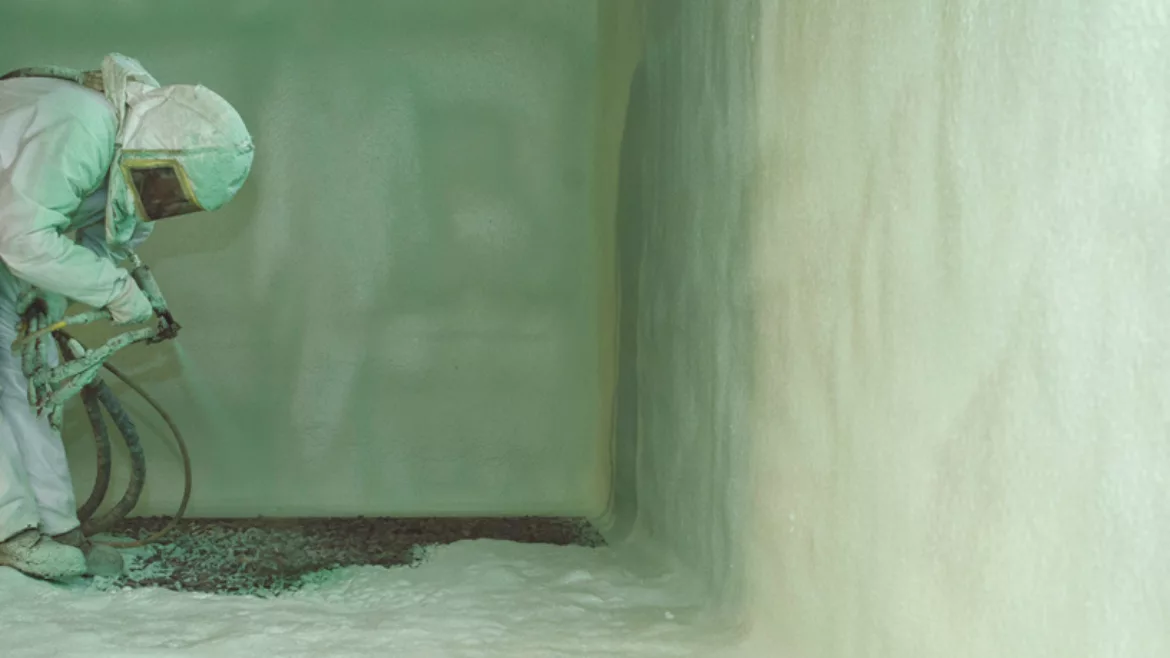
An effective means for helping to prevent radon gas from entering structures at the common points of entry leverages closed cell spray polyurethane foam, or SPF. An insulation that can optimize building envelope performance in an array of commercial, institutional, residential and agricultural structures, closed cell spray foam can act as an all-in-one thermal, air and vapor barrier solution. As an insulant, SPF can meaningfully enhance energy efficiency. When applied for radon mitigation, the spray foam solution is typically quick and cost effective, with less room for error when compared to other options such as polystyrene and polyiso installed below slab (as these require more materials, steps and labor).
Following is a guide for the installation of the spray foam and accompanying materials that comprise this radon mitigation solution.
Subfloor Preparation – A layer of gas-permeable material can be placed under concrete slabs and other floor systems that directly contact the ground and are within the walls of the living spaces of the building. The gas permeable layer should consist of clean aggregate at a minimum of 4-inch thickness.
Install Depressurization Pipe – A perforated pipe of minimum three inches in diameter can be installed horizontally in the gas permeable aggregate. The depressurization pipe can then be connected to a vertical vent pipe that can extend through the building and terminate above the roof. This preventatively installed pipe is typically connected to an exhaust fan after the work is completed if a test indicates a radon concentration over 4 pCI/L.
Install Water Drains – Because radon can use water as a vehicle for infiltrating the structure, the installation of floor drains, which are specifically designed to prevent entry of the gas, is essential.
Air Barrier Installation – This step in the process is where the closed cell spray foam insulation comes in. Because it is a highly effective air barrier, the SPF is typically most effectively applied under the foundation slab and above the gas-permeable layer to help provide air tightness and build thermal insulation. The SPF should be ICC compliant in accordance with ASTM 2178 and be applied to a minimum thickness of 1.25” in order to meet insulation, air tightness and vapor retarder requirements (note that Huntsman Building Solutions offers Heatlok and Premium Icynene Series SPF options that are developed to meet these requirements and have been tested as radon gas resistant, as demonstrated by K124/02/95 method C of ISO/TS 11665-13 tests, while offering greater effectiveness than a 6-mil polyethylene membrane at 1.25”).
Seal Joints - The capacity for seamless continuity of the spray foam helps to provide a seal of the foundation wall joint to the foundation, developed to leave no seams in the basement or ground-level insulation anywhere including the wall, slab and rim joist. The spray foam can adhere and mold to the building structure and no sealant, tape or cutting of materials is typically required. This means there are typically no compatibility issues between materials.
Seal All Openings - The closed cell spray foam can seal openings and penetrations. The material seals and expands up to 30 times its initial volume in just five seconds. It can therefore penetrate through the gravel creating a full surface adhesion. The system is developed to be more resistant to puncture than commonly applied products, allowing for workers to walk on top of it after application and curing are complete, without damaging the integrity of the barrier.
Install Sealed Lid on Sumps – The final step in the radon mitigation solution is to install a sealed lid on sumps. Because sumps can communicate directly with gravel, a known origin of radon, it is imperative to utilize specifically designed lids for this final step.
REFERENCES
In addition to helping to reduce radon infiltration, structures insulated with closed cell spray foam can render long-term energy savings and offer better indoor air quality overall. And because it’s a secondary water barrier, SPF can also help to fortify the building against future mold and water damage.
[i] Key Statistics for Lung Cancer, American Cancer Society, https://www.cancer.org/cancer/types/lung-cancer/about/key-statistics.html
[ii] Women and Lung Cancer, Lung Cancer Research Foundation, https://www.lungcancerresearchfoundation.org/for-patients/free-educational-materials/lung-cancer-facts/women-and-lc/?gad_source=1&gclid=CjwKCAiAiaC-BhBEEiwAjY99qOqntAnJxsr18X2_a31c7dajaXEtgp4sI24v3A6851KmN2u9FR9IwxoCe5YQAvD_BwE
[iii] Lung Cancer Risk Factors, American Cancer Society, https://www.cancer.org/cancer/types/lung-cancer/causes-risks-prevention/risk-factors.html
[iv] National Cancer Institute, Radon and Cancer Fact Sheet, https://www.cancer.gov/about-cancer/causes-prevention/risk/substances/radon/radon-fact-sheet
[v] EPA, Radon Standards of Practice, https://www.epa.gov/radon/radon-standards-practice
[vi] Kansas State University, Nation1al Radon Program Services, https://sosradon.org/devices
DISCLAIMER
The information herein is to assist in consideration of suitability of products for radon applications. An inspection and test of products should be conducted by qualified spray foam insulation installers before use and satisfy themselves as to contents and suitability. Nothing herein shall constitute a warranty, expressed or implied, including any warranty of merchantability or fitness, nor is protection from any law or patent inferred.
Looking for a reprint of this article?
From high-res PDFs to custom plaques, order your copy today!

.webp?height=740&t=1767036885&width=auto "Header - BE 1170x658 (002).png")

.webp?height=740&t=1755781744&width=auto "KEE(2).png")