Preventing Radon Infiltration in Commercial Facilities
Six Steps to Using Closed Cell Spray Polyurethane Foam
Radon, a radioactive gas released from the natural decay of the elements Uranium, Thorium and Radium present in soil and rocks, usually exists in low levels outdoors. The invisible, odorless and tasteless gas seeps up through the ground and into the air.1 Because Radon is naturally present outside, we all breathe it in daily, albeit typically in low levels. However, when inhaled in higher levels, the substance puts an individual at increased risk of developing lung cancer. In fact, research from the American Lung Association asserts Radon is the second leading cause of lung cancer in the United States, responsible for thousands of deaths each year. Exposure causes no immediate symptoms, however the long-term threat of the disease is significant to everyone. Notably, people who have never smoked comprise approximately 2,900 of the 21,000 radon-related lung cancer deaths each year.2
As the National Cancer Institute points out, Radon can accumulate in areas with direct proximity to soil and in places without adequate ventilation, including in underground and ground floor spaces. In these locations, Radon may accumulate in higher levels, substantially increasing the risk of lung cancer.3 Because of their direct proximity to the ground soil, it is possible for basements as well as the ground level of commercial and institutional facilities to become such dangerous spaces.
Radon can infiltrate the structure in several key places. The common pathways for Radon gas entry include cracks and openings in the floor slab, cracks in the foundation wall, or sumps. Despite the risk of Radon accumulation in commercial and institutional buildings, there are solutions available to both test for, and to prevent the infiltration of, Radon in these structures.
Testing for Radon
The EPA provides a wide array of best practices guidance for detecting and preventing, or reducing, Radon infiltration in buildings and homes.4 Additionally, Kansas State University, through its National Radon Program Services, provides information on the two common categories of Radon test devices utilized to measure levels of the gas in structures. Passive, or powerless, devices are short term tests which include alpha track detectors, charcoal canisters and charcoal liquid scintillation detectors. After use, passive tests are returned to a lab for analysis. Active devices, which require power and are typically operated by trained professionals, include continuous monitors and continuous working level monitors. These long-term tests track variation in Radon levels over a period of time.5
Closed Cell Spray Polyurethane Foam
Closed cell spray polyurethane foam (SPF), a thermal, air and vapor barrier solution, is commonly used to insulate and seal the building envelope of commercial facilities of all types including schools, hospitals, office, retail, industrial and agricultural buildings. The insulation is well known as a superb solution for enhancing energy efficiency in structures. The professionally applied material may also notably be applied in key places to minimize, or stop, the infiltration of Radon into basements and ground levels of commercial and institutional facilities. The following six-step process outlines how to utilize spray foam as a solution for Radon.
Six-step Spray Foam Solution
The first step in leveraging the power of closed cell spray foam for Radon abatement is to install a depressurization pipe. A pipe, perforated and 4 inches in diameter, must be installed in 3/4-inch gravel net and run to the center of the surface of the floor slab. This preventatively installed pipe is connected to an exhaust fan if, after the work is completed, a test indicates a Radon concentration over 200 Bq/m3.
Step two of the Radon abatement process will be to install water drains. It is important to note that Radon can use water as a vehicle for infiltrating the structure. Therefore, it is necessary to install floor drains which are specifically designed to prevent entry of the gas.
The third step in the process is to install an air barrier. A closed cell spray foam system may be utilized since it performs as an effective air barrier. The spray foam selected should be ICC compliant in accordance with ASTM 2178. The spray foam provides complete air tightness under the foundation slab and also provides thermal insulation. Heatlok HFO, a closed cell SPF solution manufactured by Huntsman Building Solutions, meets these requirements and is also Radon gas resistant, as demonstrated by ISO/ICC 17025-OL tests while offering greater effectiveness than a 6-mil polyethylene membrane at 1.25 inches. The spray foam should be applied in a minimum thickness of 1.25 inches to meet insulation, air tightness and vapor retarder requirements.
Step four is a sealing of joints. The seamless continuity of spray polyurethane foam provides a seal to the foundation wall joint to the foundation, leaving no seams in the basement or ground-level insulation anywhere, including wall, slab and rim joist. Spray foam adheres and molds perfectly to the building structure and no sealant, tape or cutting of materials is required. This equates to zero compatibility issues between materials.
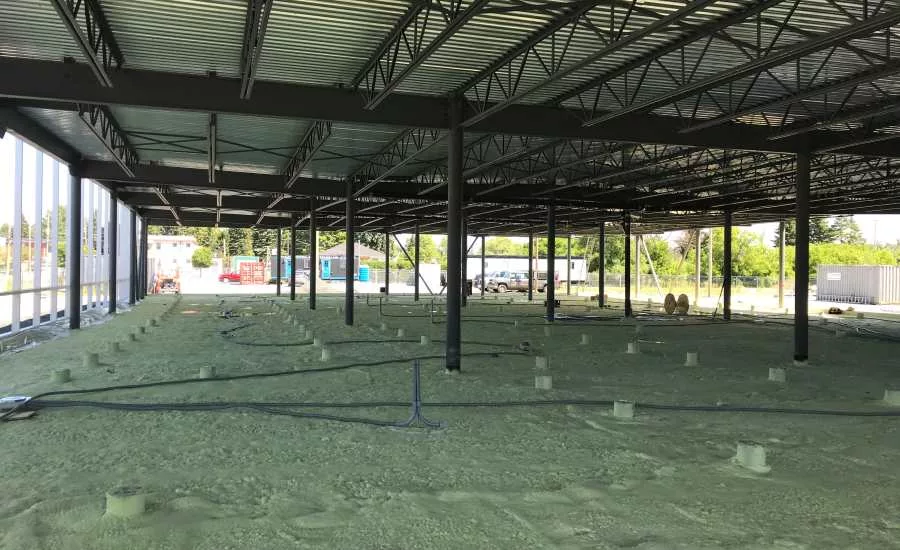
Sealing all openings is step five of the process. The closed cell spray foam seals openings and posts, leaving no room for error. The material seals and expands to 30 times its initial volume in just five seconds. It therefore penetrates through the gravel creating a full surface adhesion. The system is more resistant to puncture than commonly applied products, allowing for workers to walked on top of it without damaging the integrity of the gas barrier.
The sixth and final step in the process will be to install a sealed lid on sumps. Because sumps can communicate directly with gravel, which is an origin of Radon, it is imperative to utilize specifically designed lids.
There are additional benefits to applying closed cell spray foam as under slab insulation, as is done in this six-step process for Radon abatement. Key among them are that the application is very quick and real savings may be achieved. Product cost will ultimately be lower per square foot, since the applicator’s travel time and prep are offset by the volume to install, as compared with a conventional insulation system that involves more steps, several materials and additional labor—all of which also open the door for more risk of error.
Also, in addition to acting as a cost-effective Radon barrier, closed cell spray foam provides a number of key additional benefits to the structure. When applied as an insulation, the air sealing quality of spray foam dramatically reduces the structure’s energy demands as well as its long-term energy bills. Closed cell spray foam also minimizes the infiltration of allergens and pests, while providing structural enhancement. As a secondary water barrier, the durable material helps to protect the building against mold and water damage, while ultimately enhancing indoor comfort for the building’s inhabitants, or users.
1. National Cancer Institute, Radon and Cancer Fact Sheet, https://www.cancer.gov/about-cancer/causes-prevention/risk/substances/radon/radon-fact-sheet
2. American Lung Association, Radon, https://www.lung.org/clean-air/at-home/indoor-air-pollutants/radon
3. National Cancer Institute, Radon and Cancer Fact Sheet, https://www.cancer.gov/about-cancer/causes-prevention/risk/substances/radon/radon-fact-sheet
4. EPA, Radon Standards of Practice, https://www.epa.gov/radon/radon-standards-practice
5. Kansas State University, National Radon Program Services, https://sosradon.org/devices
Looking for a reprint of this article?
From high-res PDFs to custom plaques, order your copy today!
.webp?height=740&t=1767036885&width=auto "Header - BE 1170x658 (002).png")

.webp?height=740&t=1755781744&width=auto "KEE(2).png")
.webp?height=200&t=1779895786&width=200 "Construction(15).png")


