Building Enclosure logo
search
cart
facebook twitter linkedin youtube instagram Spotify Podcasts Apple Podcasts Spotify Podcasts Apple Podcasts
  • Sign In
  • Create Account
  • Sign Out
  • My Account
Building Enclosure logo
  • NEWS
    • Breaking News
  • SECTIONS
    • Columns
    • Project Profiles
    • Trade Shows
    • Sponsor Insights
  • SYSTEM DESIGNS
    • Low-Slope Roofs
    • Pitched Roofs
    • Metal Roofing Materials
    • Waterproofing
    • Sustainability
    • Insulation
    • Exterior Claddings
    • Wall Systems
    • Building Envelope
  • BLOG
    • The BE Blog
  • MEDIA
    • Podcasts
    • Webinars
    • Quiz
    • Videos
    • Polls
    • Interactive Spotlights
    • Newsletter
    • Photo Galleries
  • DIRECTORIES
    • Directory: Blue Book
    • Directory: Roofing Resource
  • PRODUCTS
  • TECHNICAL
    • Codes
      • Waterproofing
      • Roofing
    • Details
      • Waterproofing
      • Roofing
  • CONTINUING ED
  • ABOUT
    • Advertise
      • Editorial Calendar
    • Contact
    • eMag Archive Issues
  • SIGN UP!
Project Profiles

A Highly Sustainable Urban Intervention
2022AK22_101_lr.jpg
CODE - Center of Developing Entrepreneurs, Eskew Dumez Ripple, and Wolfe Ackerman
July 13, 2023

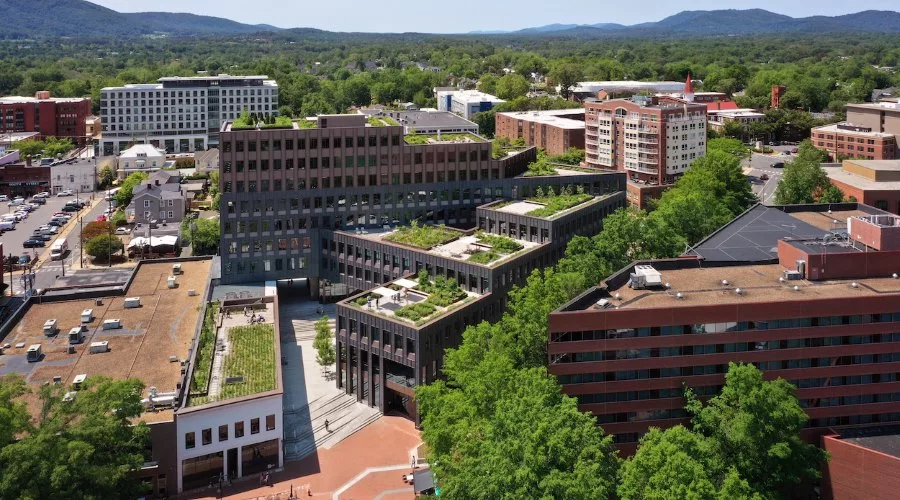
The Center of Developing Entrepreneurs (CODE) is a new sustainable, mixed-use project in downtown Charlottesville, comprised of a new public plaza and 215,000 square feet of multi-use space, including a strategic combination of co-working, office space, shared amenities, and retail. 

The investor behind the development, a University of Virginia (UVA) graduate, wanted to give back to the community by providing a place where locally grown innovations in information technology, clean energy, and allied fields, could blossom into locally based businesses, rather than seeing those ideas and human talent relocate outside of the region. Building the project on the mall would reinforce a commitment to walkability but posed the tricky challenge of integrating a project of the requisite size with the small scale of the mall. In response, the design team introduced a novel solution: stair-stepping the massing up from the mall towards the intersection of Main and Water streets, then spiral up further to meet the scale of Water Street, with a cascade of occupiable terraces and green roofs.

While exploring building massing options, simulations were performed, not just for their impact on energy consumption, but also of the impact of shadows cast upon existing trees. At the ground floor, the brick is lifted, replaced by a glazed first story, exposing a unique public space intended to enliven the street and promote connectivity. This interior plaza also serves to extend the conclusion of the main thoroughfare, Main Street, with a direct connection to adjacent Water Street, facilitating access between the adjoining areas and allowing further retail space to be integrated into the surrounding pedestrian mall.

Based on the results of peer-reviewed research demonstrating improved learning and decision-making performance for knowledge workers when ambient air has lower levels of carbon dioxide and other contaminants, a palette of low-emissions materials was employed, and the building ventilation system provides more than twice the standard flow of fresh air—but does this in ways that still achieves energy use that is 1/3 that of the benchmark office building. Design choices were also informed by ongoing assessment of the carbon emissions associated with the materials used for construction, helping the team lower the carbon footprint of the project even before the building opens. A full 32% of the site (including portions of the building), is covered by native plants. Energy use intensity is calculated at an impressive 25.86%, a 73% reduction from the benchmark for a building of this type.

The building envelope draws from the brick cladding and punched window openings of its historic context but is implemented with a modern rain screen to achieve high levels of insulation and thermal comfort while providing defense-in-depth against water intrusion.

Coworking continues to experience rapid development and evolution. The design team researched other spaces extensively, visiting various coworking facilities in achieving the perfect blend of office and coworking space. Throughout, the design team worked with a client representative in pursuing a vision to uphold the changing nature of work, straddling a line between the formal and informal, instilling a unique blend of clean commercial space with a more relaxed residential feel. All interior elements, from furniture and textiles to fixtures and artwork, were handpicked by the team to foster a warm and welcoming environment.

CODE is designed to be a LEED Platinum certified building, employing systems and technologies beyond LEED standards that will increase fresh air exchange and provide fine-tuned environmental controls to support natural ventilation and generous daylighting.


EskewDumezRipple and WOLF ACKERMAN team

EskewDumezRipple — José Alvarez, Noah Marble, Steve Dumez, Z Smith, Tyler Guidroz, Jill Traylor, Max Katz, Shannon Griffin, Tom Gibbons, Alex Swiggum, Kelsey Wotila, project team

WOLF ACKERMAN — Fred Wolf, Dave Ackerman, Mark Merolla, Joey Laughlin, project team


Project team

EskewDumezRipple (associate architect and interior design)

WOLF ACKERMAN (architect of record)

Fox & Associates (structural)

Timmons Group (civil)

2RW (m/e/p) 

Gregg Bleam Landscape Architect (landscape)

DKT Lighting (lighting design)

STRUCTR Advisors (sustainability)

Thorton Tomasetti (energy modeling)

MSTB (commissioning)

General Contractor: Hourigan

Client: CSH Development


Sources

Glazing: Guardian

Doors: CR Laurance; Kawneer

Ceilings: Arktura; Hunter Douglas

Carpet: Bentley

Lighting: MP Lighting; Lumenpulse

KEYWORDS: building design mixed-use project sustainable design

Share This Story

Looking for a reprint of this article?
From high-res PDFs to custom plaques, order your copy today!


Recommended Content

JOIN TODAY
to unlock your recommendations.

Already have an account? Sign In

  • bar graph shows LEED v4/LEED v5/LEED v6 in various colors

    When Will LEED v4 / v4.1 and LEED v5 Expire?

    The latest version of the LEED rating system, LEED v5, is...
    Sustainability
    By: Daniel Overbey
  • Celebrating Women In AEC-2026

    Celebrating Women in The AEC Industry Part 1

    A round-up of women in the design, engineering and...
    Sustainability
    By: Lindsay Lewis
  • KEE membrane application on a roof

    A Beginner’s Guide to Single-Ply Roofing Membranes

    While PVC and TPO appear extremely similar, the chemistry...
    Low-Slope Roofs
    By: Peter Gross
Manage My Account
  • Sign up for the Newsletter
  • Online Registration
  • Manage My Preferences
  • Registration Customer Service

More Videos

Sponsored Content

Sponsored Content is a special paid section where industry companies provide high quality, objective, non-commercial content around topics of interest to the Building Enclosure audience. All Sponsored Content is supplied by the advertising company and any opinions expressed in this article are those of the author and not necessarily reflect the views of Building Enclosure or its parent company, BNP Media. Interested in participating in our Sponsored Content section? Contact your local rep!

close
  • 2 construction workers and a DEXcell panel
    Sponsored byDEXcell Roof Boards

    Designing Low-Slope Roofs for Resilience

  • Bell Bank headquarters in Fargo, North Dakota
    Sponsored bySto Corp.

    Drained and Back-Ventilated Rainscreens vs Pressurized-Equalized Rainscreens

  • A construction worker using DEXcell roof boards
    Sponsored byDEXcell Roof Boards

    The Hidden Strength of Low-Slope Roof Systems: Why Roof Cover Boards Matter

Popular Stories

a man wearing a mask installs insulation into a wall system

Quiet Rooms and Healthier Air: A Second Look at What Goes Inside the Wall Cavity

Canalino Elementary School and Canalino Family School exterior

Daylighting Design to Support Rapidly Growing Trend in Modular Building Construction

construction workers on a roof, plane flies in background

Why Specifications Are Becoming the Next Critical Layer of Construction Compliance

Building Enclosure Newsletter

BE Poll

Events

June 17, 2025

Addressing Condensation in Low-Slope Roof Assemblies

Credits: 1 AIA LU/HSW; 0.1 ICC CEU; 1 IIBEC CEH; 0.1 IACET CEU

On Demand In modern roofing systems, vapor retarders and air barriers do more than just minimize air leakage—they’re essential to maximizing performance and longevity. This engaging course dives into the next generation of moisture control: permeable vapor retarders and air barriers. Discover how these cutting-edge technologies are transforming low-slope roofing assemblies by improving energy efficiency, managing moisture, and boosting wind uplift resistance.

April 9, 2026

Strategies for High-Performance Below-Grade Waterproofing

Credits: 1 AIA LU/HSW ; 1 IIBEC CEH; 0.1 IACET CEU

On-Demand Designing a high-performance building enclosure requires more than just surface-level protection; it demands a rigorous, performance-based mastery of below-grade water and gas mitigation. This discussion will provide an expert-level analysis of below-grade waterproofing within the comprehensive framework of the high-performance building enclosure.

View All Submit An Event

Products

Plaster and Drywall Assemblies Manual

Plaster and Drywall Assemblies Manual

This is a comprehensive manual that goes beyond codes and standards, providing expert guidance in design, detailing, material selection and troubleshooting for plaster and drywall.

See More Products

Related Articles

  • GGA Leads Sustainable Urban Planning Movement

    See More
  • Wuasau

    Sustainable Curtainwall Houses Urban Professionals

    See More
  • Civita

    Civita: Cooling a Neighborhood, Restoring a Landscape, and Rethinking Urban Infill in San Diego

    See More

Related Products

See More Products
  • ninteeth century.jpg

    Sustainable Building Design: Learning from nineteenth-century innovations

  • heating cooling.jpg

    Heating, Cooling, Lighting: Sustainable Design Strategies Towards Net Zero Architecture, 5th Edition

  • 0470872616.jpg

    Sustainable Renovation: Strategies for Commercial Building Systems and Envelope

See More Products
×

Enhance your expertise with unparalleled insights.

Join thousands of building professionals today. Shouldn’t you know what they know?

SUBSCRIBE TODAY!
  • RESOURCES
    • Advertise
    • Contact Us
    • Store
    • Want More
  • SIGN UP TODAY
    • Create Account
    • Newsletter
    • Customer Service
    • Manage Preferences
  • SERVICES
    • Marketing Services
    • Reprints
    • Market Research
    • List Rental
    • Survey/Respondent Access
  • STAY CONNECTED
    • LinkedIn
    • Facebook
    • Instagram
    • YouTube
    • X
  • PRIVACY
    • PRIVACY POLICY
    • TERMS & CONDITIONS
    • DO NOT SELL MY PERSONAL INFORMATION
    • PRIVACY REQUEST
    • ACCESSIBILITY

Copyright ©2026. All Rights Reserved BNP Media, Inc. and BNP Media II, LLC.

Design, CMS, Hosting & Web Development :: ePublishing