Civita: Cooling a Neighborhood, Restoring a Landscape, and Rethinking Urban Infill in San Diego
Once a 230-acre sand and gravel quarry known as Quarry Falls, the area is now home to a master-planned community
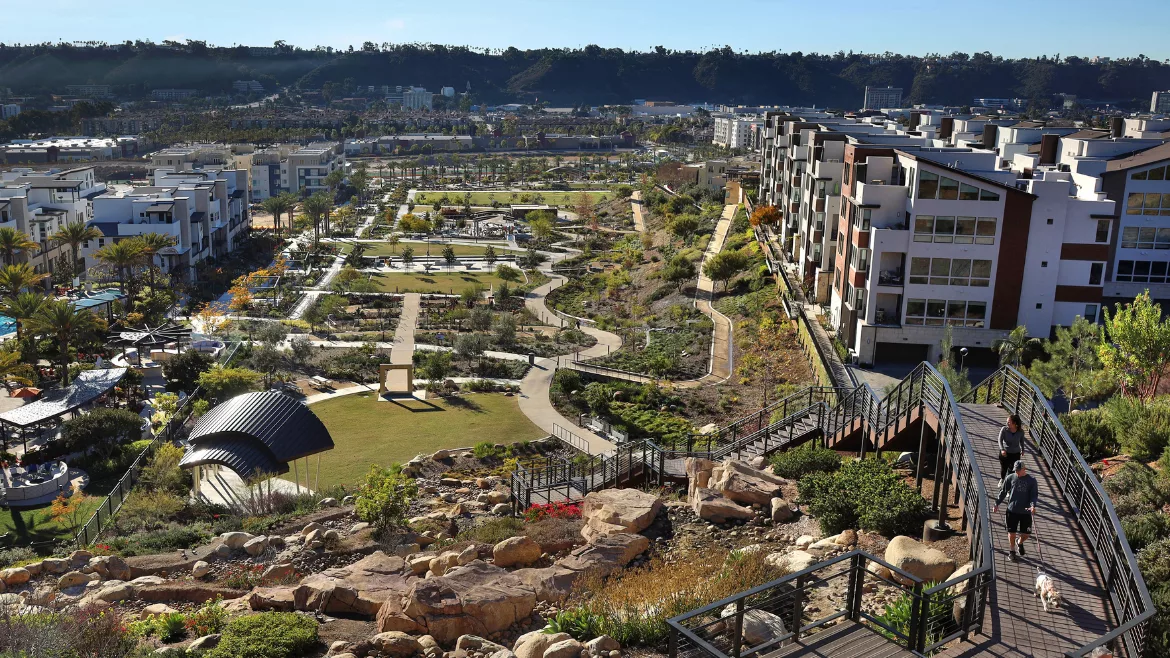
Instead of flattening the steep topography of the former quarry, the master plan works with it. Slopes were transformed into terraced streetscapes, multi-level parks, and elevated overlooks. This topographic choreography enhances walkability, encourages airflow and shading, and brings spatial richness to the community experience.
Across the U.S., cities are grappling with escalating temperatures, the urban heat island effect, and the challenge of designing communities that can adapt to climate change while remaining livable and welcoming. In San Diego’s Mission Valley, Civita demonstrates how natural cooling strategies, ecological restoration, and human-scaled planning can converge to transform a challenging site into a thriving, climate-resilient neighborhood.
Once a 230-acre sand and gravel quarry known as Quarry Falls, the area is now home to a master-planned community led by Sudberry Properties, with Carrier Johnson + Culture as Design Architect and Architect of Record. Guided by a culture-focused design approach, the team envisioned Civita as more than housing; it’s a living model for how walkability, open space, and green infrastructure can help mitigate heat, restore ecosystems, and improve quality of life.
The Green Spine: Connecting Ecology and Community
From the outset, the design team recognized Civita as an opportunity to work with the land, not against it. Rather than flatten the steep topography of the former quarry, the master plan turns gradients into terraced streetscapes, multi-level parks, and elevated overlooks. These moves do more than create visual interest; they also facilitate airflow, maximize shade potential, and create microclimates that naturally cool public spaces.
A defining feature of Civita is its central green spine, a landscaped corridor that links the elevated mesa with the San Diego River Valley. Serving as both a pedestrian route and an ecological connector, the spine threads together neighborhoods, open spaces, and natural systems. Native and climate-appropriate plantings line the corridor, along with bioswales and permeable surfaces that manage stormwater while restoring local habitat. These elements support biodiversity and microclimate balance. At the same time, shaded paths, seating, and intuitive wayfinding encourage walking and active use throughout the day.
By integrating green infrastructure into the daily flow of life, Civita creates a seamless blend of natural and urban systems. This approach strengthens identity while helping reduce car dependency and environmental impact.
 The pedestrian tunnel that passes under Via Alta. Image courtesy of Carrier Johnson + Culture.
Civita Park: Public Realm as Climate Asset
At the centerpiece of the development is Civita Park, a 14-acre public space that has become one of Mission Valley’s most valued community assets. Designed in partnership with Schmidt Design Group, the park serves as both a civic landmark and a day-to-day amenity for residents. Beyond its social and recreational functions, the park plays a significant role in microclimate regulation. Open lawns are balanced by tree canopies, regional vegetation, and shaded seating areas, creating diverse thermal zones. Cooling pockets and multisensory elements help create an immersive and restorative environment.
Its programming also includes dog parks, playgrounds, and trails. Each element is designed to be accessible, inclusive, and comfortable, with an emphasis on regional vegetation and sustainable maintenance. For many, the park has become a place to gather, reflect, and recharge.
Walkable, Human-Scaled, and Transit-Connected
Walkability is embedded into Civita’s DNA. From wide sidewalks and tree-lined streets to retail clusters and public transit connections, every design decision supports both health and ecological resilience. Homes are situated within easy reach of daily needs, and a dedicated shuttle connects the neighborhood to San Diego’s trolley system.
This human-scaled layout fosters healthier lifestyles, stronger social ties, and a deeper sense of place. The thoughtful arrangement of streetscapes, shaded rest points, and public plazas makes mobility not only possible but enjoyable. Reducing car dependency has brought measurable benefits: fewer vehicle trips mean cleaner air and noticeably reduced noise, creating a calmer, more pleasant environment. Streets also feel safer for children, seniors, and cyclists, encouraging outdoor activity and strengthening social bonds. Meanwhile, retail and community hubs have seen increased foot traffic, reinforcing both connection and economic vitality.
Together, these shifts demonstrate how walkable, transit-oriented planning can directly improve public health, comfort, and quality of life.
Redeveloping a Quarry: Challenges and Opportunities
The transformation of a former quarry into a thriving neighborhood came with complex challenges. Steep grades, site contamination, and a lack of existing infrastructure required inventive solutions and a long-term commitment to adaptive reuse.
Rather than erase the site’s industrial history, the design team chose to reinterpret and honor it. Elements of the past are reimagined in public art, material choices, and site features, allowing memory to coexist with modern life. This approach cultivated a sense of authenticity and connection within the social fabric.
At the same time, Civita’s redevelopment served as a platform to test scalable strategies for climate resilience. Integrated stormwater systems, native planting palettes, and compact land use exemplify how infill sites can evolve into ecologically sensitive, highly livable communities. These strategies have been reinforced through performance monitoring: stormwater systems reduce runoff and flooding during heavy rains while replenishing groundwater supplies; native, climate-appropriate plantings improve biodiversity by attracting pollinators and bird species while requiring less irrigation and maintenance; and compact land use creates shaded, walkable streets that retain less heat, lowering ambient temperatures by several degrees compared to surrounding developed areas. These design moves collectively show that resilience can be both measurable and replicable.
Key Takeaways for Future Master Plans
Civita offers meaningful lessons for planners, designers, and developers working to build future-ready communities:
- Work with the land: Leverage existing topography to enhance airflow, shading, and drainage while reducing grading impacts.
- Design for people first: Walkable street networks, shaded paths, and easy access to transit improve livability while reducing heat-retaining pavement.
- Celebrate place and memory: Honor site history to create identity and encourage long-term community stewardship.
- Embed green infrastructure: Treat bioswales, permeable pavements, and tree canopy as essential infrastructure. To remain effective, these systems require ongoing stewardship, but with clear maintenance protocols, they can be sustained at relatively low cost. Choosing resilient, low-maintenance plant species reduces water use and ensures year-round performance with minimal intervention. Partnering with local agencies and community groups has also proven critical to ensuring upkeep while fostering civic pride. These lessons highlight that climate-responsive infrastructure must be supported by equally resilient management strategies to deliver lasting results.
Looking Ahead
If Civita were envisioned today, new technologies and refined climate strategies would further strengthen the project. Solar integration, regenerative landscapes, and expanded habitat corridors might be layered into the existing framework. But core values like restoring land, honoring place, and enhancing human experience remain just as relevant.
By aligning ecological performance with cultural awareness and high-quality urban living, Civita stands as a compelling model for future infill development. By turning a site of extraction into a place of life, connection, and possibility, its legacy is one of reinvention.
Where the land once bore the weight of industry, it now supports homes, parks, and trails that nurture community and celebrate the San Diego landscape. Civita is not only a neighborhood but a vision for how cities can grow with intention, resilience, and a lasting sense of place.
Looking for a reprint of this article?
From high-res PDFs to custom plaques, order your copy today!
.webp?height=740&t=1767036885&width=auto "Header - BE 1170x658 (002).png")

.webp?height=740&t=1755781744&width=auto "KEE(2).png")