Sustainability Remains Hot Topic in Industry

The American Architectural Manufacturers Association (AAMA) heard from a number of speakers and presenters focused on green building topics and sustainability at the AAMA 80th Annual Conference in Phoenix, Feb. 12-15. Participants heard upcoming changes to California's Proposition 65, as well as an overview of Environmental Product Declarations (EPDs), the importance of sustainable cities and the manufacturer's role in reaching consumers.
Prop 65 Regulations and Amendments
John Nolan of the Gary Law Group spoke about California Prop 65 and the changes expected in 2018. Prop 65 covers the warning for certain chemicals that the state has deemed potentially harmful, calling for specific labeling to warn consumers. However, some of the warning language and Prop 65  definitions will change before a revised version goes into effect Aug. 30, 2018.
"Clearer information is needed," said Nolan. "The existing language is perhaps not as clear as it should be, and the existing regulations have not been amended in 25 years."
Additionally, Nolan said, there's a need for assisting non-English speakers in California.
Prop 65 is not a ban on certain chemicals, and it's not a criminal statute. It's enforced through civil court proceedings. The Office of Environmental Health Hazard Assessment (OEHHA) is the state entity responsible for its implementation. The state is required to publish list of chemicals "known to the state of California to cause cancer or reproductive toxicity." It's now up to around 900 chemicals, and the list is updated yearly, said Nolan.
"If a warning is needed, it must be clear and reasonable, per Section 25601 of the Act. The warning must be prominently placed on a product's label. Warnings will say, in the future, that a person 'can be exposed' to a listed chemical," according to Nolan.
He also reiterated that the names of one or more listed chemicals must be included in the warning, plus a link to a website maintained by OEHHA. On the label, the word "WARNING" must be in all caps and bold. The language must comply with Prop 65 wording, and the traditional yellow, triangular warning sign must be included on the label.
"What is your anticipated contact with the state of California?" asked Nolan. "This is something to consider. Know your distribution."
Business Value of EPDs
Vik Ahuja, a life cycle assessment consultant for thinkstep, presented "Why, How and Business Value of LCA and EPDs."
 Ahuja went over the acronyms: Product Category Rules (PCR), Life Cycle Assessment (LCA) and Environmental Product Declarations (EPDs).
"The LCA part takes about 80 percent of your project's time," said Ahuja, "because analysis takes time."
The PCR is the guideline, and you must have a PCR before you do an EPD, said Ahuja.
"For residential products group, the PCR is the linchpin. You need the PCR to plot your path forward with the LCA and EPD," he said.
Ahuja encouraged the use of products and materials for which verified life cycle information is available.
"Use at least 20 different permanently installed products sourced from at least five different manufacturers that have a product-specific LCA, an industry-average EPD and a product-specific EPD," he said.
According to Ahuja, an EPD can be done by a single manufacturer (product spec) or an entire industry. The budget for a product specification could be between $40,000 and $50,000, and the budget for an industry-wide project could be between $80,000 and $100,000, with the timeline ranging between one and eight months.
When asked why manufacturers or the industry should go down this road, Ahuja replied, "There's demand. Owners are driving requirements for buildings, including LEED accreditation and energy efficiency."
Windows in Future Buildings
Stephen Selkowitz, representing the Lawrence Berkeley National Laboratory, presented "Windows in Future Buildings: Smart, Adaptive Solutions for Sustainable Cities."
 "We need to be transforming the building industry," advised Selkowitz. "A grain of sand starts as an irritant and winds up being a pearl."
"Buildings consume 40 percent of total U.S. energy, and $500 per household is spent for window energy use each year. Windows, of course, don't consume energy, but they impact energy use when it comes to heating, cooling and lighting," said Selkowitz. "Making a better window increases occupant benefits like view, comfort and health. Plus, you'll increase real estate market value."
However, he offered a reality check regarding guaranteeing building performance to building owners. "Low energy buildings do not consistently perform as expected, and results will vary." Still, Selkowitz had a suggestion for where to start for good results.
"We're putting our money on thin lightweight triple, a thin float glass with two low-e coatings and a krypton glass fill," he said. "Krypton is one-third of the cost it was a couple years ago."
He added that, at the end of the day, occupant satisfaction is crucial.
"People really care about the role daylight plays in spaces, and windows and skylights have a large part in that," Selkowitz concluded.
Manufacturer's Perspective on Sustainability
Amanda Provenzano, sustainability and interior door certification manager at JELD-WEN, rounded out the list of green building and sustainability speakers with some advice.
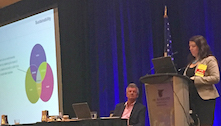 "Sustainability is a responsibility that also meets the needs of our customers," said Provenzano.
Sustainable design is important because it reduces waste stream and cuts costs, and it creates Millennial brand loyalty. There's also market demand for it – 81 percent of consumers say they will make personal sacrifices to address social and environmental issues.
"Millennials are willing to talk to friends and on social media about whether or not brands are sustainable," said Provenzano. "They're also willing to boycott ones that aren't."
In terms of the workforce, Millennials also care about working for companies with a strong environmental commitment and company culture. Some responsible leaders include Amazon, Interface, Lowe's and Nike, said Provenzano.
The manufacturer's role in sustainability is to address customers' concerns via certifications and to listen to those customers. Sustainability is attainable, said Provenzano. "Companies are already doing some of the process flow. For example, you already have waste management."
"Studies show that profit increases when companies prioritize sustainability," concluded Provenzano. "Realize your financial growth."
More information about AAMA and its activities can be found via the AAMA website, http://www.aamanet.org.
Looking for a reprint of this article?
From high-res PDFs to custom plaques, order your copy today!
.webp?height=740&t=1767036885&width=auto "Header - BE 1170x658 (002).png")

.webp?height=740&t=1755781744&width=auto "KEE(2).png")