Building Enclosure logo
search
cart
facebook twitter linkedin youtube instagram Spotify Podcasts Apple Podcasts Spotify Podcasts Apple Podcasts
  • Sign In
  • Create Account
  • Sign Out
  • My Account
Building Enclosure logo
  • NEWS
    • Breaking News
  • SECTIONS
    • Columns
    • Project Profiles
    • Trade Shows
    • Sponsor Insights
  • SYSTEM DESIGNS
    • Low-Slope Roofs
    • Pitched Roofs
    • Metal Roofing Materials
    • Waterproofing
    • Sustainability
    • Insulation
    • Exterior Claddings
    • Wall Systems
    • Building Envelope
  • BLOG
    • The BE Blog
  • MEDIA
    • Podcasts
    • Webinars
    • Quiz
    • Videos
    • Polls
    • Interactive Spotlights
    • Newsletter
    • Photo Galleries
  • DIRECTORIES
    • Directory: Blue Book
    • Directory: Roofing Resource
  • PRODUCTS
  • TECHNICAL
    • Codes
      • Waterproofing
      • Roofing
    • Details
      • Waterproofing
      • Roofing
  • CONTINUING ED
  • ABOUT
    • Advertise
      • Editorial Calendar
    • Contact
    • eMag Archive Issues
  • SIGN UP!
Project Profiles

Campus Designed as New Multi-Faceted Complex
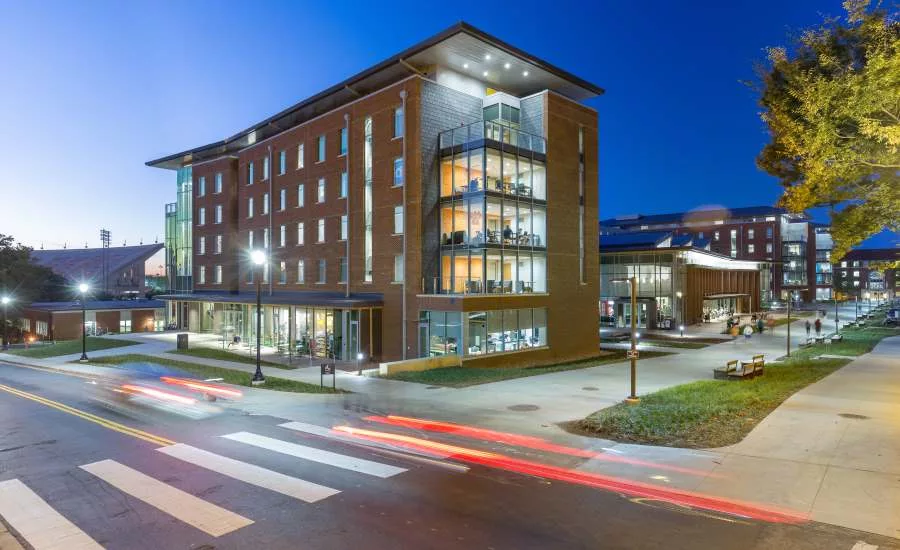
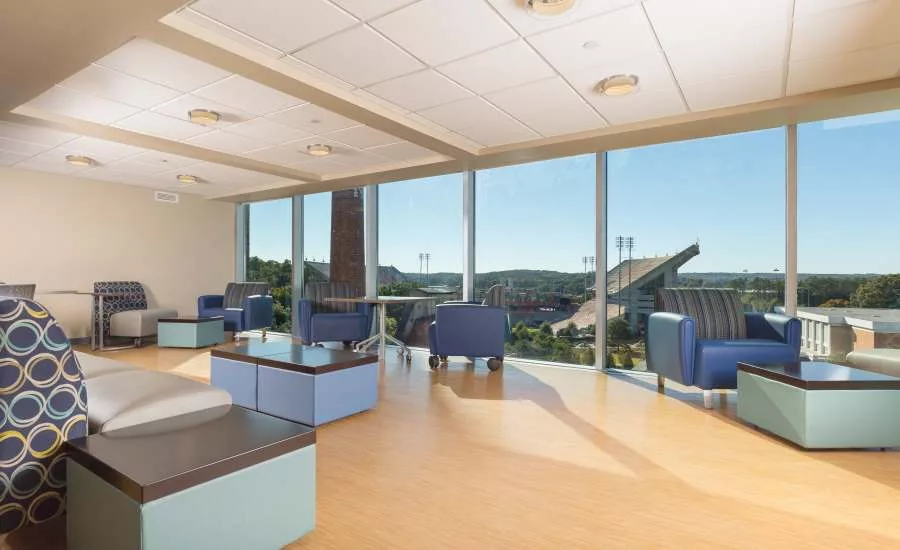
Clemson Univ
Photo courtesy of Flashnick Visuals LLC.
Clemson Univ2
Photo courtesy of Flashnick Visuals LLC.
Clemson Univ3
Photo courtesy of Flashnick Visuals LLC.
Clemson Univ
Clemson Univ2
Clemson Univ3
December 28, 2016

Stevens & Wilkinson, a full-service architecture, engineering and interior design firm based in Atlanta and Columbia, S.C., recently completed site planning, architectural, and engineering design for Clemson University’s new Core Campus Housing and Dining precinct improvements. Completion of the facilities marked the first step in Clemson University’s redevelopment of its core campus, as envisioned in the university’s 2002 masterplan. The Core Campus’s new construction is a progressive approach to residential housing, dining venues and academic space that has created an interactive, living-learning community.

Comprised of nearly 286,000 square-feet, with an estimated construction cost of $83,000,000, this project will help meet the growing demands for contemporary housing and dining options. The facility supports Clemson University’s goal of retaining more sophomore students on campus. As one of the nation’s top-20 public universities, the new precinct will also enable the demolition and redevelopment of the school’s Harcombe Dining Hall and Student Union in subsequent phases.

Located on the site of the former Johnstone Residence Hall, the new Core Campus complex was conceptualized as an integrated mega-structure that serves to anchor the precinct on campus. The complex now provides 700 student beds and 1,200 seats of dining, and is the new home to the Calhoun Honors College and associated academic spaces.

“Beyond square footage and new construction, the project aspires to much more, including the design and development of quality campus life for students and new forms of housing that support the university’s desire for a multi-purpose, mixed-use center of living and learning,” said Ashby Gressette, AIA and president of Stevens & Wilkinson, South Carolina.

Primary goals for the project included capturing the best of the “Clemson experience”; advanced coordination of future projects outlined in the Campus Masterplan; creating a facility to enable recruitment and retention of students; and achieving LEED Silver Certification. The latter is currently pending final review with the United States Green Building Council. 

The new dining facilities offer a wide array of choices across 300 seats of retail dining and 900 seats of residential dining in a modern capacity. Retail venues with extended hours; a delicatessen and grill; national coffee and chicken sandwich chains; and a convenience store provide flexible options.

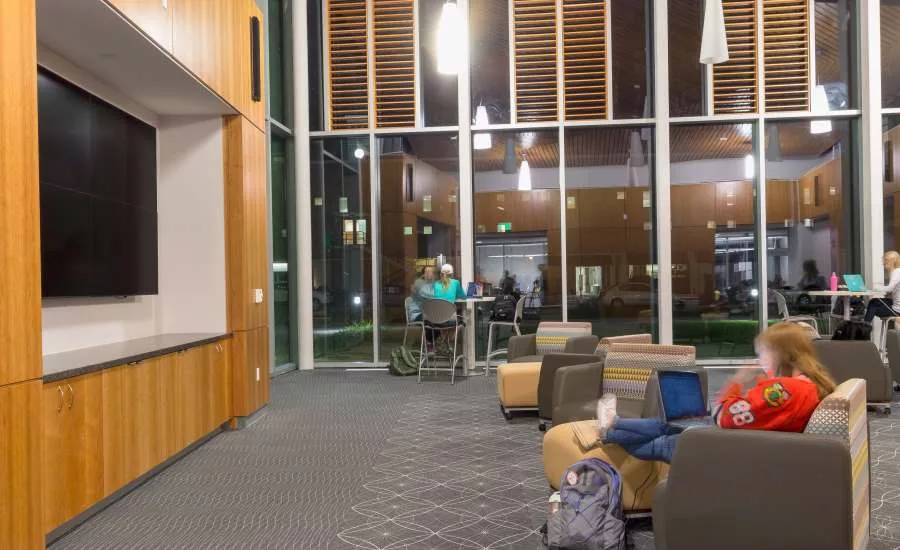
“The character of the new, high-end facility offers a variety of seating areas separated by custom millwork-style seating and partition screens,” says Gressette. “Each retail dining venue has its own unique character and finishes that have been tied into the overall aesthetic of the facility.”

The dining complex has three levels, including a lower service level, main dining level, and a relaxed dining mezzanine, all of which are connected by a centrally located main circulation core.

The Stevens & Wilkinson project team designed the new housing spaces to provide numerous residential unit types and community options for students, furthering the university’s plan for student growth and on-campus retention.

At the north end of the site, two 7-story residence halls of 244 and 178 beds comprise the Calhoun Honors College, with academic assembly and administrative space on the first floor arranged around a raised courtyard. Common lounges connected by open stairs enhance the idea of community in close proximity to student accommodations of double and single semi-suites with semi-private baths. To the south, a 265-bed residence hall provides double occupancy rooms with common private baths.

This housing design aids the college in its student recruitment for a National Scholars Program and the continued retention of students living on campus following their first year.

Newly implemented site planning and landscape architecture created flexible and high-quality, open spaces for easy connectivity to and from central campus buildings. This began by creating the popular Clemson Walk pedestrian spine, which now acts as a key unifying space for the entire precinct.

“The 20-foot-wide walk features integrally colored concrete paving and is framed by an allée of trees and LED lighting elements,” says Gressette. “Pairs of bench elements are arranged along the walk, and the new housing, dining, and honors college are accessed from this path.”

To the west, Clemson Walk opens into a series of courtyards, providing access to the buildings. The courtyards provide lawn space, deciduous canopies of trees, and areas of concrete paver units for activities. These spaces were also created for public art selected via a national competition.

Due to previous development, the site was formerly crossed by most major campus utility services, including steam, chilled water, power, telecommunications, storm and sanitary sewers, which were strategically relocated by the team to make way for the project.


Project Details in Brief

  • Overall Square Footage: 286,000 Gross Square Feet (GSF)
  • Dining: 81,000 GSF
  • Housing: 184,000 GSF
  • Academics: 21,000 GSF
  • Occupancy Date: 2016 Fall Semester
  • LEED (Silver certification details to be announced and provided upon confirmation)


Collaborative Project Team Members

  • RMS Architecture - Construction Observation
  • VMDO - Housing Design Team
  • SASAKI - Dining Hall Design Team
  • Ricca Design Studios - Food Service Consultant
  • Cromer Engineering - Fire Protection
  • Newcomb & Boyd - Lighting, AV, Acoustical
  • Merrick/Energy - Ace LEED Consultant
KEYWORDS: architecture firms LEED

Share This Story

Looking for a reprint of this article?
From high-res PDFs to custom plaques, order your copy today!


Recommended Content

JOIN TODAY
to unlock your recommendations.

Already have an account? Sign In

  • bar graph shows LEED v4/LEED v5/LEED v6 in various colors

    When Will LEED v4 / v4.1 and LEED v5 Expire?

    The latest version of the LEED rating system, LEED v5, is...
    Sustainability
    By: Daniel Overbey
  • Celebrating Women In AEC-2026

    Celebrating Women in The AEC Industry Part 1

    A round-up of women in the design, engineering and...
    Building Envelope
    By: Lindsay Lewis
  • KEE membrane application on a roof

    A Beginner’s Guide to Single-Ply Roofing Membranes

    While PVC and TPO appear extremely similar, the chemistry...
    Low-Slope Roofs
    By: Peter Gross
Manage My Account
  • Sign up for the Newsletter
  • Online Registration
  • Manage My Preferences
  • Registration Customer Service

More Videos

Sponsored Content

Sponsored Content is a special paid section where industry companies provide high quality, objective, non-commercial content around topics of interest to the Building Enclosure audience. All Sponsored Content is supplied by the advertising company and any opinions expressed in this article are those of the author and not necessarily reflect the views of Building Enclosure or its parent company, BNP Media. Interested in participating in our Sponsored Content section? Contact your local rep!

close
  • 2 construction workers and a DEXcell panel
    Sponsored byDEXcell Roof Boards

    Designing Low-Slope Roofs for Resilience

  • Bell Bank headquarters in Fargo, North Dakota
    Sponsored bySto Corp.

    Drained and Back-Ventilated Rainscreens vs Pressurized-Equalized Rainscreens

  • A construction worker using DEXcell roof boards
    Sponsored byDEXcell Roof Boards

    The Hidden Strength of Low-Slope Roof Systems: Why Roof Cover Boards Matter

Popular Stories

construction industry workers in hard hats stand around a city scape

Construction Industry Revolts Over New CSI Licensing Plan

a man wearing a mask installs insulation into a wall system

Quiet Rooms and Healthier Air: A Second Look at What Goes Inside the Wall Cavity

Canalino Elementary School and Canalino Family School exterior

Daylighting Design to Support Rapidly Growing Trend in Modular Building Construction

Building Enclosure Newsletter

BE Poll

Events

June 17, 2025

Addressing Condensation in Low-Slope Roof Assemblies

Credits: 1 AIA LU/HSW; 0.1 ICC CEU; 1 IIBEC CEH; 0.1 IACET CEU

On Demand In modern roofing systems, vapor retarders and air barriers do more than just minimize air leakage—they’re essential to maximizing performance and longevity. This engaging course dives into the next generation of moisture control: permeable vapor retarders and air barriers. Discover how these cutting-edge technologies are transforming low-slope roofing assemblies by improving energy efficiency, managing moisture, and boosting wind uplift resistance.

April 9, 2026

Strategies for High-Performance Below-Grade Waterproofing

Credits: 1 AIA LU/HSW ; 1 IIBEC CEH; 0.1 IACET CEU

On-Demand Designing a high-performance building enclosure requires more than just surface-level protection; it demands a rigorous, performance-based mastery of below-grade water and gas mitigation. This discussion will provide an expert-level analysis of below-grade waterproofing within the comprehensive framework of the high-performance building enclosure.

View All Submit An Event

Products

Plaster and Drywall Assemblies Manual

Plaster and Drywall Assemblies Manual

This is a comprehensive manual that goes beyond codes and standards, providing expert guidance in design, detailing, material selection and troubleshooting for plaster and drywall.

See More Products

Related Articles

  • Hayward_KS_213022_N123_medium.jpg

    Track and Field Facility Designed as 'Finest in the World'

    See More
  • student housing in Downtown Berkeley, California

    Reinventing Berkeley Building as New Student Housing

    See More
  • Neil Dawson

    Neil Dawson Announced as New AIA Georgia President-Elect

    See More

Related Products

See More Products
  • bni book

    BNi Building News Facilities Manager's Costbook 2026 (Print Edition)

See More Products
×

Enhance your expertise with unparalleled insights.

Join thousands of building professionals today. Shouldn’t you know what they know?

SUBSCRIBE TODAY!
  • RESOURCES
    • Advertise
    • Contact Us
    • Store
    • Want More
  • SIGN UP TODAY
    • Create Account
    • Newsletter
    • Customer Service
    • Manage Preferences
  • SERVICES
    • Marketing Services
    • Reprints
    • Market Research
    • List Rental
    • Survey/Respondent Access
  • STAY CONNECTED
    • LinkedIn
    • Facebook
    • Instagram
    • YouTube
    • X
  • PRIVACY
    • PRIVACY POLICY
    • TERMS & CONDITIONS
    • DO NOT SELL MY PERSONAL INFORMATION
    • PRIVACY REQUEST
    • ACCESSIBILITY

Copyright ©2026. All Rights Reserved BNP Media, Inc. and BNP Media II, LLC.

Design, CMS, Hosting & Web Development :: ePublishing