Preventing Trouble in Paradise
The undulating profile of the Marco Polo Condominiums has been a fixture on the skyline of Honolulu since 1971. But even though the building still looks striking after 40 years, there was trouble in paradise - in the form of a leaky roof.
The undulating profile of the Marco Polo Condominiums has been a fixture on the skyline of Honolulu since 1971. But even though the building still looks striking after 40 years, there was trouble in paradise - in the form of a leaky roof. The existing roof had its share of problems, including asbestos and numerous penetrations that had popped up over the last four decades. Charlie Beeck Jr., the president of Tropical Roofing and Raingutters Inc. in Honolulu, knew that the job could be handled smoothly if the right system were specified.
 Tropical Roofing and Raingutters does all types of roofing, including fiberglass shingles, modified bitumen, built-up, wood shake, all types of tile, and elastomeric roof coatings. They also do a great deal of metal work, including standing seam roofs in copper, aluminum, and Zincalume®. The company also has its own gutter division and a sheet metal division that produces roof panels, flashings and valley metal, which are manufactured for other contractors as well as their own needs. “We’re pretty diversified,” said Beeck, who is also a member of the Western States Roofing Contractors Association and the current president of the Roofing Contractors Association of Hawaii.
Beeck moved to Hawaii in 1977 and entered the roofing industry almost by default. “It’s kind of a funny story,” he said. “I sold solar water heating door-to-door to homeowners. They’d say, ‘I can’t afford solar - I need a new roof.” I asked one guy, ‘If I could get you a new roof and a solar system at the right price, would you buy them both?’ He said yes and did, and I got two commissions.”
 Beeck sold both roofing and solar systems until 1985, when the solar tax credits ran out. Then he completed the transition into roofing and eventually opened his own business. He was asked to bid on the re-roofing project at the Marco Polo Condominiums and got the job. “It’s the largest condo complex in the state and a very well-known, high-profile building,” Beeck said. “The existing roof was the original roof from when they built it 40 years ago. It was an old bitumen roof over lightweight concrete. Plus, there was asbestos involved.”
The presence of asbestos meant a licensed abatement company had to handle its removal. “An abatement company removed the old roof due to the asbestos, and we followed behind them and dried it in,” Beeck said.
There were also numerous penetrations, which Beeck acknowledged were the toughest part of the project. “There’s more equipment up there than anyone can imagine,” he said. “Air conditioners, air handlers, vents - it was jam-packed with equipment.”
The new system specified included membranes from Polyglass USA, Inc., beginning with its Elastoflex® SA V FR base sheet. Polytherm® 3.1-inch iso insulation board was adhered with Dow InstaStik adhesive to achieve an R value of 19. Half-inch Securock served as the cover board, while quarter-inch DensDeck Prime was used on the vertical curbs. The system was then topped with one ply of Polyglass’ Elastoflex SA V FR base, a self-adhered, SBS modified bitumen base sheet that features patented ADESO® Dual Compound Technology. Polyflex® G FR, a polyester-reinforced, APP mod bit granulated cap sheet, was then torch-applied to finish the job. It is available in ten colors, and white was chosen for this project.
“Because of all the penetrations, this system was a very good choice,” Beeck said. “It was easy to flash. It’s a very flexible product and it was easy to move around penetrations. It works very well around corners, up walls, in situations like that.”
The self-adhered base sheet also saves time, Beeck noted. “It goes pretty fast as long as you’ve got it lined up right.”
Luckily Beeck and his crews are used to working in those conditions. “It rains almost every night, and you have to get it dried off before you can get to work,” he said. “We used blowers to speed the drying process. The Hawaii hot sun also helps a lot.”
 Now that the project is complete, Beeck looks back at it with pride. “I think after we were finished, and the dust settled, for a job of that size and that level of difficulty, it went very well,” he said. “The resident manager wrote us a nice thank-you letter and told us we did a nice job. Those are always nice to get.”
The increased insulation and the reflectivity of the roof surface will also help reduce the building’s utility bills, noted Beeck. “It will definitely be cooler, and they’ll save on air conditioning costs.”
Beeck expressed thanks to his Polyglass representative, Howard Meechan, RRO, for his help with the project. “We work with Polyglass a lot, and Howard Meechan is very knowledgeable about the roofing industry. He did all the inspections and had all the specifications written so we could give them a 20-year warranty.”
“I’m very happy we went with Polyglass,” he concluded. “The boys work with it well and they like it. It was the correct product for the job.”
For more information about Polyglass, visit www.polyglass.com. For more information about Tropical Roofing and Raingutters Inc., visit www.tropicalroofingandraingutters.com.
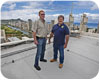
Charlie Beeck Jr. (left), president of Tropical Roofing and Raingutters Inc., checks out the completed project along with Howard Meechan of Polyglass.
The undulating profile of the Marco Polo Condominiums has been a fixture on the skyline of Honolulu since 1971. But even though the building still looks striking after 40 years, there was trouble in paradise - in the form of a leaky roof. The existing roof had its share of problems, including asbestos and numerous penetrations that had popped up over the last four decades. Charlie Beeck Jr., the president of Tropical Roofing and Raingutters Inc. in Honolulu, knew that the job could be handled smoothly if the right system were specified.
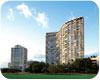
The Marco Polo Condominium building is has been Honolulu landmark since it was built in 1971. (Photos courtesy of Polyglass USA, Inc.)
Beeck moved to Hawaii in 1977 and entered the roofing industry almost by default. “It’s kind of a funny story,” he said. “I sold solar water heating door-to-door to homeowners. They’d say, ‘I can’t afford solar - I need a new roof.” I asked one guy, ‘If I could get you a new roof and a solar system at the right price, would you buy them both?’ He said yes and did, and I got two commissions.”
The presence of asbestos meant a licensed abatement company had to handle its removal. “An abatement company removed the old roof due to the asbestos, and we followed behind them and dried it in,” Beeck said.
The Roof System
Challenges on the 300-square project included limited roof access. A crane could not be used to load the roof, so getting material up to the roof was a chore. “Everything had to be taken up the elevator and then up one flight of stairs,” said Beeck. “It was very labor intensive. We brought material up every day.”There were also numerous penetrations, which Beeck acknowledged were the toughest part of the project. “There’s more equipment up there than anyone can imagine,” he said. “Air conditioners, air handlers, vents - it was jam-packed with equipment.”
The new system specified included membranes from Polyglass USA, Inc., beginning with its Elastoflex® SA V FR base sheet. Polytherm® 3.1-inch iso insulation board was adhered with Dow InstaStik adhesive to achieve an R value of 19. Half-inch Securock served as the cover board, while quarter-inch DensDeck Prime was used on the vertical curbs. The system was then topped with one ply of Polyglass’ Elastoflex SA V FR base, a self-adhered, SBS modified bitumen base sheet that features patented ADESO® Dual Compound Technology. Polyflex® G FR, a polyester-reinforced, APP mod bit granulated cap sheet, was then torch-applied to finish the job. It is available in ten colors, and white was chosen for this project.
“Because of all the penetrations, this system was a very good choice,” Beeck said. “It was easy to flash. It’s a very flexible product and it was easy to move around penetrations. It works very well around corners, up walls, in situations like that.”
The self-adhered base sheet also saves time, Beeck noted. “It goes pretty fast as long as you’ve got it lined up right.”
Watching the Skies
Work spanned the month of February, which can mean rough weather, even in Hawaii. “Of course, safety is the biggest concern on every job, but the building lies in a little rain belt, so the weather was also a concern,” Beeck said. “We did this job over the winter, which is our rainy time of the year. We had strong winds and a lot of rain. We watched the weather reports in order to set up the schedule. We got on the computer every day to check it out.”Luckily Beeck and his crews are used to working in those conditions. “It rains almost every night, and you have to get it dried off before you can get to work,” he said. “We used blowers to speed the drying process. The Hawaii hot sun also helps a lot.”
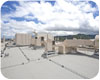
The system specified included Polyglass’ Elastoflex SA V FR base sheet, Polytherm insulation board, and half-inch Securock. The system was topped with one ply of Polyglass’ Elastoflex SA V FR base and a white Polyflex G FR cap sheet.
The increased insulation and the reflectivity of the roof surface will also help reduce the building’s utility bills, noted Beeck. “It will definitely be cooler, and they’ll save on air conditioning costs.”
Beeck expressed thanks to his Polyglass representative, Howard Meechan, RRO, for his help with the project. “We work with Polyglass a lot, and Howard Meechan is very knowledgeable about the roofing industry. He did all the inspections and had all the specifications written so we could give them a 20-year warranty.”
“I’m very happy we went with Polyglass,” he concluded. “The boys work with it well and they like it. It was the correct product for the job.”
For more information about Polyglass, visit www.polyglass.com. For more information about Tropical Roofing and Raingutters Inc., visit www.tropicalroofingandraingutters.com.
Looking for a reprint of this article?
From high-res PDFs to custom plaques, order your copy today!
.webp?height=740&t=1767036885&width=auto "Header - BE 1170x658 (002).png")

.webp?height=740&t=1755781744&width=auto "KEE(2).png")
.webp?height=200&t=1769446143&width=200 "FGIA(14).png")


