Building Enclosure logo
search
cart
facebook twitter linkedin youtube instagram Spotify Podcasts Apple Podcasts Spotify Podcasts Apple Podcasts
  • Sign In
  • Create Account
  • Sign Out
  • My Account
Building Enclosure logo
  • NEWS
    • Breaking News
  • SECTIONS
    • Columns
    • Project Profiles
    • Trade Shows
    • Sponsor Insights
  • SYSTEM DESIGNS
    • Low-Slope Roofs
    • Pitched Roofs
    • Metal Roofing Materials
    • Waterproofing
    • Sustainability
    • Insulation
    • Exterior Claddings
    • Wall Systems
    • Building Envelope
  • BLOG
    • The BE Blog
  • MEDIA
    • Podcasts
    • Webinars
    • Quiz
    • Videos
    • Polls
    • Interactive Spotlights
    • Newsletter
    • Photo Galleries
  • DIRECTORIES
    • Directory: Blue Book
    • Directory: Roofing Resource
  • PRODUCTS
  • TECHNICAL
    • Codes
      • Waterproofing
      • Roofing
    • Details
      • Waterproofing
      • Roofing
  • CONTINUING ED
  • ABOUT
    • Advertise
      • Editorial Calendar
    • Contact
    • eMag Archive Issues
  • SIGN UP!
Columns

Best Practices: Attachment of Asphalt Shingles in High-Velocity Wind Zones
By Alvaro Mejia
June 10, 2008
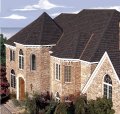
The recent increase in storm frequency and the number of high-velocity wind events throughout the United States is prompting changes in the roofing industry. (Photo courtesy of GAF-ELK.)


Mistake: Improper shingle nailing. Problem: Potential for roof blow-off. Proper design: Install the proper amount of shingles required by the manufacturer in the specific geographic wind zone. Most three-tab shingles require four nails in typical applications and six nails in high-velocity wind zones. The placement of the nails is as important as the number of nails. Place nails in the manufacturer’s required placement areas. Most dimensional shingle manufacturers now provide shingle placement zones. Nails should be driven straight into the deck; avoid nailing from an angle. Nails should penetrate through the deck a minimum of 3⁄4 of an inch. Standard roofing nails have barbed shanks and are typically 11- or 12-gauge nails with 3⁄8-inch to 7⁄16-inch diameter heads.
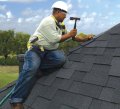
The nails applied at the starter strip should be a maximum of 1⁄2 inch from the edge of the sheathing. (Photo courtesy of GAF-ELK.)

The recent increase in storm frequency and the number of high-velocity wind events throughout the United States is prompting changes in the roofing industry. While last year was relatively mild, attachment procedures for all roof systems - steep slope and low slope - are being scrutinized in the wake of the damaging hurricanes of the previous few years, and code changes are imminent. Stringent building codes and tightened regulations were enacted in South Florida after Hurricane Andrew in 1992, and the severe weather events of 2004 and 2005 are the driving force behind other proposed code changes.

Some codes have already been altered to reflect the need for increased attachment methods. In 2004, the International Building Code enacted new high-wind performance standards for asphalt shingles. The standards, published in the 2004 IBC Supplement, provide attachment criteria for asphalt shingles in high-velocity wind zones where wind speeds reach up to 150 mph. The new asphalt shingle standards are based ANSI/UL2390-04, “Test Method for the Wind Resistance of Asphalt Shingles with Sealed Tabs,” and ASTM D6381, “Measurement of Asphalt Shingle Mechanical Uplift Resistance.” Adoption of these standards was reached through the promotion of the Asphalt Roofing Manufacturers Association (ARMA), which spent nearly 15 years assisting code officials, wind engineers and insurance companies with research and development of new test methods for asphalt shingle performance in high-wind situations.

The primary advantage of the code adoption is that designers, contractors, building owners and homeowners now have standards for proper asphalt shingle selection in high-velocity wind zones. It also provides code enforcement officials with guidelines for enforcement of material selection and application methods. Until this time, many code officials would not allow the use of asphalt shingles in high-velocity wind zones due to the fact that there were no wind-uplift resistance standards.
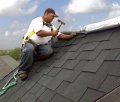
Most of the damage that occurs from high-velocity winds on steepslope shingle systems comes in the form of the loss of shingles or other roof covering components. (Photo courtesy of GAF-ELK.)

Attachment Guidelines

The roof deck sheathing should be manufactured of structural plywood or OSB board in the nominal thickness range of 7⁄16 to ⅝ inches. Nails should be used to secure the decking to the structural trusses. Acceptable nails for this securement procedure are 8d common nails (0.131 inches by 2.5 inches long), 10d box nails (0.128 inches by 3 inches long) or power-driven nails (0.113 inches by 2⅜ inches long). If the trusses are spaced 16 inches on center or less, then the decking should be fastened at a minimum rate of 6 inches on center. If the trusses are spaced 24 inches on center, then the decking should be fastened at a minimum rate of 4 inches on center. Truss spacing should be in compliance with local code requirements.

On remedial applications, the existing decking should be inspected to verify that the proper nailing pattern of the deck to the trusses or rafters is followed. If the existing nailing pattern is inadequate, then the addition of nails to meet the current requirements should be completed. Proper attachment of deck panels near roof edges and ridges is critical, as these areas are the most vulnerable to damage because wind forces are the highest at these locations.

Most of the damage that occurs from high-velocity winds on steep-slope shingle systems comes in the form of the loss of shingles or other roof covering components. In a majority of cases, damage is localized and it rarely results in structural damage. The major losses typically occur from moisture infiltration into the interior spaces, which results in damage to drywall, carpeting and furnishings. The interior damage can be limited - or avoided altogether - if a secure underlayment is applied between the structural decking and shingle coverings.

Steep slope underlayments are typically 15-pound or 30-pound fiberglass felts. The underlayment should be secured to the decking with capped-head nails or with metal disks applied under the roofing nails to improve the water-resistance capabilities of the underlayment. The fastening pattern should be determined using Factory Mutual or ASCE Standard wind-uplift calculations, which determine the wind-uplift pressure rating on the specific building. The wind-uplift calculation takes into account the basic wind speed in the geographical area, the ground surrounding the building and the roof uplift pressure at the field of the roof.

Code Changes

The most prominent change that the code enacts is in the area of shingle application methods. The code addresses application methods at the most critical points of steep-slope applications: shingle attachment in the field of the roof and at areas that are most vulnerable to wind damage, such as at ridges, eaves, hips and rakes. Shingle application should be completed by applying a six-nail pattern - not the traditional four nails - at each shingle. On three-tab shingles, the nails should be placed just below the self-sealing tar line and within the nailing zone provided on dimensional shingles. The shingles must be secured with approved nails such as 11⁄4-inch No. 12 wire gauge shank nails with a 3⁄4-inch diameter head.

The nails applied at the starter strip should be a maximum of 1⁄2 inch from the edge of the sheathing. At the ridges, one nail should be placed on each side of the shingle between the sealant and the exposed part of the shingle, 1 inch from the edge.

Share This Story

Looking for a reprint of this article?
From high-res PDFs to custom plaques, order your copy today!


Alvaro Mejia is an engineer specializing in building exterior and wind technology.

Recommended Content

JOIN TODAY
to unlock your recommendations.

Already have an account? Sign In

  • bar graph shows LEED v4/LEED v5/LEED v6 in various colors

    When Will LEED v4 / v4.1 and LEED v5 Expire?

    The latest version of the LEED rating system, LEED v5, is...
    Sustainability
    By: Daniel Overbey
  • Celebrating Women In AEC-2026

    Celebrating Women in The AEC Industry Part 1

    A round-up of women in the design, engineering and...
    Building Envelope
    By: Lindsay Lewis
  • KEE membrane application on a roof

    A Beginner’s Guide to Single-Ply Roofing Membranes

    While PVC and TPO appear extremely similar, the chemistry...
    Low-Slope Roofs
    By: Peter Gross
Manage My Account
  • Sign up for the Newsletter
  • Online Registration
  • Manage My Preferences
  • Registration Customer Service

More Videos

Sponsored Content

Sponsored Content is a special paid section where industry companies provide high quality, objective, non-commercial content around topics of interest to the Building Enclosure audience. All Sponsored Content is supplied by the advertising company and any opinions expressed in this article are those of the author and not necessarily reflect the views of Building Enclosure or its parent company, BNP Media. Interested in participating in our Sponsored Content section? Contact your local rep!

close
  • HITT Construction headquarters
    Sponsored byBuilding Composites® LLC

    Pushing the Envelope

  • 2 construction workers and a DEXcell panel
    Sponsored byDEXcell Roof Boards

    Designing Low-Slope Roofs for Resilience

  • Bell Bank headquarters in Fargo, North Dakota
    Sponsored bySto Corp.

    Drained and Back-Ventilated Rainscreens vs Pressurized-Equalized Rainscreens

Popular Stories

graphic shows white arrows pointing to the right on a light green background

A Breakdown of Air Leakage Testing in LEED v5 BD+C

graphic shows a building destoryed by tornados with information on the amount of torandos in 2026 in the US

Record-Breaking Tornado Activity in Illinois Signals New Challenges for Architects

HITT Construction headquarters

Pushing the Envelope

Building Enclosure Newsletter

BE Poll

Events

April 9, 2026

Strategies for High-Performance Below-Grade Waterproofing

Credits: 1 AIA LU/HSW ; 1 IIBEC CEH; 0.1 IACET CEU

On-Demand Designing a high-performance building enclosure requires more than just surface-level protection; it demands a rigorous, performance-based mastery of below-grade water and gas mitigation. This discussion will provide an expert-level analysis of below-grade waterproofing within the comprehensive framework of the high-performance building enclosure.

April 28, 2026

Roof Design Considerations That Prevent Installation Failures and Change Orders

Credit: 1 AIA LU/HSW; 1 IIBEC CEH; 0.1 ICC CEU

On-Demand This course provides visual examples of actual field conditions. Some good, some not so good; along with design suggestions that can cut installation costs and reduce construction change orders. Upon completion of this course, you will have a better understanding of the requirements the roofing contractor must meet to provide the specified roofing system warranty, and long-term value to the owner.

View All Submit An Event

Products

Plaster and Drywall Assemblies Manual

Plaster and Drywall Assemblies Manual

This is a comprehensive manual that goes beyond codes and standards, providing expert guidance in design, detailing, material selection and troubleshooting for plaster and drywall.

See More Products

Related Articles

  • Best Practices: Enhancing Single Ply Wind Performance

    See More
  • Best Practices: Alternatives to Roof Edge Blocking

    See More
  • Laminated Asphalt Shingles

    See More

Related Products

See More Products
  • ecology.jpg

    Architecture and Systems Ecology: Thermodynamic Principles of Environmental Building Design, in three parts

  • Optimizing Social Media from a B2B Perspective

  • 1118458605.jpg

    Sustainable Facades: Design Methods for High-Performance Building Envelopes

See More Products
×

Enhance your expertise with unparalleled insights.

Join thousands of building professionals today. Shouldn’t you know what they know?

SUBSCRIBE TODAY!
  • RESOURCES
    • Advertise
    • Contact Us
    • Store
    • Want More
  • SIGN UP TODAY
    • Create Account
    • Newsletter
    • Customer Service
    • Manage Preferences
  • SERVICES
    • Marketing Services
    • Reprints
    • Market Research
    • List Rental
    • Survey/Respondent Access
  • STAY CONNECTED
    • LinkedIn
    • Facebook
    • Instagram
    • YouTube
    • X
  • PRIVACY
    • PRIVACY POLICY
    • TERMS & CONDITIONS
    • DO NOT SELL MY PERSONAL INFORMATION
    • PRIVACY REQUEST
    • ACCESSIBILITY

Copyright ©2026. All Rights Reserved BNP Media, Inc. and BNP Media II, LLC.

Design, CMS, Hosting & Web Development :: ePublishing