Building Enclosure logo
search
cart
facebook twitter linkedin youtube instagram Spotify Podcasts Apple Podcasts Spotify Podcasts Apple Podcasts
  • Sign In
  • Create Account
  • Sign Out
  • My Account
Building Enclosure logo
  • NEWS
    • Breaking News
  • SECTIONS
    • Columns
    • Project Profiles
    • Trade Shows
    • Sponsor Insights
  • SYSTEM DESIGNS
    • Low-Slope Roofs
    • Pitched Roofs
    • Metal Roofing Materials
    • Waterproofing
    • Sustainability
    • Insulation
    • Exterior Claddings
    • Wall Systems
    • Building Envelope
  • BLOG
    • The BE Blog
  • MEDIA
    • Podcasts
    • Webinars
    • Quiz
    • Videos
    • Polls
    • Interactive Spotlights
    • Newsletter
    • Photo Galleries
  • DIRECTORIES
    • Directory: Blue Book
    • Directory: Roofing Resource
  • PRODUCTS
  • TECHNICAL
    • Codes
      • Waterproofing
      • Roofing
    • Details
      • Waterproofing
      • Roofing
  • CONTINUING ED
  • ABOUT
    • Advertise
      • Editorial Calendar
    • Contact
    • eMag Archive Issues
  • SIGN UP!
Columns

Best Practices: Enhancing Single Ply Wind Performance

August 1, 2007


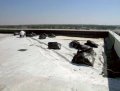
During Hurricane Ivan, high wind pressures created increasing peel forces around the edges of a ballooning membrane and caused the ballooned area to progressively expand. However, as the river rock in this ballasted single-ply roof collected at the edge of the billowing membrane, enough weight accumulated to stop the progressive ballooning action.

Single-ply roofing systems have a long and successful performance record in the low-slope roofing industry, with some materials now touting up to 40 years of performance history. In general, adhered roofs offer good wind uplift resistance and meet FM Global and Underwriters Laboratories wind uplift requirements. However, in some areas of the United States, roofing systems may experience extreme wind events that challenge their ability to remain in place. Wind-related failures can occur on all types of roofing systems, but the potential for membrane displacement from a “peeling” action occurs primarily on fully adhered roofing systems.

Peel failure occurs when an adhered membrane separates from the underlying substrate, or the separation occurs within the substrate itself (i.e., a facer peeling away from an insulation board). The good news for contractors and roofing specifiers is there are some low-cost system enhancements for adhered roofing systems that will help reduce the potential for catastrophic loss during a hurricane or other high wind event.

There are many causes of peeltype damage to roofing systems during high wind events. These include roof edge failure, inadequate perimeter and corner attachment, air infiltration below the membrane, internal pressurization of the building, and even membrane damage due to flying debris. Of these causes, edge failure is the failure mode cited most often by the Roofing Industry Committee on Weather Issues (RICOWI). Similarly, FM Approvals cites edge damage in 79 percent of 145 cases of insurance losses experienced after high wind events.

The peel-failure phenomenon can occur in two basic ways. In the first case, the edge termination fails and becomes a sail to catch wind, allowing the wind to progressively peel the membrane from the perimeter edge inward toward the center of the roof.

In the second failure mode, the membrane remains attached at the edge but it separates from the substrate and “balloons.” This ballooning action creates increasing peel forces around the edges of the balloon and causes the ballooned area to progressively expand. In either case, the peel action will continue until stopped by a physical feature or roof system enhancement.

Recent RICOWI research has helped illustrate the effects of wind forces at the edge of the roof and points out the effectiveness of a “peel stop” type of restraint to resist progressive damage that could otherwise occur. Peel stops fall into various categories, including emergency on-the-job measures, intentionally designed securement systems and unintentional barriers.

The emergency use of sandbags by roofing contractors or building personnel can prevent further peel of the membrane after a high wind event. As the river rock in a ballasted single-ply roof collects at the edge of the billowing membrane, enough weight accumulates to stop the progressive ballooning action. Curbs and pipes can also stop a membrane from peeling across a roof.
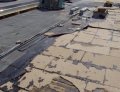
Here the emergency use of sandbags helped prevent further peeling of the membrane after a high wind event in Florida.

Roof Membrane Restraints

On mechanically fastened single-ply systems, the fastener rows used to secure the membrane can also serve as an unintentional membrane restraint mechanism (or peel stop) and limit exposure of the substrate should edge attachment be lost during a storm.

In the case of adhered systems, system-inherent membrane restraints, such as the piling of river rock ballast or rows of mechanical fasteners, do not exist as a feature of the system. Therefore, a peel-stop device would need to be intentionally designed into adhered roofing systems.

The basic concept of a peelstop design (also referred to as a “storm strip,” “hurricane strip” or “hurricane bar”) is to install a termination device (typically a bar or a fastened reinforced membrane strip) approximately 12 inches away from the roof edge or parapet wall around the entire roof perimeter. The device is attached with mechanical anchors to the structural deck using fasteners spaced 6 inches on center.

There are numerous variations to the peel-stop design. For example, the termination device can be placed within the membrane field splice or over the membrane and then “stripped in,” or even placed below the membrane with the membrane adhered to it.
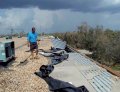
A few roof curbs and pipes eventually stopped this membrane from peeling across the field of the roof during Hurricane Charley. (Photos courtesy of RICOWI.)

A peel-stop device can even be used to terminate the perimeter membrane directly to the structural deck, completely isolating the perimeter area from the rest of the roof. Depending on the severity of expected wind exposure, additional rows of the termination device can also be installed.

Despite the generally positive performance history of adhered roofing systems in extreme wind events, Single Ply Roofing Industry (SPRI) members recommend the inclusion of peel-stop devices. These systems are a low-cost, common sense design enhancement for adhered roofing systems installed in High Velocity Hurricane Zones (HVHZ), or when the designer is otherwise concerned about the possibility of high wind events. (Note: The use of a highdensity gypsum cover board can also dramatically enhance the peel resistance of many lowslope roofing systems.)

Roofing contactors and specifiers should contact the roofing system materials manufacturer or supplier to discuss the appropriate peel-stop design options.

Contributed by The Single Ply Roofing Industry

Share This Story

Looking for a reprint of this article?
From high-res PDFs to custom plaques, order your copy today!


Recommended Content

JOIN TODAY
to unlock your recommendations.

Already have an account? Sign In

  • bar graph shows LEED v4/LEED v5/LEED v6 in various colors

    When Will LEED v4 / v4.1 and LEED v5 Expire?

    The latest version of the LEED rating system, LEED v5, is...
    Sustainability
    By: Daniel Overbey
  • Celebrating Women In AEC-2026

    Celebrating Women in The AEC Industry Part 1

    A round-up of women in the design, engineering and...
    Sustainability
    By: Lindsay Lewis
  • KEE membrane application on a roof

    A Beginner’s Guide to Single-Ply Roofing Membranes

    While PVC and TPO appear extremely similar, the chemistry...
    Low-Slope Roofs
    By: Peter Gross
Manage My Account
  • Sign up for the Newsletter
  • Online Registration
  • Manage My Preferences
  • Registration Customer Service

More Videos

Sponsored Content

Sponsored Content is a special paid section where industry companies provide high quality, objective, non-commercial content around topics of interest to the Building Enclosure audience. All Sponsored Content is supplied by the advertising company and any opinions expressed in this article are those of the author and not necessarily reflect the views of Building Enclosure or its parent company, BNP Media. Interested in participating in our Sponsored Content section? Contact your local rep!

close
  • HITT Construction headquarters
    Sponsored byBuilding Composites® LLC

    Pushing the Envelope

  • 2 construction workers and a DEXcell panel
    Sponsored byDEXcell Roof Boards

    Designing Low-Slope Roofs for Resilience

  • Bell Bank headquarters in Fargo, North Dakota
    Sponsored bySto Corp.

    Drained and Back-Ventilated Rainscreens vs Pressurized-Equalized Rainscreens

Popular Stories

graphic shows white arrows pointing to the right on a light green background

A Breakdown of Air Leakage Testing in LEED v5 BD+C

graphic shows a building destoryed by tornados with information on the amount of torandos in 2026 in the US

Record-Breaking Tornado Activity in Illinois Signals New Challenges for Architects

HITT Construction headquarters

Pushing the Envelope

Building Enclosure Newsletter

BE Poll

Events

April 9, 2026

Strategies for High-Performance Below-Grade Waterproofing

Credits: 1 AIA LU/HSW ; 1 IIBEC CEH; 0.1 IACET CEU

On-Demand Designing a high-performance building enclosure requires more than just surface-level protection; it demands a rigorous, performance-based mastery of below-grade water and gas mitigation. This discussion will provide an expert-level analysis of below-grade waterproofing within the comprehensive framework of the high-performance building enclosure.

April 28, 2026

Roof Design Considerations That Prevent Installation Failures and Change Orders

Credit: 1 AIA LU/HSW; 1 IIBEC CEH; 0.1 ICC CEU

On-Demand This course provides visual examples of actual field conditions. Some good, some not so good; along with design suggestions that can cut installation costs and reduce construction change orders. Upon completion of this course, you will have a better understanding of the requirements the roofing contractor must meet to provide the specified roofing system warranty, and long-term value to the owner.

View All Submit An Event

Products

Plaster and Drywall Assemblies Manual

Plaster and Drywall Assemblies Manual

This is a comprehensive manual that goes beyond codes and standards, providing expert guidance in design, detailing, material selection and troubleshooting for plaster and drywall.

See More Products

Related Articles

  • Best Practices: Attachment of Asphalt Shingles in High-Velocity Wind Zones

    See More
  • KEE membrane application on a roof

    A Beginner’s Guide to Single-Ply Roofing Membranes

    See More
  • Best Practices: Roof System Design Standards

    See More

Related Products

See More Products
  • Optimizing Social Media from a B2B Perspective

  • studentguidebook.jpg

    Integrating Building Performance with Design: An Architecture Student’s Guidebook

  • 1118458605.jpg

    Sustainable Facades: Design Methods for High-Performance Building Envelopes

See More Products
×

Enhance your expertise with unparalleled insights.

Join thousands of building professionals today. Shouldn’t you know what they know?

SUBSCRIBE TODAY!
  • RESOURCES
    • Advertise
    • Contact Us
    • Store
    • Want More
  • SIGN UP TODAY
    • Create Account
    • Newsletter
    • Customer Service
    • Manage Preferences
  • SERVICES
    • Marketing Services
    • Reprints
    • Market Research
    • List Rental
    • Survey/Respondent Access
  • STAY CONNECTED
    • LinkedIn
    • Facebook
    • Instagram
    • YouTube
    • X
  • PRIVACY
    • PRIVACY POLICY
    • TERMS & CONDITIONS
    • DO NOT SELL MY PERSONAL INFORMATION
    • PRIVACY REQUEST
    • ACCESSIBILITY

Copyright ©2026. All Rights Reserved BNP Media, Inc. and BNP Media II, LLC.

Design, CMS, Hosting & Web Development :: ePublishing