Best Practices: Roof System Design Standards

OMG Roofing Products conducts a wind uplift test on a 12-foot by 24-foot section of a system
at its dedicated testing facility in Agawam, Mass.
The design standards that are referenced in bid documents are important for proper roof application. The acronyms that are strategically placed throughout the bid documents are not there simply to protect the designers. The standards are inserted to ensure that the installed roof system meets the requirements of the roofing industry, as well as local and national building codes and insurance requirements. When properly presented in the bid documents, the standards can be a valuable asset to the installing contractor.
The responsibility of deciphering the standards and determining how and where they apply in the design documents is the responsibility of the specifier. Simply providing a statement such as “comply with (name of standard)” is inadequate if it does not provide the exact design standard requirements for the system. For instance, in the case of Factory Mutual wind uplift requirements, the specifier should go beyond the statement “apply in accordance with FM 1-90” and state the required attachment method for the specified deck and insulation components. This would include items such as providing the exact number of fasteners required per square foot to comply with the standard. If this information is not clearly identified by the specifier, the contractor is forced to provide bids based on assumptions.
Deciphering the standards by the exact name and/or number is also a critical issue. Most of the standards have several different classifications. For example, the statement “complete the metal coping in accordance with NRCA details” is vague and confusing due to the fact that there are several variations of this type of detail. The specifier should state the exact standard or be prepared to allow the contractors to complete the detail based on their own interpretation.
This type of practice could lead to inaccurate bids, as each contractor’s interpretation could be different. It could also lead to jobsite disputes, change orders, and confrontations between the specifier and the contractor. In the end, it could result in an unsatisfied building owner. The specifier must determine the standards that apply to the roof system, list them in clear and concise language and, where necessary, define the methods required to meet the standards during installation.
Although the responsibility of determining the design standards for the roof system is placed on the specifier, the contractor should have a basic understanding of the standards and why and where they are required. The most prominent standards used in roof system design are ASTM International, Factory Mutual (FM), Underwriters Laboratories (UL), and various details from manufacturers’ literature and guidelines issued by the National Roofing Contractors Association (NRCA) or the Sheet Metal and Air Conditioning Contactors’ National Association (SMACNA).

Pictured here are the pressure regulator and manometer at the OMG testing facility.
Founded in 1898, ASTM International is a not-for-profit organization that provides a global forum for the development and publication of voluntary consensus standards for materials, products, systems and services. Over 30,000 individuals from 100 nations are the members of ASTM International, including manufacturers, consumers, and representatives of government and academia. In over 130 varied industry areas, ASTM standards serve as the basis for manufacturing, procurement and regulatory activities. Formerly known as the American Society for Testing and Materials, ASTM International provides standards that are accepted and used in research and development, product testing, quality systems and commercial transactions around the globe.
In the roofing and waterproofing industry, ASTM committees are comprised of industry volunteers, predominately from material manufacturers and producers, who outline the test methods and standards for material specifications. The ASTM standards referred to in bidding documents are specifically related to component materials.
Most roofing and waterproofing materials have minimum ASTM requirements that they must comply with.
All of the ASTM standards have reference numbers. All of the standards in the roofing and waterproofing division begin with the letter D, followed by the standard number and the year of origin of the standard. Changes or modifications to the standards are denoted with the year of revision in parenthesis after the original year.
For example, D4-86 (1998), “Standard Test Method for Bitumen Content.”
The ASTM standards are classified in three categories: standard specifications, standard test methods and standard practices. The standard specifications provide the minimum specifications that a material must comply with to meet the standard. Some of the newer materials, such as TPOs and SBS, do not have ASTM standards at this time.
Since the organization relies on volunteers and since most of the participants are representatives of material manufacturers (who have a vested interest in the requirements), development or revision of the standards follows the same chain as a legislative bill passing through Congress. In bidding documents, it is the standard specifications that should be referenced. If the specifier erroneously submits a standard test method in the materials section of the bid documents, the contractor should clarify that material testing is not required. Test methods and practices may be provided in the execution section of the bidding documents if the specifier requires quality assurance testing.
Typically, test methods are used in forensics evaluations of applied materials. It is the responsibility of the specifier to verify that designed materials meet or exceed the ASTM standards specifications.
Factory Mutual Requirements
The Factory Mutual Engineering Corporation has published “Loss Prevention Data for the Roofing Contractor,” which provides guidelines for installation of roof systems to prevent substantial damage from severe weather. The established testing and standards were developed as a result of millions of dollars paid in insurance claims for roof damage that occurred due to the elements. As an insurance company, Factory Mutual holds a vested interest in decreasing these types of failures.
In addition to the design standards, Factory Mutual also conducts testing to approve materials and systems. The materials and systems are tested (for a fee) to meet wind-uplift and fire standards. The membranes are typically tested in system configurations over different deck types and by using different insulations. Factory Mutual charges a separate fee for all tests and each system configuration must pass on its own for individual certification. The specifier must determine that the proposed system being designed has passed FM in the exact configuration they are specifying. The approvals are based on systems - not separate components. Factory Mutual design standards and testing procedures have been accepted in the roofing industry.
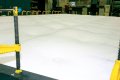
This wind uplift test in progress shows a system under pressure. The membrane is beginning to lift in response to increased air pressure from below. (Photo courtesy of OMG Roofing Products.)
Prior to design, the specifier should indicate whether the building owner is insured by Factory Mutual. Companies that are insured by FM must comply with the design standards set forth in the loss prevention guidelines using FM approved roof systems.
FM periodically inspects insured facilities to make sure they are in compliance with the standards and often reviews design documents for compliance on new and remedial construction projects.
Although FM provides loss prevention standards for fire, hail and roof loads, they are most commonly recognized for wind uplift testing. The total roof system must be designed to comply with the standards at insulation and membrane attachment and at all perimeter flashings.
There are two common misconceptions associated with the FM wind uplift classifications. The first involves the numerical classification of the standard itself; the classification is denoted by the numeral 1, not the letter “I”; therefore, the correct pronunciation is FM 1-60, not FM I-60.
The second misconception concerns what the uplift classes actually mean. The common misconception is that Class 1-60 systems can withstand wind speeds of 60 miles per hour. This is incorrect. The determination is actually based on pounds per square foot of pressure that the system can withstand. This is determined during testing procedures. In this process, the complete roof system - including the deck - is secured to the frame of the wind uplift test apparatus. During the test procedure, compressed air is slowly introduced below the deck in increments of 15 psf. If the sample maintains 60 psf for one minute without damage, it is classified as Class 1-60. The same procedure applies for Class 1-90, which must maintain 90 psf for one minute, and Class 1-120, which must maintain 120 psf for one minute.
The procedure used to determine wind uplift classifications on specific buildings during the design phase is based a calculation that takes into account the basic wind speed in the geographical area, the ground surrounding the building and the roof uplift pressure at the field of the roof. The building’s height and perimeter construction is also considered. It is the responsibility of the specifier to complete these calculations. It is also the specifier’s responsibility to determine the proper wind uplift classification for the building.
Manufacturers’ Literature, Association Guidelines
Compliance to manufacturers’ requirements is particularly important due to the fact that the manufacturer will be required to provide a warranty for the project. However, it is the specifier’s responsibility to determine the design issues that best meet the requirements of the building. After all, the specifier has actually investigated the building, and the specifier should be aware of the as-built conditions that may not be covered in manufacturers’ literature or generic details from association guidelines. The generic details may not adequately illustrate actual field conditions. Furthermore, simply copying a detail from a book does not constitute true design.
Manufacturers’ literature, NRCA details and all other industry organizations can serve as guidelines for design, and the specifier should be aware of the requirements established by these organizations. However, the design should be completed to best meet the requirements of the building - even if the demands are more stringent than industry requirements.
It is the responsibility of the specifier to determine the exact standards that are required for each building and to properly define the requirements of the standards so that the contractors can comply with them during installation. The contractors involved with the project should also have a broad knowledge of the standards. If the project is properly designed and the pertinent standards are followed during installation, the standards can help ensure a successful roof project and eliminate future problems that could put a dent in the contractor’s bottom line.
Looking for a reprint of this article?
From high-res PDFs to custom plaques, order your copy today!
.webp?height=740&t=1767036885&width=auto "Header - BE 1170x658 (002).png")

.webp?height=740&t=1755781744&width=auto "KEE(2).png")