Best Practices: Alternatives to Roof Edge Blocking
The most critical point of the roof assembly is the roof edge. This juncture is the most susceptible to wind uplift failures and moisture infiltration. The majority of roof damage created by high-velocity winds is initiated at the perimeter or corners of the building and infiltrates throughout the field of the system.

 The most critical point of the roof assembly is the roof edge. This juncture is the most susceptible to wind uplift failures and moisture infiltration. The majority of roof damage created by high-velocity winds is initiated at the perimeter or corners of the building and infiltrates throughout the field of the system. In these conditions, an air mass transcends up the building’s perimeter and forms a vortex that creates uplift damage throughout the roof as it flows over and around the building. Proper design and attachment methods can eliminate wind damage, as can the securement of innovative products that are manufactured to withstand high-velocity winds.
Perimeter metal attachment should be determined through the completion of a perimeter edge calculation. This calculation determines the proper securement spacing required to meet the wind design pressure of an existing building. In high-velocity wind zones, the base perimeter materials should be secured to the structural components - not the deck - with properly approved fasteners. The perimeter metal materials must comply with ANSI ES-1 regulations, which require testing and certification of the materials.
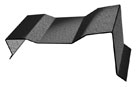 An important roof component at the perimeter area that is often overlooked is blocking material. Wood blocking has long been used as an anchoring substrate for metal edge and flashing components, such as expansion joints, curbs and accessories. Traditionally, blocking has been manufactured from pressure-treated lumber. Recently, there have been changes to wood blocking due to environmental concerns relating to the treatment of the materials. These changes could have an impact on wood blocking material used at perimeter edges, particularly in high-velocity wind zones.
In January of 2004 federal regulators halted the production of lumber that was treated with arsenic as a preservative to protect against wood rot, insects and deterioration from moisture. The EPA classified the chemical used in the pressure treatment process - chromated copper arsenate (CCA) - as a potential cancer risk. EPA studies concluded that CCA was linked to bladder, liver and lung cancer. It has been estimated that CCA was used on approximately 90 percent of all pressure-treated lumber in the United States.
 Federal regulators allowed for a phasing out period of CCA for nearly two years, up until 2006, and until then most lumber treated in the United States still used CCA. This was partially due to the fact that viable alternatives were not readily available. The lumber producers are currently using two newer additives - alkaline copper quat (ACQ) and acid copper chromate (ACC). Both of these products have a short track record and are largely unproven in this area. This could lead to the instability that we have seen with other roofing products that have changed their basic formulations over the years. Failures at this component due to moisture deterioration such as wood rot or termites (a significant concern in the South) could potentially weaken the roof at its most vulnerable point.

The products are fully recyclable, which provides a significant environmental advantage in LEED-engineered buildings. ARBS also has excellent fire resistance and provides a Class A Fire Rating. The products are noncombustible and there is no threat of accelerated fire spread, which is a concern with traditional wood blocking. Torch-applied products can be applied directly to this system.
 The major advantage of the system is the enhancement of wind uplift protection that it provides at the roof’s most vulnerable point - the roof edge. The metal edge material is specifically designed to meet wind uplift pullout and pullover tests. Tests completed by an independent testing agency (Hurricane Test Laboratory) on the edge blocking indicated that the system performs better than traditional blocking methods. HTL tested five edge blocking systems to failure as defined by Florida Building Code TAS 111B. The average failure load for all specimens was 755,000 foot-pounds with a standard deviation of 51.23 foot-pounds, which correlates to a pressure of 862.85 psf.
 Product installation is simple and accurate securement is designed into the manufactured product. Proper fastening is ensured through the placement of prefabricated holes in the manufacturing process. The contractor simply secures fasteners at each opening and the proper fastening requirements are met. Fastener corrosion, common in wood blocking applications when non-hot dipped fasteners are used, is not a concern.
The blocking system is prefabricated and formed to fit any thickness of lightweight concrete or insulation - including tapered insulation. The blocking is properly formed to the slope of the lightweight or tapered insulation. On lightweight concrete systems, the blocking is secured directly to the lightweight concrete and prefabricated vent holes are set at the intermediate portion of the blocking to provide for venting of gases and moisture that may accumulate in the roof system, thereby reducing the likelihood of premature roof failure.
 Since the blocking is fabricated to accommodate slope changes, the same size fastener can be used throughout the project. This eliminates the problem of using incorrect fastener lengths that do not adequately secure the blocking to the structural substrate, eliminating the potential for fasteners backing out. In increased slope applications, wood blocking is sometimes stacked up to three or four boards in height. This leads to the requirement of longer fasteners and the potential for unstable edge substrates. Metal to metal components experience less expansion and contraction from differential movement then wood to metal adjoinments.
Finally, metal blocking is less expensive per lineal foot than lumber, and since the cleat is built into the blocking system, application of edge metal and coping is seamless and is less labor intensive. The blocking system can be formed on-site, allowing the contractor to have the material shipped in coils to the jobsite. This eliminates contractors from having to turn their jobsites or shops into lumberyards for each project.
ARBS provides a Quality Assurance Certificate (upon request) that includes the data from the specific lot of material referenced and an assurance to quality in the materials and manufacturing process. ARBS also offers a warranty on all of its manufactured components that is consistent with the terms and materials offered by the roof membrane manufacturer used on the project.
 Since introduction into the market within the last 10 years, ARBS has experienced significant growth in the Southeastern United States. The product has been widely used in this region for its enhanced wind uplift capacity and because it is less susceptible to deterioration from insects (termites) and humidity - conditions prevalent in the Gulf and Atlantic coast regions. ARBS recently entered into an affiliation agreement with TECTA America to provide these systems for TECTA’s 50-plus nationwide branches. The system is also available by contacting ARBS directly at 866-981-5942 or visiting the company’s Web site, www.concrecelusa.com.
The Alternative Roof Blocking System was developed and patented by Henry Gembala.
This engineered metal fabrication system includes one or more pre-formed component structures fabricated from a non-corrosive, durable material.
Perimeter metal attachment should be determined through the completion of a perimeter edge calculation. This calculation determines the proper securement spacing required to meet the wind design pressure of an existing building. In high-velocity wind zones, the base perimeter materials should be secured to the structural components - not the deck - with properly approved fasteners. The perimeter metal materials must comply with ANSI ES-1 regulations, which require testing and certification of the materials.
In January of 2004 federal regulators halted the production of lumber that was treated with arsenic as a preservative to protect against wood rot, insects and deterioration from moisture. The EPA classified the chemical used in the pressure treatment process - chromated copper arsenate (CCA) - as a potential cancer risk. EPA studies concluded that CCA was linked to bladder, liver and lung cancer. It has been estimated that CCA was used on approximately 90 percent of all pressure-treated lumber in the United States.
The blocking can be fabricated from galvanized steel, aluminum or stainless steel, depending on project requirements.
Photos courtesy of Concrecel USA.
Alternative Roof Blocking
Since most roof damage from high-velocity winds occurs at the perimeter edge, a metal blocking system has been developed to enhance the roof’s perimeter for wind uplift resistance. The Alternative Roof Blocking System (ARBS) is an engineered metal fabrication system that was developed and patented by Henry Gembala. The materials used for the manufacturing of the ARBS System are constructed from materials meeting the standards, quality and thickness recommended by SMACNA, NRCA, IBC and ASCE 7. The blocking assembly includes one or more pre-formed component structures fabricated from a non-corrosive, durable material. The blocking can be fabricated from galvanized steel, aluminum or stainless steel, depending on project requirements.The products are fully recyclable, which provides a significant environmental advantage in LEED-engineered buildings. ARBS also has excellent fire resistance and provides a Class A Fire Rating. The products are noncombustible and there is no threat of accelerated fire spread, which is a concern with traditional wood blocking. Torch-applied products can be applied directly to this system.
Photos courtesy of Concrecel USA.
Photos courtesy of Concrecel USA.
The blocking system is prefabricated and formed to fit any thickness of lightweight concrete or insulation - including tapered insulation. The blocking is properly formed to the slope of the lightweight or tapered insulation. On lightweight concrete systems, the blocking is secured directly to the lightweight concrete and prefabricated vent holes are set at the intermediate portion of the blocking to provide for venting of gases and moisture that may accumulate in the roof system, thereby reducing the likelihood of premature roof failure.
Studies by the Roofing Industry Committee on Weather Issues (RICOWI) after hurricanes Charley and Ivan found that the perimeter edge was the most vulnerable area of a roofing system. (Photo courtesy of RICOWI.)
Finally, metal blocking is less expensive per lineal foot than lumber, and since the cleat is built into the blocking system, application of edge metal and coping is seamless and is less labor intensive. The blocking system can be formed on-site, allowing the contractor to have the material shipped in coils to the jobsite. This eliminates contractors from having to turn their jobsites or shops into lumberyards for each project.
ARBS provides a Quality Assurance Certificate (upon request) that includes the data from the specific lot of material referenced and an assurance to quality in the materials and manufacturing process. ARBS also offers a warranty on all of its manufactured components that is consistent with the terms and materials offered by the roof membrane manufacturer used on the project.
RICOWI inspectors found the edge metal was disengaged at this Florida school building. (Photo courtesy of RICOWI.)
Looking for a reprint of this article?
From high-res PDFs to custom plaques, order your copy today!
.webp?height=740&t=1767036885&width=auto "Header - BE 1170x658 (002).png")

.webp?height=740&t=1755781744&width=auto "KEE(2).png")