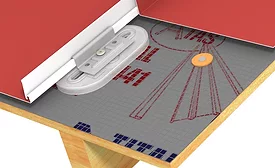
Knight Wall Systems announced the launch of ANKIT, a proprietary new fastener to be used in conjunction with Knight’s CI and HCI systems to further aid in overcoming the challenges of thermal bridging and wind-driven rain.
As urbanization becomes more prevalent, the built environment’s impact on climate change and local ecosystems will worsen. Since thermal bridging significantly reduces buildings’ energy efficiency, it’s one of the main drivers for these outcomes. What technologies and analytical techniques can prevent heat loss?
PanelShield SA joins three other underlayments offered by ATAS. For underlayments, ATAS has added PanelShield™ SA, by VaproShield, to their product offering.
Modern insulated glass units provided the Crystal windows and doors used for the OMNI Shoreham Hotel renovation project with superior energy efficiency.
Steinberg will be responsible for sales growth and market penetration of Schöck’s North American product line, centered around Isokorb® structural thermal breaks, with a focus on increasing awareness and preference among architects, engineers, owner/operators and contractors.
The 26,000 square-foot Statue of Liberty Museum located on Liberty Island was designed to complement the experience of visitors to this important UNESCO heritage site by illustrating the sculpture’s historical significance and method of construction.
This year’s AIA CEU presentation line-up includes speakers like David Altenhofen, Amy Baker and Brian Stroik, Jennifer Keegan and Corey Zussman, on a variety of topics ranging from prefabricated exterior wall assemblies to combatting thermal bridging within the building envelope.
Situated on the site of Gadsden’s Wharf, the landing point for nearly half of all enslaved Africans brought to the United States, the International African American Museum will encompass 41,800 sq ft of program and exhibit space to preserve and protect the cultures, genealogy and accumulated knowledge of Africans in the Americas.
The developers are aiming for LEED Platinum Certification, as well as compliance with Toronto Green Standard (TGS) requirements. In effect since 2010, the TGS sets tiered energy, emissions, and sustainability benchmarks for new buildings to support Toronto’s goal of reducing greenhouse gas emissions to net zero by 2050.
.webp?height=168&t=1724620606&width=275 "Untitled design(39).jpg")
.webp?height=168&t=1723846206&width=275 "Untitled design(13).jpg")