Building Enclosure logo
search
cart
facebook twitter linkedin youtube instagram Spotify Podcasts Apple Podcasts Spotify Podcasts Apple Podcasts
  • Sign In
  • Create Account
  • Sign Out
  • My Account
Building Enclosure logo
  • NEWS
    • Breaking News
  • SECTIONS
    • Columns
    • Project Profiles
    • Trade Shows
    • Sponsor Insights
  • SYSTEM DESIGNS
    • Low-Slope Roofs
    • Pitched Roofs
    • Metal Roofing Materials
    • Waterproofing
    • Sustainability
    • Insulation
    • Exterior Claddings
    • Wall Systems
    • Building Envelope
  • BLOG
    • The BE Blog
  • MEDIA
    • Podcasts
    • Webinars
    • Quiz
    • Videos
    • Polls
    • Interactive Spotlights
    • Newsletter
    • Photo Galleries
  • DIRECTORIES
    • Directory: Blue Book
    • Directory: Roofing Resource
  • PRODUCTS
  • TECHNICAL
    • Codes
      • Waterproofing
      • Roofing
    • Details
      • Waterproofing
      • Roofing
  • CONTINUING ED
  • ABOUT
    • Advertise
      • Editorial Calendar
    • Contact
    • eMag Archive Issues
  • SIGN UP!
Project Profiles

Preserving a Historic Civic Landmark with Advanced Roofing

Erected in 1928 as the Mecklenburg County Courthouse, this historic building now serves as the Mecklenburg County District Attorney’s Office and remains one of Charlotte’s most recognizable civic landmarks
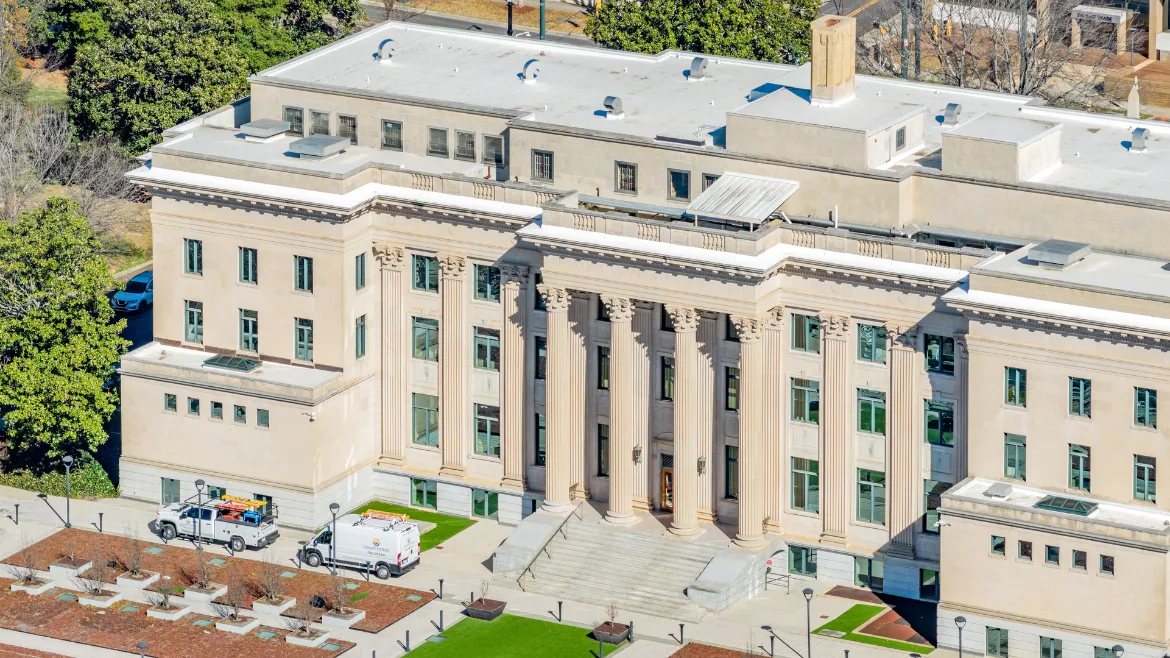
Mecklenburg County Courthouse
Clear Sky Images
April 24, 2026

Erected in 1928 as the Mecklenburg County Courthouse, this historic building now serves as the Mecklenburg County District Attorney’s Office and remains one of Charlotte’s most recognizable civic landmarks. Designed by architect Louis H. Asbury in the Neoclassical style, the property was added to the National Register of Historic Places in 1979 and designated a local historic landmark in 1983, cementing its status as a symbol of the city’s civic and architectural heritage.

When leaks began appearing across several roof sections of the Mecklenburg County District Attorney’s Office, each constructed from different materials during past renovations, the Mecklenburg County Asset and Facility Management Department sought a solution that could preserve the structure’s integrity. The building’s roof consisted of multiple systems—lightweight insulating concrete (LWIC), metal decking, and structural concrete—each varying in age and condition. Over time, some areas began to show signs of wear, and leaks became increasingly common.

Location: 700 E Trade St, Charlotte, NC 28202
Project Type: Government Renovation
Completion Date: February 2025
Owner: Mecklenburg County
Engineer: REI Engineers, Inc.
Contractor/Installer: Interstate Roofing Co.
Siplast Systems Used: Paratech Glass Base TG, 80-mil Parasolo TPX Fleeceback

REI Engineers, a North Carolina-based building enclosure consulting firm with offices throughout the eastern United States specializing in roof system design, restoration, and forensic evaluation, designed the roof replacement. Interstate Roofing Co., a prominent commercial roofing contractor based in Charlotte, was awarded the contract after approval from the Board of County Commissioners (BOCC) and elected to utilize Siplast materials. A key priority was ensuring that renovations did not disrupt daily operations. Because the building remained fully active throughout construction, careful coordination, noise management, odor mitigation, and safety protocols were essential. In addition, given the District Attorney's Office's age and continuous use, odor and air monitoring services were not initially provided. REI Engineers was made aware of complaints from the building occupants about odor, and an alternative, low-VOC adhesive was then approved for use.

Siplast’s technical knowledge made them an ideal partner for the District Attorney’s Office roofing project. REI Engineers designed this project. Siplast provided a roof system in accordance with the design: a hybrid system combining Paratech Glass Base TG, a torch-applied SBS-modified bitumen base ply, with 80-mil Parasolo TPX Fleeceback, a high-performance TPO membrane. This system provided proven durability while accommodating the District Attorney’s Office's varied roof substrates. To help ensure a durable and visually consistent transition at flashing areas, Siplast applied its patented liquid flashing detail with the TPX roof membrane. This process involves installing the TPX fleeceback membrane upside down, welding the white cap to the field membrane so the fleece faces upward. The fleece then receives a base coat of Parapro Flashing, into which Pro Fleece Reinforcement is embedded. A top coat is applied to complete the detail, providing a clean, reinforced, and cohesive finish.

To address complaints over odor in the occupied building, Siplast collaborated closely with REI Engineers to substitute the standard Parasolo Bonding Adhesive with LV50 Adhesive, a low-VOC option. This adjustment minimized fumes on-site while maintaining full system performance and warranty compliance, ensuring a safe and efficient installation in the active environment.

Security measures added an extra layer of complexity, as all workers underwent background checks and fingerprinting for building access. Despite these challenges, the project team completed the project efficiently and with minimal disruption to the District Attorney’s Office operations.

With its upgraded roof system, the Mecklenburg County District Attorney’s Office now benefits from a cohesive and warrantied solution designed for longevity and reduced maintenance, underscoring the value of Siplast’s commitment to innovation and partnership in complex renovation projects.

Siplast representatives provided hands-on technical support throughout this project, assisting with product selection, detailing, and on-site troubleshooting. Their involvement helped ensure the system met both the county’s performance standards and demanding schedule. Interstate Roofing praised the collaboration, noting that Siplast’s knowledge of modified roofing systems and comprehensive approach helped simplify the installation. Their proactive, forward-thinking solutions contributed to a smoother process and a cleaner final result.

While the project did not involve a historic review board, maintaining the Mecklenburg County District Attorney’s Office's visual character was essential. The new roof system blends durability and modern waterproofing technology with minimal visual change, preserving the building’s civic identity while extending its service life.

KEYWORDS: bitumen flashing historic buildings membranes municipal building North Carolina renovation roofing roofing membranes

Share This Story

Looking for a reprint of this article?
From high-res PDFs to custom plaques, order your copy today!


Recommended Content

JOIN TODAY
to unlock your recommendations.

Already have an account? Sign In

  • bar graph shows LEED v4/LEED v5/LEED v6 in various colors

    When Will LEED v4 / v4.1 and LEED v5 Expire?

    The latest version of the LEED rating system, LEED v5, is...
    Sustainability
    By: Daniel Overbey
  • Celebrating Women In AEC-2026

    Celebrating Women in The AEC Industry Part 1

    A round-up of women in the design, engineering and...
    Building Envelope
    By: Lindsay Lewis
  • KEE membrane application on a roof

    A Beginner’s Guide to Single-Ply Roofing Membranes

    While PVC and TPO appear extremely similar, the chemistry...
    Low-Slope Roofs
    By: Peter Gross
Manage My Account
  • Sign up for the Newsletter
  • Online Registration
  • Manage My Preferences
  • Registration Customer Service

More Videos

Sponsored Content

Sponsored Content is a special paid section where industry companies provide high quality, objective, non-commercial content around topics of interest to the Building Enclosure audience. All Sponsored Content is supplied by the advertising company and any opinions expressed in this article are those of the author and not necessarily reflect the views of Building Enclosure or its parent company, BNP Media. Interested in participating in our Sponsored Content section? Contact your local rep!

close
  • 2 construction workers and a DEXcell panel
    Sponsored byDEXcell Roof Boards

    Designing Low-Slope Roofs for Resilience

  • Bell Bank headquarters in Fargo, North Dakota
    Sponsored bySto Corp.

    Drained and Back-Ventilated Rainscreens vs Pressurized-Equalized Rainscreens

  • A construction worker using DEXcell roof boards
    Sponsored byDEXcell Roof Boards

    The Hidden Strength of Low-Slope Roof Systems: Why Roof Cover Boards Matter

Popular Stories

construction industry workers in hard hats stand around a city scape

Construction Industry Revolts Over New CSI Licensing Plan

Canalino Elementary School and Canalino Family School exterior

Daylighting Design to Support Rapidly Growing Trend in Modular Building Construction

construction workers on a roof, plane flies in background

Why Specifications Are Becoming the Next Critical Layer of Construction Compliance

Building Enclosure Newsletter

BE Poll

Events

June 17, 2025

Addressing Condensation in Low-Slope Roof Assemblies

Credits: 1 AIA LU/HSW; 0.1 ICC CEU; 1 IIBEC CEH; 0.1 IACET CEU

On Demand In modern roofing systems, vapor retarders and air barriers do more than just minimize air leakage—they’re essential to maximizing performance and longevity. This engaging course dives into the next generation of moisture control: permeable vapor retarders and air barriers. Discover how these cutting-edge technologies are transforming low-slope roofing assemblies by improving energy efficiency, managing moisture, and boosting wind uplift resistance.

April 9, 2026

Strategies for High-Performance Below-Grade Waterproofing

Credits: 1 AIA LU/HSW ; 1 IIBEC CEH; 0.1 IACET CEU

On-Demand Designing a high-performance building enclosure requires more than just surface-level protection; it demands a rigorous, performance-based mastery of below-grade water and gas mitigation. This discussion will provide an expert-level analysis of below-grade waterproofing within the comprehensive framework of the high-performance building enclosure.

View All Submit An Event

Products

Plaster and Drywall Assemblies Manual

Plaster and Drywall Assemblies Manual

This is a comprehensive manual that goes beyond codes and standards, providing expert guidance in design, detailing, material selection and troubleshooting for plaster and drywall.

See More Products

Related Articles

  • preblended stucco

    Preserving a Heritage Starts with Pre blended Stucco

    See More
  • MFI Takes it Up a Notch with Advanced Microsoft Platform

    See More
  • NeverFade® Coatings

    Historic Landmark Refreshed with Coatings

    See More
×

Enhance your expertise with unparalleled insights.

Join thousands of building professionals today. Shouldn’t you know what they know?

SUBSCRIBE TODAY!
  • RESOURCES
    • Advertise
    • Contact Us
    • Store
    • Want More
  • SIGN UP TODAY
    • Create Account
    • Newsletter
    • Customer Service
    • Manage Preferences
  • SERVICES
    • Marketing Services
    • Reprints
    • Market Research
    • List Rental
    • Survey/Respondent Access
  • STAY CONNECTED
    • LinkedIn
    • Facebook
    • Instagram
    • YouTube
    • X
  • PRIVACY
    • PRIVACY POLICY
    • TERMS & CONDITIONS
    • DO NOT SELL MY PERSONAL INFORMATION
    • PRIVACY REQUEST
    • ACCESSIBILITY

Copyright ©2026. All Rights Reserved BNP Media, Inc. and BNP Media II, LLC.

Design, CMS, Hosting & Web Development :: ePublishing