EIMA 2026 Annual Meeting
EIMA Meeting Highlights Housing Policy Shifts, Growing Advocacy Push
HUD officials and lawmakers outlined housing, funding and regulatory changes as EIFS contractors increased advocacy efforts during EIMA’s first-ever meeting in Washington, D.C.
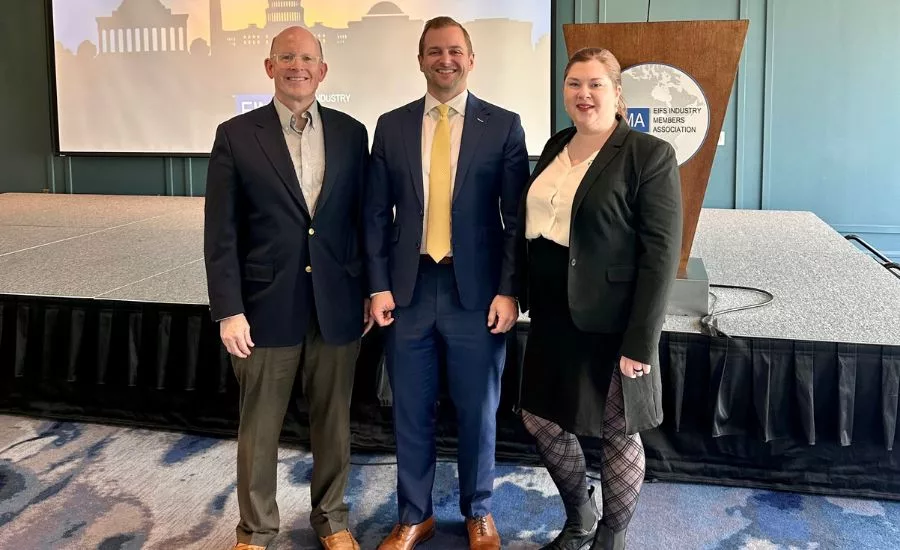
At the EIMA 2026 Annual Meeting (from left): EIMA CEO Stephen Sears; Benjamin Hobbs, assistant secretary for public and Indian housing, U.S. Department of Housing and Urban Development (HUD); and Vanessa Henley of Tremco CPG.
Key Takeaways
- Policy tailwinds could boost exterior system demand: HUD signaled regulatory relief, faster approvals and expanded financing tools—all pointing to increased multifamily and affordable housing activity where EIFS and cladding systems are widely used.
- Public housing repositioning = retrofit opportunity: The shift from aging public housing to Section 8-supported redevelopment opens the door for large-scale renovation, recladding and energy-efficiency upgrades across thousands of units.
- Advocacy is becoming a business strategy: EIMA members are stepping up engagement on Capitol Hill, recognizing that influencing legislation early can directly impact specifications, funding flows and future project pipelines.
Federal housing policy, regulatory reform and advocacy strategy took center stage at the 2026 EIFS Industry Members Association Annual Meeting, where contractors and suppliers heard directly from federal officials about opportunities tied to affordability initiatives and infrastructure investment as the meeting marked a turning point toward stronger, more coordinated industry advocacy.
Held March 25–27 at the Royal Sonesta Hotel—the association’s first gathering in the nation’s capital—the three-day program combined technical working sessions with policy-focused discussions and a Capitol Hill fly-in involving roughly 25 industry representatives.
Federal Policy Shifts Signal Opportunity for Exterior Contractors
At a time when government decision-makers are focused on affordable housing and energy efficiency, EIFS presents a compelling case. The system costs less than traditional cladding on commercial projects, and its built-in continuous insulation allows buildings to meet the International Energy Conservation Code without requiring additional insulation. Beyond performance, EIFS offers design flexibility, with wall systems capable of mimicking brick, stone, wood, metal and stucco, making it equally suited for new construction and retrofit projects.
Benjamin Hobbs, assistant secretary for public and Indian housing at the U.S. Department of Housing and Urban Development, outlined a federal agenda aimed at reducing regulatory barriers and accelerating housing production—moves that could directly impact demand for exterior wall systems.
“Housing affordability is top of mind … we’re working aggressively to bring down the cost of housing,” Hobbs told attendees, pointing to executive actions designed to streamline permitting and environmental reviews.
He emphasized that regulatory burdens account for a significant share of construction costs—roughly 40 percent for multifamily and 20 percent for single-family housing—highlighting why federal efforts are focused on cutting red tape and expediting approvals.
For EIFS contractors, one of the biggest takeaways centered on HUD’s ongoing repositioning of aging public housing stock. The agency is shifting units from traditional public housing programs to Section 8-supported redevelopment, creating renovation and recladding opportunities.
“That’s going to present significant opportunities for the suppliers and manufacturers of exterior cladding systems,” Hobbs said, noting tens of thousands of units are already approved for conversion.
HUD officials also highlighted:
- Lower mortgage insurance premiums for FHA multifamily loans, reducing financing costs
- Simplified underwriting processes to accelerate project timelines
- Upcoming Community Development Block Grant allocations to help close project funding gaps
Additionally, HUD plans to host a national Housing Showcase on the National Mall later this year, giving manufacturers and contractors a platform to demonstrate innovative building systems.
Related: EIFS in 2026: How Specialty Finishes are Redefining Exterior Wall Systems
Advocacy Ramps Up as Industry Heads to Capitol Hill

Annie Brody, director of business coalitions for the House Majority Whip’s office.
Photo: Tanja Kern/Walls & Ceilings.
From Capitol Hill, Annie Brody, director of business coalitions in the Office of the Majority Whip at the U.S. House of Representatives, reinforced the importance of that engagement, noting that trade associations play a critical role in shaping legislation and educating policymakers.
“My role is getting external support … from organizations like yours,” Brody said, emphasizing that industry voices help influence how policy is crafted and implemented.
She encouraged contractors to engage early in the legislative process (particularly during bill drafting and committee stages) when feedback can still shape outcomes. That message aligned with EIMA’s growing focus on advocacy as members look to influence regulations, funding priorities and building policies affecting exterior systems.
Key legislative priorities discussed included:
- Housing affordability packages under negotiation between the House and Senate
- A major surface transportation reauthorization bill affecting infrastructure funding
- Ongoing efforts to promote and defend tax and economic policies impacting construction businesses
Brody noted that with narrow margins in Congress, stakeholder input can carry added weight, especially as lawmakers seek real-world perspectives from contractors and manufacturers.
For contractors in the wall and ceiling sector, the message from Washington was clear: federal housing initiatives and regulatory changes are poised to increase construction activity—particularly in multifamily and affordable housing segments.
At the same time, the industry is stepping up its presence in Washington, with EIMA members increasing their advocacy efforts to help shape the policies that will drive that growth.
With funding programs expanding, regulatory hurdles easing and engagement with lawmakers intensifying, EIFS contractors may find new opportunities, and those who stay involved in both the market and the policy conversation will be best positioned to capitalize.
Looking for a reprint of this article?
From high-res PDFs to custom plaques, order your copy today!

.webp?height=740&t=1767036885&width=auto "Header - BE 1170x658 (002).png")

.webp?height=740&t=1755781744&width=auto "KEE(2).png")