Net-Positive Campus Sets New Sustainability Standard
Prioritizing sustainability while celebrating the employee experience
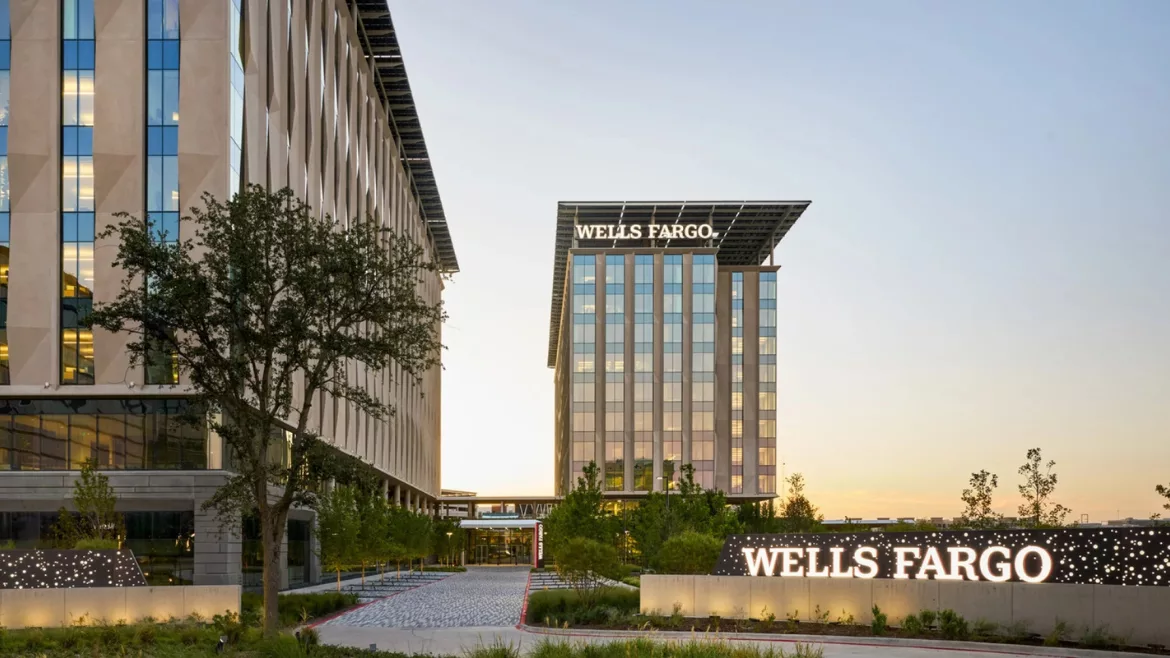
Wells Fargo’s new campus in the Las Colinas development of Irving, Texas, is a major step forward in sustainability. The campus isn’t just pursuing LEED™ Platinum certification: it is net-positive, generating more energy than it consumes — the first campus of its size to do so. This ambitious goal meant that Corgan’s design and sustainability teams needed to work closely with the client, refining the design over many iterations before arriving at a solution that functions as efficiently as possible while also providing a world-class employee experience.
With the energy demands required for managing the Texas climate, achieving net-positivity necessitated a comprehensive approach including site planning, solar panels, an all-electric campus, regionally sourced materials, lighting interventions, and strategic occupancy to consolidate the number of 24-hour customer service floors.
Planning for Growth
The project began with site selection. Wells Fargo wanted to consolidate multiple offices across Dallas-Fort Worth. The 22-acre Las Colinas campus offers plenty of space and natural beauty, making it the ideal foundation for Wells Fargo’s towering sustainability goals. The two 10-story, 425,000-square foot office buildings are a mirror of each other and will accommodate 3,000 employees; the 4,000-space parking garage is connected to the office via a skybridge for easy access. Proximity to major highways and commuter rail lines also assist with employee connectivity to the site.
Site planning preserves the human-scale and accessibility of the large site — accommodating the parking requirements while prioritizing a pedestrian-friendly campus; strategically managing flows and situating key destination points in the user experience; and maximizing sustainability and flexibility for future growth.
An open air skybridge welcomes staff from the parking garage and into the heart of the campus. The skybridge is designed with angled trusses, expressing the organic form of the structure. Faceted planters and wood soffits create an attractive pathway that maintains connection to the outdoors as it navigates employees to the second-floor entrance. The walkway ends at the promontory overlooking Lake Carolyn, the urban lake nestled at the base of the building.
Manicured outdoor paths that wrap around the buildings activate the exterior while visually outlining the zones of the building. These green areas also help break up the heat island effect that can occur when large buildings are surrounded by parking lots, sidewalks, roads, and other pavement. The walkways and landscaping feature low-water use plants, which are irrigated with collected rainwater and non-potable water from Lake Carolyn. Gray water collected from the showers is also reused for the restrooms — overall, the campus water use is 58 percent less compared to the baseline.
A Functional Façade Inspired by Natural Forces
The building envelope forms a key part of the campus’s energy efficiency. The team conducted a solar analysis of the buildings to inform the ratio of concrete and glass on the façade, with each side tuned to balance heat gain with natural daylight. These ratios are then expressed in undulating vertical stripes of glass and concrete. The concrete panels are cast in a variety of sloping triangles, creating an organic, textured exterior that mimics the rippling effect of the lake as shadows move across its surface throughout the day. Low-carbon concrete is used in the structure of the office buildings and parking garage to reduce embodied carbon.
The glazing is equally functional. After modeling several options, the team selected a double-glazed option with dynamic tinting that automatically shifts between four levels of tint, depending on the level of daylight. During high sun hours, the darker tint reduces heat gain; during low sun hours, the lightest tint allows maximum natural light into the office. Combined with the low U-value of the double-glazing, the windows help to reduce both the energy needed to cool the space and the energy needed to light the space.
The roofs of both buildings and the parking structure boast an array of photovoltaic panels totaling 360,000 square feet. The panels are elevated 20 feet above the office building’s roof deck and 10 feet above the parking garage deck, eliminating contact with necessary rooftop equipment and maximizing the usable space for electricity generation. These panels will generate 9,458,000 kWh of electricity for the campus each year – about 5% more than the estimated 9,008,908 kWh it will use. Extra energy can be returned to the grid.
As with the rest of the campus, the interior design was guided by Wells Fargo’s internal standards and focused on sustainability with an emphasis on organic look and feel. To bring in natural light and create a welcoming environment, the lobby features glass panels, a skylight, and a green roof. A custom ceiling feature mimics the movement of water, enhancing the connection to nature. A monumental stair connects levels one and two — encouraging movement and transparency.
On level two, a conference area featuring elevated finishes gives visitors and out-of-town Wells Fargo employees a place to connect with each other. These customer interaction floors — open to all employees — incorporate elevated design elements including a bespoke millwork library area and seating areas with custom rugs and a water vapor fireplace.
The floors above are dedicated to optimizing the needs of its diverse workforce and enhancing social connection. Multiple types and sizes of conference rooms as well as free seating supports flexibility for employees to choose their own seating and accommodate various meeting configurations. The contact center floors are designed for convenience, featuring monitors for call tracking and other updates. Lighting design was another tool the team used to accommodate diverse needs, with varying levels of brightness used to create different moods in different areas. Acoustic considerations were also addressed, with materials like acoustic panels installed over the coffee bar and in the dining area to manage noise levels.
The conference rooms, training center, kitchen and cafeteria, fitness areas with showers, a grab-and-go market, and coffee bar inspire connection among coworkers and reinforce work-life balance. A dining pavilion with generous overhangs offers relaxing views of the lake and serves as an attractive space to meet with colleagues or host an event. The strategically positioned amenities and furniture selections respond to comfort preferences and the rhythm of modern work while open office spaces reinforce themes of transparency and connection to each other and the outdoors.
To sustain the campus’s net positive status and other sustainability goals, the design employs terrazzo and non-PVC wall coverings, low-flow water fixtures, efficient lighting, and a hybrid mechanical system of water-cooled chillers and parallel fan-powered boxes with electric heat that is approximately 35% more efficient than the baseline system. To further minimize energy use, the team went through several scheduling iterations to find an operating schedule that meets Wells Fargo’s business needs. Of all variables, the operating schedule has the largest impact on energy use; by coordinating closely with Wells Fargo, Corgan was able to reduce 24/7 energy use and just one floor is occupied every day of the week.
A Forward-Looking View of the Workplace and Sustainable Design
Supporting the demands and preferences of a modern workforce, the new Wells Fargo campus is not only a flexible, connected space that encourages employee socialization and well-being but is also a powerful model for ambitious sustainability goals. The facilities lead industry trends, challenge design, and shape the future of work and the continued evolution of its surrounding neighborhood.
Looking for a reprint of this article?
From high-res PDFs to custom plaques, order your copy today!
.webp?height=740&t=1767036885&width=auto "Header - BE 1170x658 (002).png")

.webp?height=740&t=1755781744&width=auto "KEE(2).png")