Economic Analysis
Construction’s Split-screen Economy: Resilience at the Top, Strain Below
Private-sector reports offer snapshot of construction and design-industry performance as federal data remain unavailable

A resilient U.S. construction economy continues to expand at the top, even as cash-flow pressure and workforce shortages build beneath the surface.
Updated 9:04 PM ET, October 9, 2025
With federal labor statistics sidelined by the ongoing government shutdown, a trio of new private-sector reports offers one of the few real-time views of construction and design-industry performance heading into late 2025.
Taken together, findings from the American Council of Engineering Companies (ACEC) Research Institute, CRB Group, and Mobilization Funding—a contract-finance lender serving subcontractors and manufacturers—suggest that while the U.S. engineering and construction economy remains fundamentally strong, stress points are widening beneath the surface.
The ACEC Research Institute’s 2025 Economic Assessment and Forecast shows continued national growth, with the engineering and design services sector contributing nearly $685 billion to U.S. gross domestic product in 2024.
CRB’s Horizons: Life Sciences 2025 study captures a more cautious tone among industrial clients, particularly in the biopharmaceutical sector, while Mobilization Funding’s 2025 Construction Delays and Payment Timing Report reveals tightening liquidity and cash-flow strain among subcontractors despite robust backlogs.
The data collectively offer a combined view of the industry’s overall condition, highlighting robust top-line growth yet increasing financial challenges at the project level.
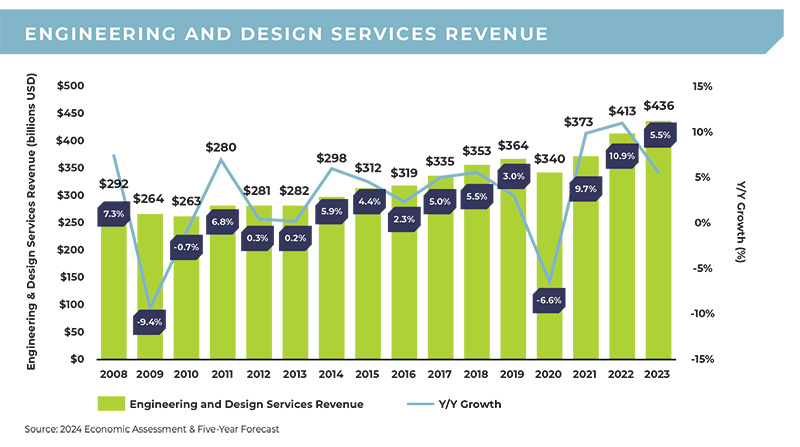
Engineering and design services revenue has climbed steadily over the past decade, reaching $436 billion in 2023—a 5.5% year-over-year increase—according to the American Council of Engineering Companies Research Institute’s 2024 Economic Assessment and Five-Year Forecast.
A Strong Top Line, but Clouds Ahead
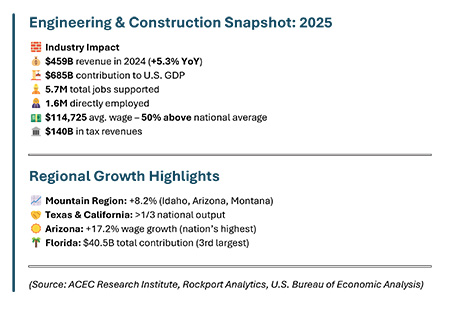
The 2025 Economic Assessment and Forecast, published by the ACEC Research Institute and Rockport Analytics, reports that the engineering and design services industry earned $459 billion in revenue last year, a 5.3% increase from 2023. The subsector supports 5.7 million jobs and added almost $685 billion to U.S. GDP in 2024.
Data from the U.S. Bureau of Economic Analysis pegs the broader construction sector—commercial and residential, collectively—accounting for 4.5% of the U.S. GDP, ranking it among the nation’s largest goods-producing industries.
By comparison, manufacturing represented 9.9%, finance and insurance about 8%, health care and social assistance 7.8%, and professional, scientific and technical services 7.3%.
While smaller than those service-driven contributors, construction’s share places it ahead of transportation, wholesale trade, and information—underscoring its continued importance as a core driver of investment and employment within the physical economy.
“Engineering and design firms are continuing to deliver incredible economic impact to the nation by creating jobs, driving innovation, and enabling infrastructure and development in every community,” said Steve Lefton, chair of the ACEC Research Institute and executive chair of Kimley-Horn.
The institute’s sixth annual analysis found that the sector directly employs 1.6 million Americans and generates $424.7 billion in labor income, with nearly $140 billion in combined federal, state, and local tax revenues.
Average wages for engineering and design services professionals climbed to $114,725, more than 50% above the national average, according to the ACEC Research Institute.
The Mountain Region posted the strongest revenue growth at 8.2%, led by Idaho, Arizona, and Montana, while Texas and California together accounted for more than one-third of total value added.
Arizona recorded the nation’s highest wage growth—17.2% year over year—and Florida, at $40.5 billion, ranked third in total economic contribution.
Despite the strong fundamentals, ACEC and Rockport project growth will moderate to 2.3% in 2025 as firms face elevated borrowing costs, renewed tariff uncertainty and persistent labor shortages.
The study attributes much of the slowdown to the federal government’s 10% universal import tariff—with steel and aluminum duties set at 50%—which has pushed up input prices across multiple construction sectors.
“The engineering industry stands at the intersection of infrastructure, innovation, and workforce transformation,” said Joe Bates, senior research consultant to the institute. “This new research underscores how vital engineering firms are—not just to the built environment, but to America’s overall economic health and competitiveness.”
Fiscal Tailwinds Amid Policy Headwinds
The ACEC study also finds that federal spending continues to play a stabilizing role amid broader economic turbulence.
It estimates that as of September 2025, roughly 40% of Bipartisan Infrastructure Law transportation funding had been disbursed, with another 30% still pending award or allocation.
That pipeline, along with tax-code extensions under President Trump’s signature One Big Beautiful Bill legislation, is expected to support capital investment through 2026, offsetting near-term private-sector caution.
Rockport Analytics projects total industry output could reach $539 billion by 2029 if those fiscal supports remain intact. But the report warns that ongoing tariff policies, combined with high interest rates, have already begun to “filter through supply chains,” driving up project costs and delaying capital expenditures in several states.
The study also notes that U.S. GDP contracted slightly in the first quarter of 2025 before rebounding midyear, and that the design-services sector continues to outperform the broader economy despite those macro fluctuations.
Rising Friction in the Supply Chain
While top-line indicators remain positive, new data from Mobilization Funding show financial strain spreading across the subcontractor base.
The company’s 2025 Construction Delays and Payment Timing Report found that payment cycles lengthened by an average of 8 to 12 days over the past year, with delayed upstream payments from general contractors and owners emerging as the leading cause of project slowdowns.
Nearly two-thirds of subcontractors cited cash-flow strain as their top business challenge entering 2025.
“The funding environment has tightened considerably for small and midsize firms,” the report stated. “Payment predictability has eroded even as contract values rise, forcing more firms to turn to alternative financing just to maintain project momentum.”
Payment delays were most severe in the Southeast and Mountain regions, where material inflation and weath disruptions compounded scheduling impacts, while the Mid-Atlantic recorded the shortest average collection cycles.
Although analysts described the broader market as stable, they cautioned that rising borrowing costs are compressing margins for firms reliant on short-term credit.
“Liquidity is becoming the critical differentiator between firms that can absorb volatility and those that can’t,” the report concluded.
Selective Investment and Technology’s Limits
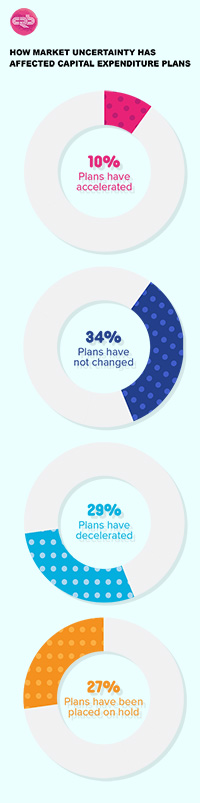
Most life-science firms have slowed or paused 2025 capital-spending plans amid market uncertainty, with only 10% accelerating investment, CRB’s Horizons: Life Sciences 2025 report shows.
At the client level, CRB’s Horizons: Life Sciences 2025—based on a survey of 400 global executives in biopharma R&D, manufacturing, and capital delivery—adds nuance to the broader picture. The data show firms are expanding capacity but recalibrating project scope and timing to manage regulatory and economic uncertainty.
The report, produced by CRB’s Horizon Thought Leadership Team, describes measured optimism: continued capital investment, but a shift toward smaller, modular, and more flexible facilities.
Firms are onshoring manufacturing to hedge against trade and tariff risks while maintaining global R&D networks.
Artificial intelligence and process-intensification technologies are increasingly used to improve efficiency, though workforce expertise remains a limiting factor.
“The market is at a crossroads between innovation and caution,” said Peter Walters, CRB’s fellow of advanced therapies and coauthor of the study.
“Our clients are optimistic about growth but are emphasizing speed-to-market and flexibility over sheer size,” he added. “It’s about smarter investment rather than larger investment.”
Across all three studies, AI and productivity emerged as central themes. According to ACEC, 85% of engineering firms now consider AI critical to competitiveness, and early adopters have realized approximately 2% higher revenue and employment growth than peers.
CRB finds similar momentum in predictive modeling and digital twins, while Mobilization Funding notes that contractors are increasingly adopting financial-management software—though smaller firms lag in implementation.
All three organizations caution that technology alone will not offset demographic pressures. ACEC reports that 25.6% of the current engineering workforce is over age 55, while engineering degree completions have remained flat since 2020—about 20,500 civil engineering and 18,600 architecture graduates annually.
The ACEC report also notes that industry unemployment rose from 1.7% to 2.4% in early 2025, a modest but notable shift in an otherwise tight labor market.
The Takeaway
The reports collectively depict a sector that balances resilience with risk. Engineering and design remain foundational to the U.S. economy, as each billion dollars in output sustains tens of thousands of downstream jobs.
However, persistent payment delays, liquidity constraints, and cautious capital planning suggest that the foundation supporting growth is under stress.
Looking for a reprint of this article?
From high-res PDFs to custom plaques, order your copy today!

.webp?height=740&t=1767036885&width=auto "Header - BE 1170x658 (002).png")

.webp?height=740&t=1755781744&width=auto "KEE(2).png")
.webp?height=200&t=1732303008&width=200 "GAF(2).png")
.webp?height=200&t=1757607265&width=200 "August-PPI-Report-(2)")