Testing at the Top
Completed in the spring of 2008, the cool and green roof demonstration/research project of Ann Arbor, Mich.-based architecture and design firm A3C took place atop its UrbEn Retreat. The project was implemented with the assistance of Firestone Building Products and in collaboration with Prof. Moji Nawab of the University of Michigan’s Sustainable Design Research Lab.
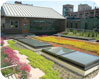
Completed in the spring of 2008, the cool and green roof demonstration/research project of Ann Arbor, Mich.-based architecture and design firm A3C took place atop its UrbEn Retreat. The project was implemented with the assistance of Firestone Building Products and in collaboration with Prof. Moji Nawab of the University of Michigan’s Sustainable Design Research Lab. The planting of 2,500 plugs in the loose-laid portion of the green roof was completed in May 2008 with the assistance of a dozen local master gardeners.
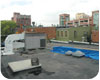
 The EPDM in the northwest corner was divided into four strips. The northernmost section was left black, while the next section to the south was coated grey. The next southern section was then colored buff, while the southernmost section was coated white. The roof coating material is designed to absorb less invisible “near-infrared” radiation (NIR), creating a cooler roof with a higher solar reflectance. These cool coatings lower roof surface temperatures, reducing the need for cooling energy.
While research studies on the thermal performance of cool roofs have been done for Minnesota and Maryland, we are not aware of any done in Southeast Michigan that take into consideration the local lake-effect weather, which results in only 2.5 days of clear sky per month during a typical winter. The 2007-2008 winter was colder and snowier than our typical winters, but it also had a few more clear-sky days. It was also our intent to study the differences between cool roofs, and between cool roofs and green roofs of varying depths during a full year.
Live Roof/Hortech provided a 4-inch pre-vegetated tray system, and Xero Flor provided a 2.5-inch mat system. We worked with Jorg Breuning of Green Roof Services in the design of the extensive and semi-intensive loose-laid systems. Atwell Hicks’ William Knighton assisted with plant selection.
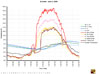
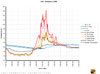 Data from the first day of summer 2008 showed the outdoor temperature went from 60 degrees in the early morning to 75 degrees during the afternoon. It was a partly cloudy day, as evidenced by the spikes in the temperature. During that time, the temperature under the black roof membrane added 23 degrees of additional heat versus the outdoor temperature, going from 60 degrees to 98 degrees. The grey and buff roofs had temperature highs of 85 and 80 degrees. The white roof reduced the thermal load to basically the outdoor temperature, resulting in only a 5-degree rise in temperature.
Under the shallow green roof adjacent to the cool roof strips, the temperature went from 60 to 68 degrees - never adding a thermal load at all. It actually helped keep the building cool. Similar results were seen in spring and fall as well. The winter chart shows that the green roof did help keep the roof warmer than the cool roof. This is probably in part due to the snow, which accumulates on the roof and the green roof acts as a thermal mass between the snow and the roof membrane.
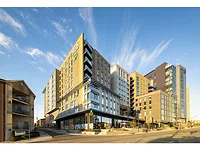
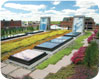
A3C’s LEED-CI Gold Sustainable Showcase & UrbEn Retreat has won nearly a dozen different local and regional awards for its sustainable accomplishments. (Photos by Charles Turok of A3C.)
Completed in the spring of 2008, the cool and green roof demonstration/research project of Ann Arbor, Mich.-based architecture and design firm A3C took place atop its UrbEn Retreat. The project was implemented with the assistance of Firestone Building Products and in collaboration with Prof. Moji Nawab of the University of Michigan’s Sustainable Design Research Lab. The planting of 2,500 plugs in the loose-laid portion of the green roof was completed in May 2008 with the assistance of a dozen local master gardeners.
This shot shows the A3C roof before the renovation.
The Subjects
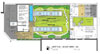
The roof consists of three different types of membrane roofing. The south end and northwest corner of the roof are 60-mil black EPDM. The northeast corner of the roof is a specially coated TPO, and the center section of the roof is a green roof with a 60-mil white TPO roof membrane and a 45-mil slip sheet/root barrier. Four and a half inches of closed-cell polyurethane was installed on top of the wood decking with a top layer of a half-inch paperless gypsum product on the insulation. The combined R-value of the roof is R-30, which is 50 percent more than the current ASHRAE prescriptive requirement for the state of Michigan.Figure 1. Summer temperatures recorded on June 4, 2009.
While research studies on the thermal performance of cool roofs have been done for Minnesota and Maryland, we are not aware of any done in Southeast Michigan that take into consideration the local lake-effect weather, which results in only 2.5 days of clear sky per month during a typical winter. The 2007-2008 winter was colder and snowier than our typical winters, but it also had a few more clear-sky days. It was also our intent to study the differences between cool roofs, and between cool roofs and green roofs of varying depths during a full year.
Live Roof/Hortech provided a 4-inch pre-vegetated tray system, and Xero Flor provided a 2.5-inch mat system. We worked with Jorg Breuning of Green Roof Services in the design of the extensive and semi-intensive loose-laid systems. Atwell Hicks’ William Knighton assisted with plant selection.
A3C’s Demonstration Green Roof reduces storm water runoff by 34 percent through a rainwater capture system and demonstration green roofs modeling semi-intensive and extensive designs.
Data Collection
A total of eighteen sensors were installed so each area could be monitored, and each area has a primary and backup sensor. Sensors are installed just under the membrane, just above the deck and just below the roof structure within the conditioned space. Data is collected at 4-minute intervals. This data is regularly downloaded and converted to spreadsheets to allow both numerical and graphical comparison. (See Figures 1 and 2.)Figure 2. Fall temperatures recorded on Oct. 2, 2008.
Under the shallow green roof adjacent to the cool roof strips, the temperature went from 60 to 68 degrees - never adding a thermal load at all. It actually helped keep the building cool. Similar results were seen in spring and fall as well. The winter chart shows that the green roof did help keep the roof warmer than the cool roof. This is probably in part due to the snow, which accumulates on the roof and the green roof acts as a thermal mass between the snow and the roof membrane.
The roof planting includes 25-plus plant varieties and 2,500 plus plugs and plants that were hand planted. The thermal performance of these green roofs and of the different color coated membrane roofs are being recorded and analyzed.
Results
After a full year of recording the performances of the different cool roofs and different-depth green roofs, we found that the green roofs performed better than the white cool roof with regard to cooling. But because of the amount of insulation, the thermal load due to the roof was negligible between the cool white roof and the green roof. That said, we would always recommend a green roof if budget or structure allowed. Green roofs provide a wider range of benefits beyond thermal performance - including stormwater runoff quality and quantity, and extending the life expectancy of the membrane roof - as well as intangibles like aesthetics. Green roofs can also act as a desirable gathering spot, especially if you have a gathering/meeting spot overlooking the park-like green roof as we do in the UrbEn Retreat.Looking for a reprint of this article?
From high-res PDFs to custom plaques, order your copy today!
.webp?height=740&t=1767036885&width=auto "Header - BE 1170x658 (002).png")

.webp?height=740&t=1755781744&width=auto "KEE(2).png")