The Evolving Role of Protective Coatings in Modern Building Envelopes
There’s a critical need for coating solutions that can streamline formulation, offer modular flexibility and provide value-added features

Without protective coatings, surfaces are vulnerable to mold, moisture and UV damage, leading to faster degradation and difficult-to-clean buildup.
Modern building envelopes face numerous challenges, including the need for long-term durability, withstanding environmental stressors and meeting sustainability expectations. These pressures require more than surface-level solutions. While coatings were once viewed primarily as a finishing touch, they have now evolved to be integral components of building performance, playing a vital role in a building envelope’s longevity and overall integrity. As coating technology advances, architects, engineers and manufacturers are seeking solutions that offer multiple benefits in a single application. This shift positions coatings not just as surface finishes, but as foundational tools that will shape the future of durable, high-performing and environmentally responsible building design.
The Fundamental Need for Multifunctional Coatings
Despite significant technological advancements, many coating formulations remain underleveraged because their benefits, such as abrasion resistance or chemical durability, are not clearly understood by consumers. At the same time, product development cycles are growing longer, and manufacturers are under pressure to reduce waste, lower costs and meet sustainability goals. There’s a critical need for coating solutions that can streamline formulation, offer modular flexibility and provide value-added features that are both visible and meaningful to end users.
The next generation of coatings should integrate multiple layers of protection:
- Physical Durability: Protecting against everyday wear, scratches, impacts and abrasion to extend the service life of surfaces.
- Chemical Resistance: Acting as a shield against corrosive agents, harsh cleaners and airborne pollutants that can quickly degrade unprotected materials.
- Biological Resistance: Inhibiting the growth of mold, mildew, and bacteria, which is a growing concern in building interiors and HVAC systems, especially in humid environments.
This multifunctional approach not only improves building performance but also simplifies decision-making for architects, engineers and manufacturers. By consolidating protective properties into a single system, material specification becomes easier, installation becomes more efficient and long-term maintenance costs could be significantly reduced. The value proposition extends beyond appearances as it leads to fewer repairs, improved occupant comfort and a more sustainable lifecycle for the building itself.
Ultimately, multifunctional coatings represent a shift from reactive problem-solving to proactive building design.
Unlocking Performance: Advanced Coatings Technologies
The next generation of building coatings is rooted in advanced polymer chemistry and surface engineering. By carefully designing materials at the molecular level, scientists can create tailored systems that deliver multiple protective functions simultaneously. These innovations extend coatings beyond their traditional role as passive barriers, transforming them into active components of a building's performance and longevity.
One of the most significant breakthroughs lies in the development of hydrophobic and omniphobic surfaces. Hydrophobicity refers to a material’s ability to repel water, while omniphobicity includes resistance to oils and other contaminants. Applied to building facades, glass curtain walls or exterior cladding, these coatings ensure that rain, dirt and pollutants bead up and roll off the surface rather than adhering to it. The result is easier-to-clean surfaces, reduced streaking or staining and a dramatic decrease in maintenance demands. These are critical advantages for large commercial buildings or high-rise structures where cleaning is costly and labor-intensive.
UV stability represents another essential benefit of high-performance coatings. Prolonged sun exposure is one of the leading causes of material degradation, resulting in cracking, fading and structural weakness over time. Coatings engineered for UV stability protect exterior surfaces from these effects, significantly extending the life of the building envelope. This durability not only preserves aesthetics but also contributes to sustainability by reducing the need for premature repairs or material replacement.
In addition, the integration of antimicrobial and antifungal properties addresses a growing concern in modern building design: the cleanliness of interior environments. Coatings with these features prevent the growth of mold, mildew and bacteria, which are common in HVAC systems, restrooms and areas exposed to high humidity. By minimizing microbial buildup, these products and surfaces stay cleaner, and maintenance operations tied to cleaning or remediation are reduced.
Together, these technological advancements unlock a new level of performance for the built environment. Multifunctional coatings not only protect materials from the forces of nature but also extend building lifespans, simplify upkeep and support long-term energy and sustainability goals. These advanced coatings are enablers of smarter, more resilient design.
A Scalable Approach: Simplifying Formulation and Application
As coating technologies evolve, one of the biggest hurdles manufacturers face is application complexity. Delivering physical, chemical and biological resistance in a single system can often require multiple layers or specialized treatments, with each adding cost, time and potential points of failure. To be practical for wide adoption, multifunctional coatings must not only perform but also scale efficiently in formulation and application.
This is where advances in additive technologies play a pivotal role. For instance, AkoTech™ by Microban International illustrates how antimicrobial functionality can be seamlessly integrated into coating chemistries at the formulation stage. Instead of requiring an additional coating layer or post-application treatment, antimicrobial additives disperse uniformly, maintaining the integrity of the system while reducing formulation complexity.
Equally important is the flexibility of integration. Manufacturing environments range widely, from smaller operations with limited production runs to global companies managing large-scale, distributed supply chains. To address these differences, coating platforms like AkoTech are designed for multiple integration pathways. Ready-to-use systems simplify the process for smaller or fast-paced operations by eliminating extra weighing, mixing or dispersion steps, while concentrated solutions support scalability for larger manufacturers by enabling localized blending and dilution.
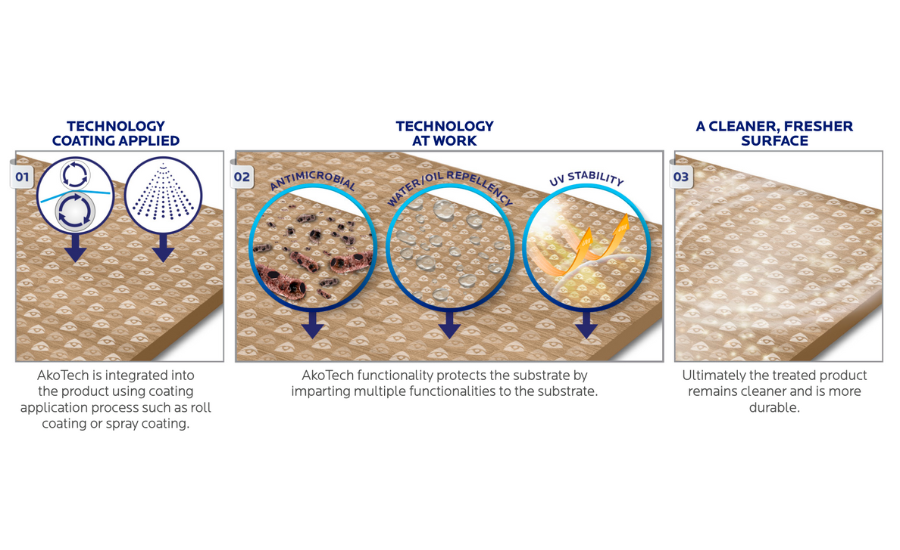
AkoTech integrates antimicrobial technology, water/oil repellency and UV stability to keep substrates cleaner, fresher and more durable.Image courtesy of Microban International
This kind of flexibility supports a larger principle of scalable innovation. By reducing trial-and-error cycles, minimizing the need for specialized equipment and streamlining formulation, multifunctional coatings become more accessible to manufacturers of all sizes. In turn, the industry can bring advanced performance technologies to market faster, with fewer barriers to adoption.
Applications in Practice: Case Studies in the Built Environment
The benefits of multifunctional coatings become most tangible when applied to real-world building environments. Exposed concrete and masonry facades, for example, face constant challenges from weathering, airborne pollutants and occasional vandalism. High-durability, water-based coatings can act as clear protective shields, preserving both appearance and structural integrity. Performance metrics like hardness, adhesion and chemical resistance demonstrate how these coatings protect underlying materials from erosion, staining and other forms of degradation, translating laboratory data into measurable, real-world outcomes. By providing multiple layers of protection in a single application, these coatings reduce maintenance needs and extend the lifecycle of the building envelope.
Large glass curtain walls present a different set of challenges, particularly in maintaining clarity and minimizing cleaning requirements. Thin, transparent coatings that create omniphobic surfaces actively repel water and oils, preventing streaking, residue build-up and unsightly stains. When antimicrobial functionality is integrated, these surfaces also reduce microbial growth in high-touch or moisture-prone areas without affecting visual clarity. Data such as contact angle measurements and surface energy analyses illustrate how these coatings maintain cleanliness and simplify maintenance cycles, demonstrating the practical impact of multifunctional technologies across various building components.
By translating technical data, such as hardness, adhesion, chemical resistance and surface repellency, into real-world outcomes, building professionals can see how advanced coating technologies protect materials, simplify maintenance and support sustainable, long-lasting construction.
The Future of High-Performance Building Materials
The evolution of coatings reflects a broader shift in building design: moving away from single-purpose solutions toward integrated systems that address multiple challenges simultaneously. By combining physical durability, chemical resistance, UV stability and antimicrobial protection, multifunctional coatings are helping to enhance surface cleanliness, extend building lifespans and reduce maintenance demands.
Advances in the underlying science of polymer chemistry, surface engineering and additive technology have made it possible to embed these features directly into coating systems. This scalable approach ensures that high-performance properties are not just theoretical but achievable in everyday applications, from HVAC components to exterior facades.
The adoption of advanced coatings encourages innovation across the construction and manufacturing sectors. It challenges formulators, architects, and engineers to think holistically about material performance, considering how multiple protective properties can work together to meet diverse environmental and operational conditions. This integrated approach not only benefits the individual building but also sets new standards for durability, cleanliness and energy efficiency in the built environment.
As buildings face growing demands, multifunctional coatings provide a proactive solution. They transform surfaces into active participants in building performance, helping to safeguard investments, support sustainable practices and ensure that structures remain functional for decades to come.
Looking for a reprint of this article?
From high-res PDFs to custom plaques, order your copy today!
.webp?height=740&t=1767036885&width=auto "Header - BE 1170x658 (002).png")

.webp?height=740&t=1755781744&width=auto "KEE(2).png")
.webp?height=200&t=1758044646&width=200 "Sto Corp(6).png")
.webp?height=200&t=1763388744&width=200 "YMCA(1).png")
.webp?height=200&t=1706129445&width=200 "Coil coatings in a sustainable environment (1).jpg")