Scientists Test Tallest Steel-Framed Building on Earthquake Simulator to Push Height Limits
UC San Diego researchers hosted the largest-ever test of cold-formed steel construction under earthquake conditions.
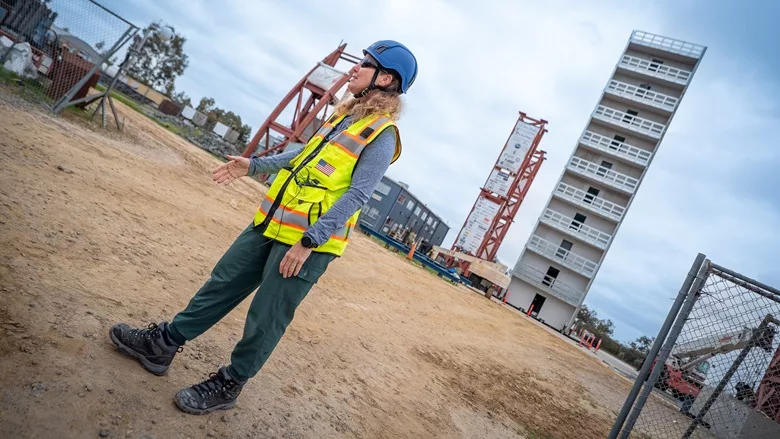
Tara Hutchinson, a professor in the UC San Diego Department of Structural Engineering, is the lead researcher on a series of tests on a 10-story, cold-formed steel-framed building at the UC San Diego outdoor earthquake simulator. Image: David Baillot/UC San Diego Jacobs School of Engineering
The tallest steel-framed building ever tested on an earthquake simulator recently underwent extensive seismic testing at the University of California, San Diego, with researchers examining whether height limits for cold-formed steel construction could be increased from the current 65-foot restriction to 100 feet.The 10-story, 103-foot structure was subjected to 18 earthquake simulations of increasing intensity on UC San Diego's Large High-Performance Outdoor Shake Table (LHPOST6), one of the world's three largest seismic simulators and the only one located outdoors. The tests included recreations of real earthquakes, including the 6.9 magnitude 1989 Loma Prieta earthquake.
The testing utilized a major $17 million upgrade to the shake table, funded by the National Science Foundation, which was completed in April 2022. The upgrade expanded the table's capabilities from single-directional movement to six degrees of freedom, allowing it to simulate realistic earthquake conditions, including up-and-down, side-to-side, and rotational motions.
"The building performed very well," said Tara Hutchinson, the project's lead researcher and a professor in UC San Diego's Department of Structural Engineering, in a story by Ioana Patringenaru for UC San Diego Today. "Despite 18 earthquake tests of increasing intensity—including three very large at and above what design engineers must consider in designing a building—the load-bearing structural system retained its integrity."
The tests focused on cold-formed steel, a lightweight, sustainable material made from 60% to 70% recycled metal that is non-combustible. Current building codes limit CFS construction to 65 feet or six stories; however, researchers are investigating whether this limit could be increased to 10 stories in seismically active areas.
The test building integrated multiple construction approaches, including conventional stick-framing, panelized construction, and volumetric modular construction, within a single structure. This allowed researchers to compare the efficiency and structural performance of different methods.
The building also featured a seismically resilient stair system, designed to remain functional during earthquakes, which is crucial for safe building evacuation. Nearly 1,000 sensors were installed throughout the structure to measure acceleration, displacement, and local strains.
Following the seismic tests, researchers are conducting live-fire testing to understand how fire spreads through earthquake-damaged compartments—a scenario known as "fire-following earthquakes." Professor Richard Emberley at California Polytechnic State University, San Luis Obispo, is leading these tests.
"CFS is non-combustible, unlike wood and some other building materials, an important beneficial characteristic if fires are a concern," Hutchinson told UC San Diego Today.Multiple agencies, including the National Science Foundation, the U.S. Department of Housing and Urban Development, the California Seismic Safety Commission, and the National Institute of Standards and Technology, sponsor the CFS-NHERI project. Industry supporters include the American Iron and Steel Institute, Steel Framing Industry Association, and numerous construction companies.
The research aims to generate data that can inform building codes and standards, enabling taller, more sustainable construction using cold-formed steel in earthquake-prone regions.
What is an Earthquake Shake Table?
An earthquake shake table is a sophisticated testing apparatus that enables controlled replication of seismic ground motions for full-scale structural testing. The system consists of a reinforced steel platform connected to high-precision hydraulic actuators that can reproduce the complex three-dimensional movements experienced during actual earthquakes.
How it works
The shake table operates by programming actuators to recreate documented ground motion records from significant seismic events, including the 1994 Northridge earthquake (magnitude 6.7) and the 1989 Loma Prieta earthquake (magnitude 6.9). These motion profiles are derived from actual seismographic data, ensuring testing conditions reflect real-world seismic forces that structures must withstand.
When full-scale buildings or structural assemblies are constructed on the table platform, they experience the same accelerations, velocities, and displacements that would occur during the original earthquake. This provides invaluable data on structural performance, including:
• Load path behavior under dynamic conditions
• Connection performance and failure modes
• Lateral force resisting system effectiveness
• Nonstructural component response
• Progressive damage accumulation
Applications for wall and ceiling professionals
For engineers and architects working with wall and ceiling systems, shake table testing provides critical insights into:
• Partition wall performance: How non-load-bearing walls respond to inter-story drift and out-of-plane accelerations
• Ceiling system behavior: Suspended ceiling performance under seismic loading, including grid distortion and tile displacement
• Connection detailing: Validation of seismic separation joints and drift-compatible connections
• Component fragility: Quantification of damage thresholds for performance-based design
Current research impact
The ongoing CFS-NHERI project exemplifies how shake table data directly influences design standards. By testing a 10-story cold-formed steel structure beyond current ASCE 7-22 height limitations, researchers aim to generate the evidence needed to revise building codes and expand design possibilities for mid-rise CFS construction.
This type of full-scale validation testing provides the empirical foundation necessary for code development committees to make informed decisions about structural design parameters, ultimately expanding the toolkit available to structural engineers and architects while maintaining safety standards.
Watch the video: https://today.ucsd.edu/story/engineers-shake-tallest-steel-framed-building-ever-to-be-built-on-an-earthquake-simulator
Looking for a reprint of this article?
From high-res PDFs to custom plaques, order your copy today!
.webp?height=740&t=1767036885&width=auto "Header - BE 1170x658 (002).png")

.webp?height=740&t=1755781744&width=auto "KEE(2).png")