Building Enclosure logo
search
cart
facebook twitter linkedin youtube instagram Spotify Podcasts Apple Podcasts Spotify Podcasts Apple Podcasts
  • Sign In
  • Create Account
  • Sign Out
  • My Account
Building Enclosure logo
  • NEWS
    • Breaking News
  • SECTIONS
    • Columns
    • Project Profiles
    • Trade Shows
    • Sponsor Insights
  • SYSTEM DESIGNS
    • Low-Slope Roofs
    • Pitched Roofs
    • Metal Roofing Materials
    • Waterproofing
    • Sustainability
    • Insulation
    • Exterior Claddings
    • Wall Systems
    • Building Envelope
  • BLOG
    • The BE Blog
  • MEDIA
    • Podcasts
    • Webinars
    • Quiz
    • Videos
    • Polls
    • Interactive Spotlights
    • Newsletter
    • Photo Galleries
  • DIRECTORIES
    • Directory: Blue Book
    • Directory: Roofing Resource
  • PRODUCTS
  • TECHNICAL
    • Codes
      • Waterproofing
      • Roofing
    • Details
      • Waterproofing
      • Roofing
  • CONTINUING ED
  • ABOUT
    • Advertise
      • Editorial Calendar
    • Contact
    • eMag Archive Issues
  • SIGN UP!
Project ProfilesWall Systems

Stabilization of Major Structural Works Within Building in Central London

The structure suffered movement due to poor ground beneath old timber foundations

12mm diameter Cintec consolidation anchors were attached to all areas of walls at ground and basement levels which would be affected by the works to form openings.

All photos courtesy of Cintec.

February 19, 2025

Cintec International Ltd were invited to devise a scheme in conjunction with the client’s structural engineers, for the stabilization of a magnificent Grade 2* listed building in 2023. 

Built between 1743 and 1764 the Neo-Palladian style building had been in commercial usage for many years and been subject to extensive alterations and modifications during that part of  its life. 

In addition to alterations the structure had suffered movement due to poor ground beneath old timber foundations which necessitated substantial underpinning. 

Major new modifications and alterations were now planned making the complete stabilization necessary before those works commenced. 

A further complication was the listed status of the building as a number of large new structural  openings would be formed at basement level requiring removal of long lengths of thick internal  structural walls at that level. 

Consequently the traditional support method of needling and propping the walls above new  openings was not possible as the internal walls needed to be preserved by the conservation  architects. 

Cintec International and their engineers MDHP were therefore tasked with the design of the  anchor support system which would be installed within the internal walls above all the new  openings, to carry the imposed loads which were up to 700kN/m. 
Cintec.png

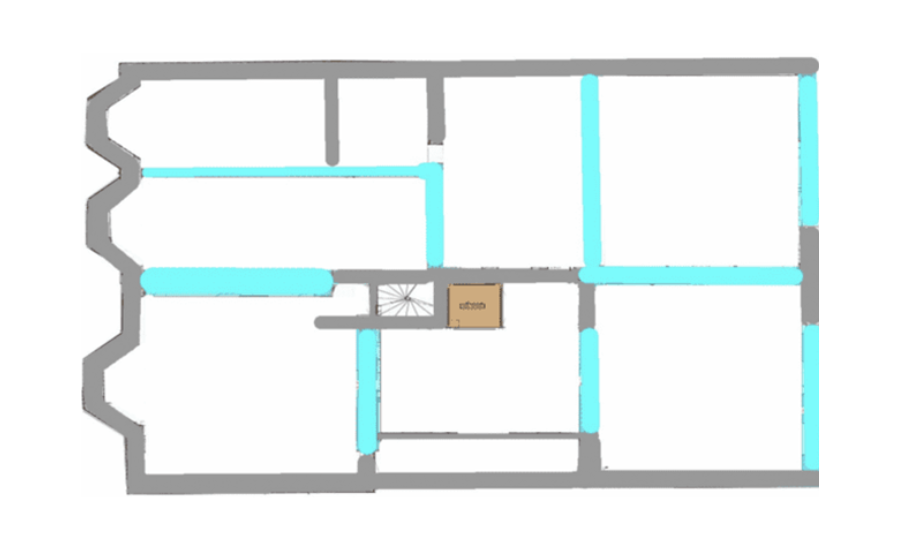
The blue shaded areas in the plan above indicate the intended location of the Cintec anchors within the  ground floor walls above the new openings in the basement. So a substantial proportion of the walls  would be removed which presented a huge structural challenge. 

The walls were up to 1200mm in thickness and consisted mostly of brickwork of varying ages and quality.


Preserving the Past for the Future

The first task was to install 12mm diameter Cintec consolidation anchors to all  areas of walls at ground  and basement levels which  would be affected by the  works to form openings. 

The nature of the walls  was variable and to ensure  their structural integrity, as  the imposed loads were so high being up to 700kN/m, the anchors were installed at approximately 500mm  horizontal vertical intervals  and at closer centers if  deemed necessary by the  engineer, and around  openings installed at  300mm centers. 

A further important task  was to provide lateral restraint to all internal and external walls which would  provide the necessary stability both during alterations and to ensure longevity in the future. This was accomplished by  installing threaded Cintec anchors to the perimeter of every floor and attaching  either an “Armlock” or “X Lock” fitted to the joists. 

This then used the floors as a diaphragm and created a  stable “box” structure within the building. A total in excess of 300 lateral restraint devices were  installed.

In conjunction with the client’s engineers the specification and methods of lateral restraint were agreed. The consolidation anchor and main reinforcement anchors were determined by MDHP’s calculations using the imposed load advised by the client’s engineers. 

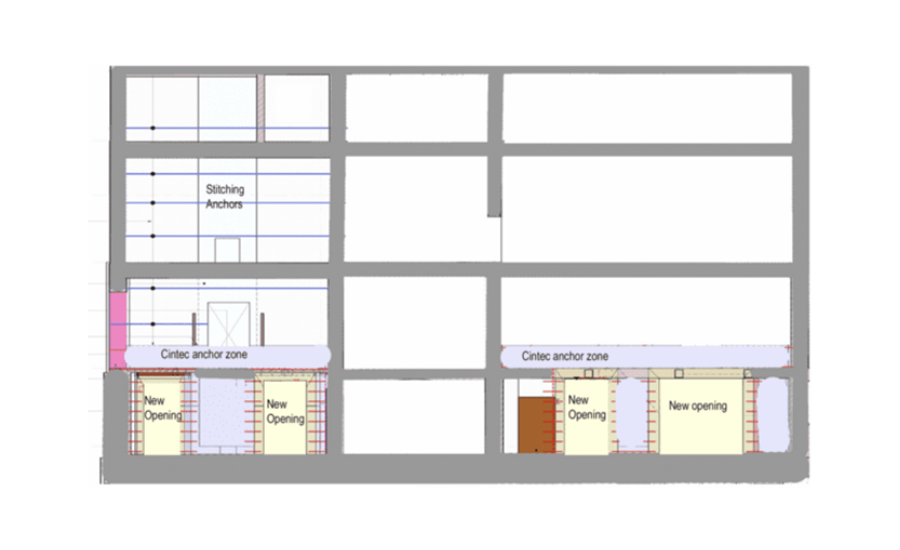
The general layout and pattern were agreed along with the extent and scope of work. Longitudinal stitching anchors were agreed and shown on the construction drawings along with schedules for lateral restraint and consolidation. 
Cintec(1).png

All agreed anchor locations were shown on the construction drawings subsequent to agreement by the project architects and conservation officer. The lines in red and blue indicate anchors.

Once the Cintec consolidation anchors had been installed the main anchors could be installed within the ground floor wall thicknesses to carry the imposed loads being up to 700kN/m. 

The anchors were Cintec GB24 in 65mm diameter core  drilled holes and up to 11.00 meters in length. As these anchors could not be drilled externally from the  building as access was restricted by either too much scaffolding or none at all, all the drilling had to be from within the door openings in each respective wall at ground floor level. This entailed making the anchors in 1500mm lengths and coupling them together whilst feeding them into each side of  the openings to the correct overall length. 

Grouting was then carried out in both directions. The restriction on drilling and installing increased the duration of the operation but additional teams of operatives were  used to carry out works concurrently. In excess of 600 meters of the GB24 anchors were installed. After the anchor installation was completed the ground floor  openings, from where the drilling was carried out, required  propping and strutting to resist compression forces when the  wall below was removed. 

This was only a temporary measure as reinforced concrete portals would be formed as permanent support for the new openings. As the imposed loads were of a high magnitude the engineers required temporary intermediate propping in the basement to reduce the unsupported span during the opening up  works to a maximum of 1250mm and each capable of carrying 325kN load. 

Additional 12mm stud anchors were installed into the sides of new openings to tie the new in-situ concrete portals to the  existing masonry. Finally, a total of more than 180 meters of Cintec 16mm diameter stitching anchors in 65mm diameter holes, up to 10 meters in length, were installed into the two end walls to provide additional restraint to the east façade and to stitch over  existing vertical cracks in both walls. 

Despite the working and access restrictions the structural stabilization works were completed on program and without  any issues being experienced when the openings up to  5.00m in width were formed at basement level.

KEYWORDS: anchoring foundation international building structural engineering

Share This Story

Looking for a reprint of this article?
From high-res PDFs to custom plaques, order your copy today!


Recommended Content

JOIN TODAY
to unlock your recommendations.

Already have an account? Sign In

  • bar graph shows LEED v4/LEED v5/LEED v6 in various colors

    When Will LEED v4 / v4.1 and LEED v5 Expire?

    The latest version of the LEED rating system, LEED v5, is...
    Sustainability
    By: Daniel Overbey
  • Celebrating Women In AEC-2026

    Celebrating Women in The AEC Industry Part 1

    A round-up of women in the design, engineering and...
    Building Envelope
    By: Lindsay Lewis
  • KEE membrane application on a roof

    A Beginner’s Guide to Single-Ply Roofing Membranes

    While PVC and TPO appear extremely similar, the chemistry...
    Low-Slope Roofs
    By: Peter Gross
Manage My Account
  • Sign up for the Newsletter
  • Online Registration
  • Manage My Preferences
  • Registration Customer Service

More Videos

Sponsored Content

Sponsored Content is a special paid section where industry companies provide high quality, objective, non-commercial content around topics of interest to the Building Enclosure audience. All Sponsored Content is supplied by the advertising company and any opinions expressed in this article are those of the author and not necessarily reflect the views of Building Enclosure or its parent company, BNP Media. Interested in participating in our Sponsored Content section? Contact your local rep!

close
  • 2 construction workers and a DEXcell panel
    Sponsored byDEXcell Roof Boards

    Designing Low-Slope Roofs for Resilience

  • Bell Bank headquarters in Fargo, North Dakota
    Sponsored bySto Corp.

    Drained and Back-Ventilated Rainscreens vs Pressurized-Equalized Rainscreens

  • A construction worker using DEXcell roof boards
    Sponsored byDEXcell Roof Boards

    The Hidden Strength of Low-Slope Roof Systems: Why Roof Cover Boards Matter

Popular Stories

construction industry workers in hard hats stand around a city scape

Construction Industry Revolts Over New CSI Licensing Plan

a man wearing a mask installs insulation into a wall system

Quiet Rooms and Healthier Air: A Second Look at What Goes Inside the Wall Cavity

Canalino Elementary School and Canalino Family School exterior

Daylighting Design to Support Rapidly Growing Trend in Modular Building Construction

Building Enclosure Newsletter

BE Poll

Events

June 17, 2025

Addressing Condensation in Low-Slope Roof Assemblies

Credits: 1 AIA LU/HSW; 0.1 ICC CEU; 1 IIBEC CEH; 0.1 IACET CEU

On Demand In modern roofing systems, vapor retarders and air barriers do more than just minimize air leakage—they’re essential to maximizing performance and longevity. This engaging course dives into the next generation of moisture control: permeable vapor retarders and air barriers. Discover how these cutting-edge technologies are transforming low-slope roofing assemblies by improving energy efficiency, managing moisture, and boosting wind uplift resistance.

April 9, 2026

Strategies for High-Performance Below-Grade Waterproofing

Credits: 1 AIA LU/HSW ; 1 IIBEC CEH; 0.1 IACET CEU

On-Demand Designing a high-performance building enclosure requires more than just surface-level protection; it demands a rigorous, performance-based mastery of below-grade water and gas mitigation. This discussion will provide an expert-level analysis of below-grade waterproofing within the comprehensive framework of the high-performance building enclosure.

View All Submit An Event

Products

Plaster and Drywall Assemblies Manual

Plaster and Drywall Assemblies Manual

This is a comprehensive manual that goes beyond codes and standards, providing expert guidance in design, detailing, material selection and troubleshooting for plaster and drywall.

See More Products

Related Articles

  • After_Roof replacement on Stone Building decorative copper repair and masonry repairs have been performed

    Gale Associates Leads $20.4M Stabilization of Maine’s Historic Stone Building

    See More
  • ‘Building within a Building’ for Savings

    See More
  • N. Trinity Way

    LRS Architects Designs Three Affordable Housing Projects in Central Oregon

    See More

Related Products

See More Products
  • ecology.jpg

    Architecture and Systems Ecology: Thermodynamic Principles of Environmental Building Design, in three parts

  • interior design.jpg

    Building Systems in Interior Design

  • bni book

    BNi Building News Public Works Costbook 2026 (Print Edition)

See More Products

Events

View AllSubmit An Event
  • October 16, 2025

    Development and Adoption of Air Leakage in Building Codes

    Credits: 1 AIA LU/HSW; 0.1 IIBEC CEH; 0.1 ICC CEUOn-Demand This presentation will discuss the development of air leakage requirements in the model energy codes for commercial buildings. It will then describe the status of adoption of model codes by the states. Finally, the implications for enforcement through whole building airtightness testing of the adopted code will be discussed.
View AllSubmit An Event
×

Enhance your expertise with unparalleled insights.

Join thousands of building professionals today. Shouldn’t you know what they know?

SUBSCRIBE TODAY!
  • RESOURCES
    • Advertise
    • Contact Us
    • Store
    • Want More
  • SIGN UP TODAY
    • Create Account
    • Newsletter
    • Customer Service
    • Manage Preferences
  • SERVICES
    • Marketing Services
    • Reprints
    • Market Research
    • List Rental
    • Survey/Respondent Access
  • STAY CONNECTED
    • LinkedIn
    • Facebook
    • Instagram
    • YouTube
    • X
  • PRIVACY
    • PRIVACY POLICY
    • TERMS & CONDITIONS
    • DO NOT SELL MY PERSONAL INFORMATION
    • PRIVACY REQUEST
    • ACCESSIBILITY

Copyright ©2026. All Rights Reserved BNP Media, Inc. and BNP Media II, LLC.

Design, CMS, Hosting & Web Development :: ePublishing