Cracks and Carbonation Are Inevitable: What’s Your Corrosion Mitigation Plan?

Artist’s conception of corrosion products expanding the volume of the rebar, putting pressure on the concrete overlay, and creating cracks that will allow the ingress of more corrosives. Image courtesy Cortec Middle East.
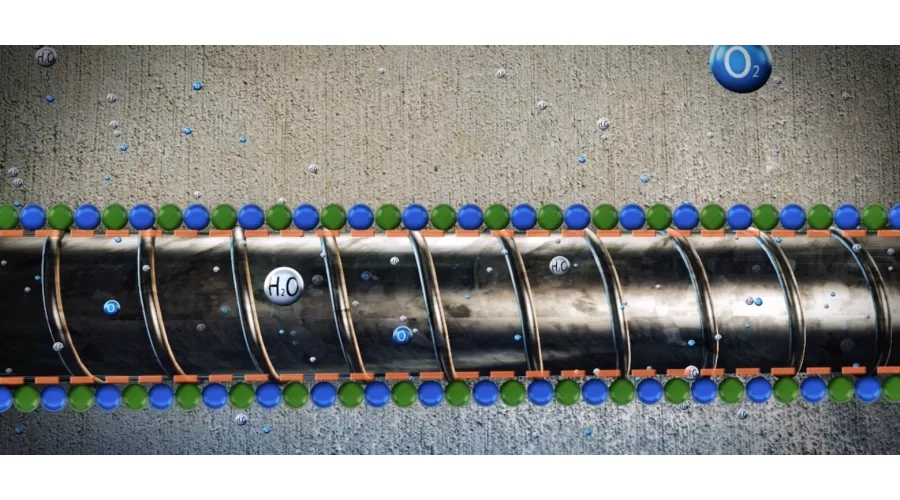
Artist’s conception of how MCI forms a molecular layer on the surface of metallic reinforcement, protecting it from interaction with water, oxygen, and chlorides. Image courtesy, Cortec Middle East.
Corrosion is the Achilles’ heel of reinforced concrete, an otherwise extremely durable, widely used building material. Once corrosion starts, it introduces a vicious cycle: corrosion products expand and put pressure on the overlying concrete, eventually causing it to crack and spall, allowing more corrosive materials to enter and continue the process until a repair is made to preserve structural integrity. While concrete initially offers a pristine protective environment, sooner or later cracks and carbonation will allow corrosion to initiate at the level of the rebar. It is therefore important for engineers and builders to incorporate corrosion mitigation into the design phase of a reinforced concrete structure.
Benefits of Corrosion Protection: Longer Service Life = Resources Saved
But why worry about how long a structure will last since repairs and replacements are a normal part of structural maintenance and may not be needed for years? Aside from the fact that construction plans typically call for a specific design life that engineers must figure out how to meet, extending service life equals resources saved for the party that owns the structure. In these days where sustainable construction is a key watchword, being able to conserve resources is highly relevant. Furthermore, those concerned about the environment may note that concrete production is a huge contributor to greenhouse gas emissions. Therefore, something that can help concrete last longer and eliminate the need for replacement concrete will theoretically reduce carbon output. Even from a practical standpoint, greater durability of a structure can allow the building owner to save time and money that might otherwise be needed for repairs or rebuilding.
Natural Protective Environment Expiration Date
But what about the natural protective environment that new concrete creates for embedded rebar? New concrete has a high pH that initially protects rebar from corrosion. Unfortunately, concrete does not stay alkaline forever. As it reacts with CO2 from the air, it forms calcium carbonates, reducing concrete pH. This carbonation can make its way through concrete at a rate of approximately 1 mm per year, more or less, depending on the quality and porosity of the concrete and other factors (e.g., industrial, metropolitan areas tend to have more CO2 in the air from burning fossil fuels for heat or industrial use).[1] What may occur even sooner is cracking. Shrinkage on new concrete, expansion and absorption from freeze-thaw cycles, heavy loads, and structural shifting can all lead to crack formation, giving corrosive materials—moisture, chlorides, oxygen, and carbon—easier access to the concrete and rebar. Unless the concrete is in a very dry, non-corrosive environment, corrosion is likely at some point in its lifespan. Most builders and engineers therefore should at least consider whether their project warrants special corrosion mitigation measures before proceeding.
What Are Your Environmental Risk Factors?
One of the first things to ask when considering corrosion mitigation is what special environmental risk factors will be present. Some regions are naturally more corrosive than others, whether directly or indirectly. For instance, concrete structures located near the sea will be exposed to higher levels of moisture and chlorides from the seawater. Tropical climates can accelerate corrosion due to high temperatures and humidity. Some regions also deal with high water tables or high-mineral sabkha soil that can bring moisture and chlorides into contact with the building’s substructure. Another serious corrosive factor in some climates is the use of deicing salts. Regions with cold winters, snow, and ice use deicers generously on roads and bridges for commuter safety. These deicing salts attack the surfaces to which they are applied and are also carried by vehicles into parking ramps. Service life prediction models take elements like these into account when calculating a projected service life and are an excellent tool for evaluating the expected benefits of admixtures and some other protective strategies.[2]
What Are Your Budget Constraints?
In addition to looking at service life predictions, engineers must consider time and budget constraints for each project. Strategies like a thicker concrete cover, epoxy coated rebar, and cathodic protection may add years to the service life of the structure but introduce prohibitive costs that take the project out of budget.
What Are Your Application Concerns?
Yet another factor to consider in selecting a corrosion mitigation strategy is to think about application practicality. For example, the use of sacrificial anodes can be time and labor intensive. Also, the use of corrosion inhibiting admixtures, which may be less expensive than other protection methods, can affect properties of the concrete mix and should be carefully considered before selection. Sometimes, the impact depends on the time of year when the job will be done. Calcium nitrite (CNI) admixtures tend to accelerate set time, and, while this may not be a bad feature in the winter, it can raise serious issues in the heat of summer, giving the contractor workability issues and even causing structural concerns such as cold joints. Still other admixtures can decelerate set time, which may be great for hot climates but not the best choice for winter construction when cold temperatures slow drying and curing time. Practically speaking, these characteristics are very relevant to project success because the easier an admixture is to work with in the field, the better the quality of the finished product (and structure) is likely to be.
Corrosion Protection Within Everyone’s Reach
When considering all these factors, Migrating Corrosion Inhibitor (MCI) admixtures based on amine carboxylate chemistry stand out as an excellent option in terms of price and performance. According to the MCI handbook, amine carboxylate formulations can double or triple time to corrosion onset and reduce corrosion rates by five to 15 times thereafter.[3] They can often be added to the concrete mix at a very small fraction of the total construction cost, while significantly increasing service life predictions. For example, the use of an amine carboxylate admixture in the foundation of the Princess Tower more than doubled service life expectancy at 0.07% of the total construction cost.[4] In another project, an engineer saved six figures and added years to the service life prediction by recommending an amine carboxylate admixture as an alternative to epoxy-coated rebar.[5]
Other benefits of the admixture[6] used in the aforementioned projects is that it contains 67% USDA certified biobased content and does not negatively impact concrete properties under ASTM C1582. The chemistry works by forming a protective molecular layer on the surface of the metal via an alkyl polar functional group that adsorbs to the metal and a non-polar hydrophobic tail that interacts with other MCI tails to form a film that microscopically repels corrosive fluids.[7] This so-called “mixed” or ambiodic protection (inhibiting both anodic and cathodic reactions)[8] at the rebar level offers advantages other methods of corrosion mitigation do not have. It is not dependent on maintaining a crack-free, high alkaline environment in the concrete cover and may even keep pH in an optimal range on the rebar surface.[9] If used in combination with epoxy coated rebar, which can be damaged during transport and installation, it can help protect areas of the rebar where the coating has been compromised. Unlike CNI, which raises the chloride threshold by competing with chloride ions to passivate the rebar surface,[10] MCI admixtures are dosed independently of expected chloride levels. Furthermore, several MCI admixtures have been certified to meet NSF Standard 61 for use in drinking water components, enhancing their user-friendly profile.
Plan Your Defense Now
Reinforced concrete will continue to be a widely used structural material for the foreseeable future. Due to the subtle but steady threat of corrosion, it is important for engineers to consider corrosion mitigation techniques in the design stage to maximize building service life and continue protection in the presence of cracks and carbonation. Due to their lower relative cost and advantages, amine carboxylate admixtures are an important option to consider—alone or in conjunction with other methods of corrosion mitigation—when choosing a strategy for structural longevity. Cracks and carbonation are inevitable, so be sure to have a line of defense ready!
References
[1] Hanson, Kayla, P.E. “Understanding Carbonation.” NPCA, 20 Jul 2015. Accessed 20 Jun 2024 .
[2] Examples include Life-365 (http://www.life-365.org/), STADIUM (https://simcotechnologies.com/what-we-do/stadium-technology-portfolio/), and WJE CASLE (https://www.wje.com/expertise/services/detail/corrosion-assessment-and-service-life-evaluation-casle).
[3] Miksic, Boris A., FNACE. Improving Durability of Infrastructure with Migratory Corrosion Inhibitors (MCI®) Handbook. Cortec® Corporation, St. Paul, MN: Jul 2014, p. 10.
[4] MCI® general brochure, p. 3 <https://www.cortecmci.com/wp-content/uploads/2023/01/MCI_Gen_Brochure_01-2023_Final.pdf>.
[5] Holmquist, Julie, Andrea Moore, and Casey Heurung. “Bio-based corrosion inhibitors: Building for resiliency in marine environments.” The Construction Specifier, 19 Sep 2019. Accessed 19 June 2024 at <https://www.constructionspecifier.com/bio-based-corrosion-inhibitors-building-for-resiliency-in-marine-environments/3/>.
[6] MCI®-2005.
[7] Miksic, p. 7-8.
[8] Miksic, p. 7.
[9] Miksic, p. 7.
[10] Miksic, p. 5.
Looking for a reprint of this article?
From high-res PDFs to custom plaques, order your copy today!
.webp?height=740&t=1767036885&width=auto "Header - BE 1170x658 (002).png")

.webp?height=740&t=1755781744&width=auto "KEE(2).png")