Building Enclosure logo
search
cart
facebook twitter linkedin youtube instagram Spotify Podcasts Apple Podcasts Spotify Podcasts Apple Podcasts
  • Sign In
  • Create Account
  • Sign Out
  • My Account
Building Enclosure logo
  • NEWS
    • Breaking News
  • SECTIONS
    • Columns
    • Project Profiles
    • Trade Shows
    • Sponsor Insights
  • SYSTEM DESIGNS
    • Low-Slope Roofs
    • Pitched Roofs
    • Metal Roofing Materials
    • Waterproofing
    • Sustainability
    • Insulation
    • Exterior Claddings
    • Wall Systems
    • Building Envelope
  • BLOG
    • The BE Blog
  • MEDIA
    • Podcasts
    • Webinars
    • Quiz
    • Videos
    • Polls
    • Interactive Spotlights
    • Newsletter
    • Photo Galleries
  • DIRECTORIES
    • Directory: Blue Book
    • Directory: Roofing Resource
  • PRODUCTS
  • TECHNICAL
    • Codes
      • Waterproofing
      • Roofing
    • Details
      • Waterproofing
      • Roofing
  • CONTINUING ED
  • ABOUT
    • Advertise
      • Editorial Calendar
    • Contact
    • eMag Archive Issues
  • SIGN UP!
Project Profiles

Vitro Architectural Glass Releases NEW Environmental Product Declarations
9VFozboVw7wQhvjXvl05B.jpg
June 15, 2023

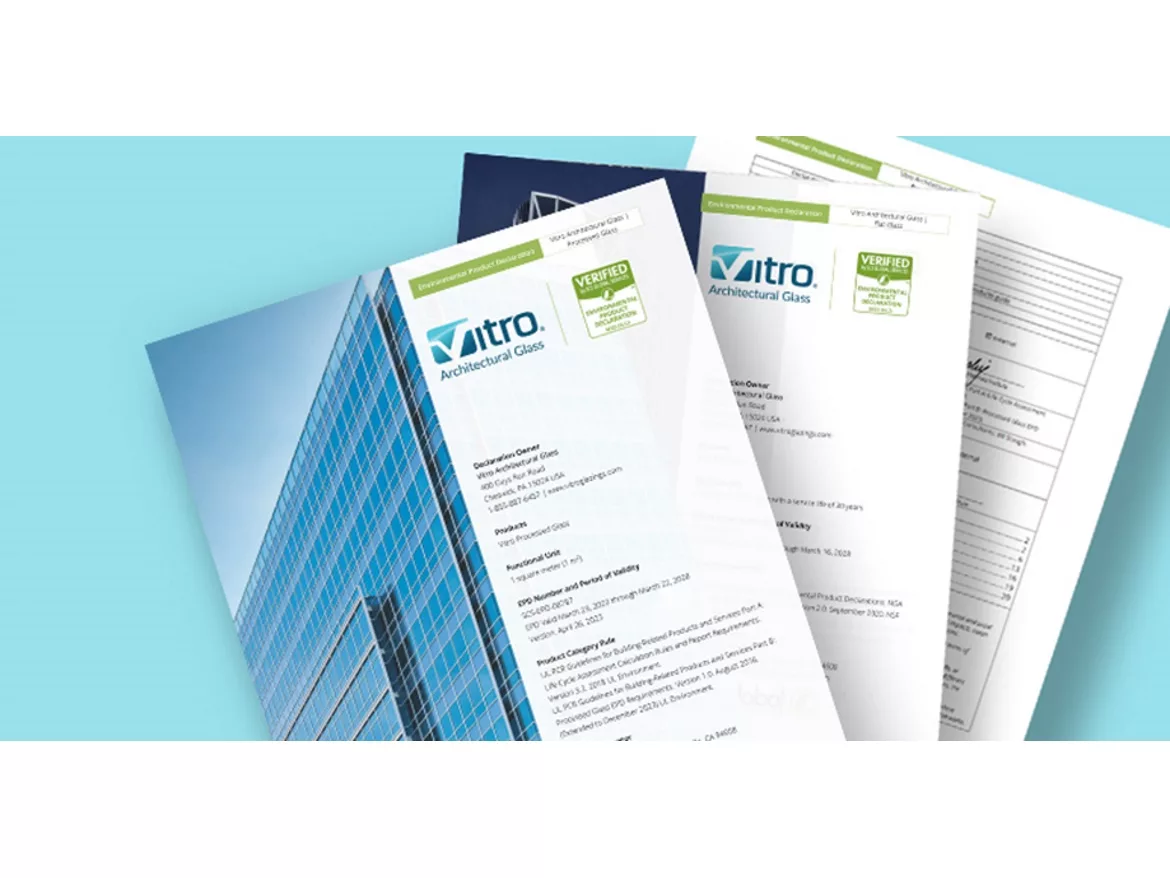
Vitro Architectural Glass (formerly PPG Glass) has published updated versions of its Environmental Product Declarations (EPDs) for both flat and processed glass. These updates reaffirm that Vitro’s glass products contain less embodied carbon than the industry standard for architectural glass products and indicate a lower embodied carbon value than previously reported in 2017 editions of these EPDs.

EPDs offer detailed data about the embodied carbon values and life-cycle impact on the environment of a wide range of architectural building products, including information about the extraction, transportation and processing of related raw materials, and can be used as credentialing documentation for sustainability certifications such as the U.S. Green Building Council’s Leadership in Energy and Environmental Design (LEED ®) Certification.

As a standard measure of embodied carbon, EPDs calculate a value of global warming potential (GWP) that is expressed as kilograms of CO2 equivalent.

In 2017, Vitro became the first North American manufacturer to publish third-party verified EPDs for its flat glass and processed glass products.

In 2019, the National Glass Association (NGA) published an architectural glass EPD that evaluated the embodied carbon of clear, low-iron and tinted flat glass produced by four member companies of the NGA’s Forming Committee, including Vitro. Its findings suggested an industry average GWP of 1430 for comparable products.

Vitro’s 2023 EPDs indicate that its products contain just 1350 kilograms of CO2 equivalent, which is 6% lower than the NGA’s industry standard figure and an improvement on figures reported in 2017.

Vitro’s lower GWP was driven by several key steps taken by Vitro’s production teams to lower embodied carbon generated during glass production. These include more efficient use of batch material, implementing furnace efficiency and design improvements, installing energy-efficient lighting and regulating equipment and driving supplier improvements. A highlight of these efforts is Vitro’s pioneering use of oxy-fuel technology at three plant locations in the U.S., which can reduce energy consumption in glass melting furnaces by as much as 20% and cut greenhouse gas emissions in half.

These enhancements create opportunities to reduce embodied carbon in architectural glass production, which is otherwise challenging to accomplish because flat glass manufacturing itself makes up more than 75% of the GWP of double-pane insulating glass units (IGUs). Other processes such as heat treatment, the application of low-e coatings or even the assembly of the IGU itself contribute significantly less to GWP of glass.

“EPDs have become extremely valuable as green building certifications and sustainable design have become more mainstream and architects demand greater transparency in their product selections,” said Mike Hammond, manager, technical support, Vitro Architectural Glass. “We’re pleased to be able to offer EPDs for our glass products that attest to Vitro’s lower embodied carbon values, especially with this latest update.

More significant than the lower GWP value is the improved data that was used to determine the GWP value. Vitro’s 2023 EPDs were produced using the NGA’s updated 2020 Product Category Rules (PCR), which provide more precise data for a more confident calculation of embodied carbon. Additionally, Vitro submitted 24 months of production data from its plants for its 2023 EPDs compared to 12 months of data in 2017. These methodological improvements ensure the improved results are sound.

The product-specific flat glass EPD is valid for annealed and untreated glass products manufactured by Vitro in the United States. The product-specific processed glass EPD is valid for Vitro products that undergo secondary treatment, such as the addition of low-emissivity (low-e) coatings, heat-strengthening or fabrication into multi-pane IGUs.

Both EPDs are certified by ASTM International as conforming to the requirements of ISO 14025. Life cycle assessments (LCAs) for flat glass and processed glass products were performed according to ISO 14040, ISO 14044 and ISO 21930 following the PCRs for each product type.

To learn more about Vitro and its commitment to sustainability transparency, please visit www.vitroglazings.com

KEYWORDS: embodied carbon EPDs (Environmental Product Declarations) glass life-cycle assessment manufacturing

Share This Story

Looking for a reprint of this article?
From high-res PDFs to custom plaques, order your copy today!


Recommended Content

JOIN TODAY
to unlock your recommendations.

Already have an account? Sign In

  • bar graph shows LEED v4/LEED v5/LEED v6 in various colors

    When Will LEED v4 / v4.1 and LEED v5 Expire?

    The latest version of the LEED rating system, LEED v5, is...
    Sustainability
    By: Daniel Overbey
  • Celebrating Women In AEC-2026

    Celebrating Women in The AEC Industry Part 1

    A round-up of women in the design, engineering and...
    Sustainability
    By: Lindsay Lewis
  • KEE membrane application on a roof

    A Beginner’s Guide to Single-Ply Roofing Membranes

    While PVC and TPO appear extremely similar, the chemistry...
    Low-Slope Roofs
    By: Peter Gross
Manage My Account
  • Sign up for the Newsletter
  • Online Registration
  • Manage My Preferences
  • Registration Customer Service

More Videos

Sponsored Content

Sponsored Content is a special paid section where industry companies provide high quality, objective, non-commercial content around topics of interest to the Building Enclosure audience. All Sponsored Content is supplied by the advertising company and any opinions expressed in this article are those of the author and not necessarily reflect the views of Building Enclosure or its parent company, BNP Media. Interested in participating in our Sponsored Content section? Contact your local rep!

close
  • HITT Construction headquarters
    Sponsored byBuilding Composites® LLC

    Pushing the Envelope

  • 2 construction workers and a DEXcell panel
    Sponsored byDEXcell Roof Boards

    Designing Low-Slope Roofs for Resilience

  • Bell Bank headquarters in Fargo, North Dakota
    Sponsored bySto Corp.

    Drained and Back-Ventilated Rainscreens vs Pressurized-Equalized Rainscreens

Popular Stories

graphic shows white arrows pointing to the right on a light green background

A Breakdown of Air Leakage Testing in LEED v5 BD+C

Open vs. closed cell foam in an attic

Open-Cell vs. Closed-Cell Spray Foam

skyscraper

NYC Tower Failure Offers Warning for Contractors

Building Enclosure Newsletter

BE Poll

Events

April 9, 2026

Strategies for High-Performance Below-Grade Waterproofing

Credits: 1 AIA LU/HSW ; 1 IIBEC CEH; 0.1 IACET CEU

On-Demand Designing a high-performance building enclosure requires more than just surface-level protection; it demands a rigorous, performance-based mastery of below-grade water and gas mitigation. This discussion will provide an expert-level analysis of below-grade waterproofing within the comprehensive framework of the high-performance building enclosure.

April 28, 2026

Roof Design Considerations That Prevent Installation Failures and Change Orders

Credit: 1 AIA LU/HSW; 1 IIBEC CEH; 0.1 ICC CEU

On-Demand This course provides visual examples of actual field conditions. Some good, some not so good; along with design suggestions that can cut installation costs and reduce construction change orders. Upon completion of this course, you will have a better understanding of the requirements the roofing contractor must meet to provide the specified roofing system warranty, and long-term value to the owner.

View All Submit An Event

Products

Plaster and Drywall Assemblies Manual

Plaster and Drywall Assemblies Manual

This is a comprehensive manual that goes beyond codes and standards, providing expert guidance in design, detailing, material selection and troubleshooting for plaster and drywall.

See More Products

Related Articles

  • vit_ucsd-torrey-pines-1.jpg

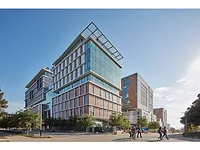
    Vitro Architectural Glass Updates Environmental Product Declarations to Meet Low Embodied Carbon Standards

    See More
  • a woman with curly hair looks at a computer screen with EPD information on it

    A2P Reinforces Commitment to Environmental Stewardship with New Environmental Product Declarations

    See More
  • Sto Corp.

    Sto Corp. Releases Environmental Product Declarations

    See More

Related Products

See More Products
  • ecology.jpg

    Architecture and Systems Ecology: Thermodynamic Principles of Environmental Building Design, in three parts

  • 111890950X.jpg

    Architectural Graphic Standards, 12th Edition

  • buildings.jpg

    Mechanical and Electrical Equipment for Buildings, 13th Edition

See More Products

Events

View AllSubmit An Event
  • July 14, 2026

    Comparing Environmental Product Declarations (EPDs) for Structural Materials

    Credits: 1 AIA LU/HSW; 0.1 ICC CEU On-Demand This presentation will explain what an EPD is, how it is developed using product category rules, and how it shows environmental impacts of typical construction products. We will then look at how various industries develop EPDs,  what different types of EPDs are available, and how these can be used in the life cycle assessment of a building project.
View AllSubmit An Event
×

Enhance your expertise with unparalleled insights.

Join thousands of building professionals today. Shouldn’t you know what they know?

SUBSCRIBE TODAY!
  • RESOURCES
    • Advertise
    • Contact Us
    • Store
    • Want More
  • SIGN UP TODAY
    • Create Account
    • Newsletter
    • Customer Service
    • Manage Preferences
  • SERVICES
    • Marketing Services
    • Reprints
    • Market Research
    • List Rental
    • Survey/Respondent Access
  • STAY CONNECTED
    • LinkedIn
    • Facebook
    • Instagram
    • YouTube
    • X
  • PRIVACY
    • PRIVACY POLICY
    • TERMS & CONDITIONS
    • DO NOT SELL MY PERSONAL INFORMATION
    • PRIVACY REQUEST
    • ACCESSIBILITY

Copyright ©2026. All Rights Reserved BNP Media, Inc. and BNP Media II, LLC.

Design, CMS, Hosting & Web Development :: ePublishing