Award-Winning Affordable Passive House Building Debuts for Boston Seniors
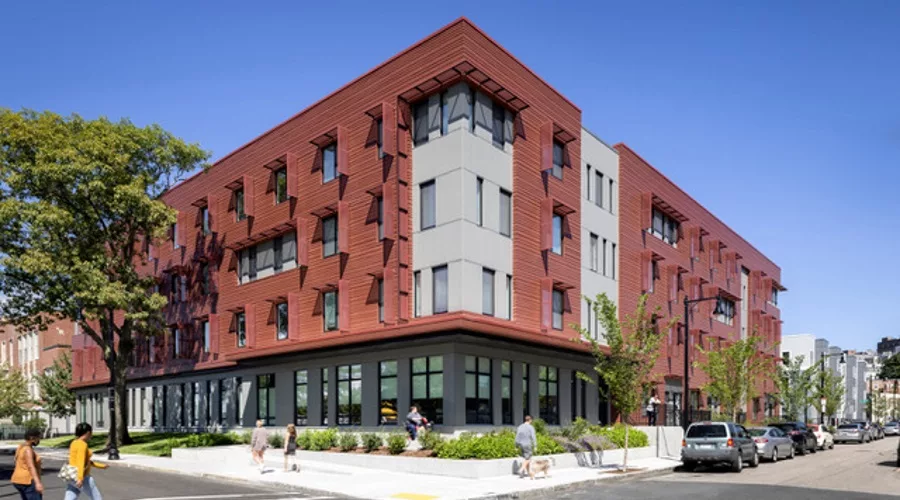
The Architectural Team (TAT), an award-winning architecture and master planning firm, and Beacon Communities LLC, a privately-owned real estate firm that develops, acquires, invests in, and manages multi-family housing, have announced the completion of a ground-breaking new affordable housing building for seniors in South Boston. Known as Phase Three C of The Anne M. Lynch Homes at Old Colony, this 55-apartment midrise building stands out for its use of Passive House design principles. Constructed by Dimeo Construction, it is one of just a handful of affordable housing developments in the state built to the stringent, energy-saving standard better known for its use in high-end, single-family homes.
Thanks to this innovative approach, the project recently won a design excellence award in the low-rise multi-family category from the Passive House Institute US chapter (Phius). The juried Phius Passive Projects Design Competition honors fully certified passive building projects throughout the United States and Canada, with awardees recognized for pushing the boundaries of passive building design. Phase Three C of The Anne M. Lynch Homes at Old Colony offers some of the most comfortable and efficient rental apartments available anywhere, setting an important benchmark for affordable senior housing as the number of people over-60 soars nationally.
“The Passive House approach is a game-changer for affordable and workforce housing projects, which can significantly benefit from the standard’s lower ongoing operating costs, healthier interior environments for residents, and a growing number of incentives from states and cities,” says Nate Thomas, CPHC, of TAT, a passive house project manager expert at the firm. “This is a critical and necessary step in facilitating more and better affordable apartments for vulnerable populations such as seniors, while reducing greenhouse gas emissions and the building’s ecological footprint.”
A Forward-Looking Perspective on Affordable Housing, Decades in the Making
Now open to residents, the distinctive four-story, 51,000-square-foot building forms a linchpin of TAT and Beacon’s decade-plus-long redevelopment of the Old Colony community, the nation’s oldest federal public housing development. Carried out in association with the Boston Housing Authority, the transformation has redeveloped almost the entire community over the last decade and is on track to complete the redevelopment with three more passive house buildings. The award-winning previous phases that were also designed by TAT and whose recognition includes the Boston Society of Architects’ John M. Clancy Award for Socially Responsible Housing among other honors, advanced a redeveloped series of midcentury superblocks.
The result is a welcoming neighborhood of attractive midrise buildings and townhomes set within a walkable street grid and a variety of public open spaces that create a national model for public housing transformation. Earlier phases also provided community assets and gathering hubs, including The Joseph M. Tierney Learning Center that offers educational services and health and wellness programs to support residents.
The completion of Phase Three C follows the conclusion Phases One - Three, comprised of 590 apartments. According to Beacon and TAT, three additional buildings of the redevelopment comprised of 297 apartments, with two soon to begin construction, will also pursue Passive House design standards, underscoring the development team’s longstanding commitment to sustainability and its resident-centric focus on wellbeing.
“Working in partnership with the Boston Housing Authority, Beacon has strived to build energy-efficient and healthy homes for our residents in every phase of our work on The Anne M. Lynch Homes at Old Colony,” says Darcy L. Jameson, Vice President of Development for Beacon Communities. “Over a decade ago, when Beacon began this redevelopment, we were thrilled to build one of the first 100% affordable LEED Platinum buildings in Boston. Continuing the goal of building near net-zero buildings across our portfolio and in support of the City of Boston’s goal to be carbon free by 2050, we are excited to complete this building and are honored to receive an award from Phius.”
Design, Comfort, and Performance
TAT’s architectural approach for this phase of the Anne M. Lynch Homes at Old Colony draws on core principles of Passive House design. Located on a prominent corner within the Old Colony community, the building emphasizes passive solar design and compact geometries to reduce thermal bridging with its dynamic red and grey façade holding robust, heavily insulated walls. High-performance windows and a highly efficient HVAC split system further ensure a healthy and comfortable indoor environment for tenants by improving air quality and reducing contaminants such as mold. The project’s roof-mounted photovoltaic (PV) array also generates power to cut carbon emissions and boost sustainability and resiliency.
"Passive House buildings such as The Anne M. Lynch Homes at Old Colony Phase Three C are far more resilient than traditional apartment communities in severe weather conditions,” says the architect and TAT principal Jay Szymanski, AIA, NCARB, LEED AP. "Due to very low air leakage and exceptional thermal performance, these developments maintain their user comfort for significantly longer in the event of power outages. As the number of severe storms and extreme weather events increases, this is another clear benefit of the Passive House approach—especially for seniors who are at much greater risk of negative health outcomes from extreme weather."
Other comfort- and performance-enhancing features at Old Colony Phase Three C also express themselves as engaging elements of the exterior design, improving the building’s efficiency and inviting curiosity and attention from passersby. For example, a series of thermally broken metal fins act as solar shades bracketing many of the building's window openings, reducing solar heat gain while also adding dynamic visual interest to the façade.
“The Passive House approach informed every aspect of our design, and the challenges of working to such a rigorous standard also created opportunities for a striking and distinctive, yet contextual architectural presence,” concludes TAT’s Szymanski. “The result is an apartment community that fits into the larger Old Colony community and also makes a clear statement that highly livable, sustainable, and beautiful rental homes are affordable for vulnerable populations.”
TAT’s innovative Passive House work for The Anne M. Lynch Homes at Old Colony is the latest in a long line of creative and high-performing multifamily communities, including the acclaimed resilient waterfront community at Clippership Wharf in East Boston, and Moran Square in Fitchburg, Mass., an adaptive reuse of two historic buildings and the new construction of a fivestory building into a mixed-use, mixed-income multifamily community with 8,000 square feet for commercial space, which has received Passive House Pre-Certification.
As well, TAT’s work on The Loop at Mattapan is a $57M new transit-oriented development of 135 apartments of mixed-income housing and 10,000 square feet of commercial/retail space, designed in conjunction with MASS Design Group. Once complete, the Passive House envelope will include the entirety of the woodframed tower portion of the building, which is separated from the concrete podium by a posttensioned concrete slab on the second floor.
Looking for a reprint of this article?
From high-res PDFs to custom plaques, order your copy today!
.webp?height=740&t=1767036885&width=auto "Header - BE 1170x658 (002).png")

.webp?height=740&t=1755781744&width=auto "KEE(2).png")