Building Enclosure logo
search
cart
facebook twitter linkedin youtube instagram Spotify Podcasts Apple Podcasts Spotify Podcasts Apple Podcasts
  • Sign In
  • Create Account
  • Sign Out
  • My Account
Building Enclosure logo
  • NEWS
    • Breaking News
  • SECTIONS
    • Columns
    • Project Profiles
    • Trade Shows
    • Sponsor Insights
  • SYSTEM DESIGNS
    • Low-Slope Roofs
    • Pitched Roofs
    • Metal Roofing Materials
    • Waterproofing
    • Sustainability
    • Insulation
    • Exterior Claddings
    • Wall Systems
    • Building Envelope
  • BLOG
    • The BE Blog
  • MEDIA
    • Podcasts
    • Webinars
    • Quiz
    • Videos
    • Polls
    • Interactive Spotlights
    • Newsletter
    • Photo Galleries
  • DIRECTORIES
    • Directory: Blue Book
    • Directory: Roofing Resource
  • PRODUCTS
  • TECHNICAL
    • Codes
      • Waterproofing
      • Roofing
    • Details
      • Waterproofing
      • Roofing
  • CONTINUING ED
  • ABOUT
    • Advertise
      • Editorial Calendar
    • Contact
    • eMag Archive Issues
  • SIGN UP!
Exterior CladdingsProject Profiles

Metal-clad Housing Supports, Honors Native American Families
Metal2.JPG

Photo courtesy of alanblakely.com.

May 20, 2022

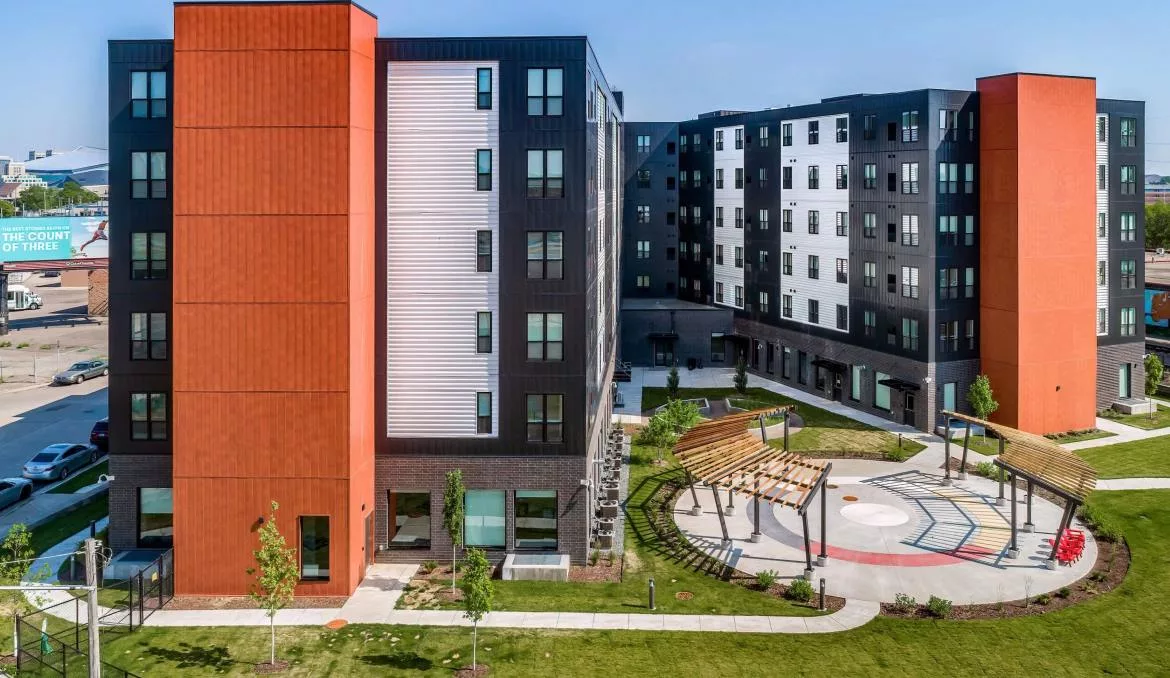
With a name that translates roughly from the Chippewa Ojibwe language as “live the good life,” the Mino-Bimaadiziwin apartment building in Minneapolis is now helping 110 American Indian families, primarily from the Red Lake Band of Chippewa Indians, do just that. The project was developed to address the severe housing shortage among the city’s American Indian citizens and provide added social support. Its façade features metal wall panels in a dramatic palette that also incorporates panels with a unique woodgrain finish that ties the building to the tribe’s historic home in a reservation in the woods of Northwest Minnesota.
 
 The apartment building, which also houses the Red Lake Nation Embassy, a childcare center and a wellness clinic, is constructed on what was previously the site of an emergency housing shelter at one end of Minneapolis’s Native American Cultural Corridor. In 2018, that shelter was, itself, a response to a significant homelessness problem. The Red Lake Band’s leadership decided a more permanent solution was needed to reduce the challenges of housing insecurity many of their people were facing in the Twin Cities area. That’s when they decided to build one of the first tribal-sponsored housing developments in the United States to both address housing shortfalls and add an anchor point for the city’s burgeoning American Indian community.
 
 “The location of the project is within a larger cultural context – the client stressed the importance that the building be of its place,” says Jeremiah Johnson, senior associate with the local office of The Cuningham group, the project’s designers. “We were looking to create a building that offered a strong focal point for the cultural corridor, anchoring it where it crosses both Hiawatha Avenue and the light rail line.”
 
 The building comprises two wings in a V-shaped arrangement. For the exterior, plans combined masonry cladding for the first floor with metal wall panels rising the rest of the building’s six-story height. Both the color and texture of the metal cladding act to break up what could have looked like a very boxy structure. Three-bay sections of matte black vertical flush panels alternate with similarly sized sections of nearly white ribbed panels installed horizontally, with the varied panel profiles and orientations enabling a play of light and shadow across the façade. At either end, stairwells are clad in vertical flush panels finished in a red-toned woodgrain pattern that offers several layers of historical symbolism.
 
 “These seven vertical elements are an abstract representation of the seven member tribes of the Red Lake Nation,” Johnson says. “For the wood-look elements, we chose a finish called ‘Super Douglas’ because it most closely resembled wood milled from the white cedar trees that are native to Red Lake Nation lands.”
 
 Cuningham’s designers looked at several material types for the project, including fiber cement, but, in the end, metal panels won out due to several factors. “This project is a long-term investment in the community and our clients needed something that was durable, low maintenance and attractive,” Johnson says. “With great finishes and a variety of panel types, metal became the top choice. An additional advantage was that a single contractor could install nearly all the cladding, using the same details throughout, resulting in fewer opportunities for errors and a smooth installation.”
 
 Petersen was the panel supplier for the project, which incorporated 21,000 sq. ft. of PAC-CLAD Flush panels in Matte Black finish and another 13,000 sq. ft. in the custom woodgrain finish, along with 13,600 sq. ft. of PAC 7.2 Rib panels in Bone White. The installer, Progressive Building Systems out of Otsego, Minn., worked closely with Petersen personnel, including in the decision to specify a coil-coated finish instead of powder-coated.
 
 “When the project was first bid, the only wood grain finish that Petersen had to offer was a powder coated finish that would have to be applied after parts were fabricated,” says David Lage, project manager and estimator with Progressive Building Systems. This had the potential for causing delays while installers verified field conditions for their flashings. “David Mercer with the local Petersen office ultimately was able to offer a coil-coated product, so we could order flat sheet materials ahead of time and fabricate our flashings as needed.”
 
 Johnson also has high praise for Petersen, a frequent supplier of choice. “I have always found the people with Petersen to be very helpful on our projects,” he says. “With the wide range of products and finishes, Petersen is always my first choice in metal cladding products.”
 
 The project wrapped up in December 2020 and has already become the community anchor the Red Lake Nation’s leaders were hoping for, the architect adds. “I think everyone is happy with how the project turned out – it really serves the community well,” he says. “There has been talk of more development in the area, spurred by the success of this project.”

KEYWORDS: cladding metal metal cladding multi-family buildings

Share This Story

Looking for a reprint of this article?
From high-res PDFs to custom plaques, order your copy today!


Recommended Content

JOIN TODAY
to unlock your recommendations.

Already have an account? Sign In

  • bar graph shows LEED v4/LEED v5/LEED v6 in various colors

    When Will LEED v4 / v4.1 and LEED v5 Expire?

    The latest version of the LEED rating system, LEED v5, is...
    Sustainability
    By: Daniel Overbey
  • Celebrating Women In AEC-2026

    Celebrating Women in The AEC Industry Part 1

    A round-up of women in the design, engineering and...
    Building Envelope
    By: Lindsay Lewis
  • KEE membrane application on a roof

    A Beginner’s Guide to Single-Ply Roofing Membranes

    While PVC and TPO appear extremely similar, the chemistry...
    Low-Slope Roofs
    By: Peter Gross
Manage My Account
  • Sign up for the Newsletter
  • Online Registration
  • Manage My Preferences
  • Registration Customer Service

More Videos

Sponsored Content

Sponsored Content is a special paid section where industry companies provide high quality, objective, non-commercial content around topics of interest to the Building Enclosure audience. All Sponsored Content is supplied by the advertising company and any opinions expressed in this article are those of the author and not necessarily reflect the views of Building Enclosure or its parent company, BNP Media. Interested in participating in our Sponsored Content section? Contact your local rep!

close
  • 2 construction workers and a DEXcell panel
    Sponsored byDEXcell Roof Boards

    Designing Low-Slope Roofs for Resilience

  • Bell Bank headquarters in Fargo, North Dakota
    Sponsored bySto Corp.

    Drained and Back-Ventilated Rainscreens vs Pressurized-Equalized Rainscreens

  • A construction worker using DEXcell roof boards
    Sponsored byDEXcell Roof Boards

    The Hidden Strength of Low-Slope Roof Systems: Why Roof Cover Boards Matter

Popular Stories

construction industry workers in hard hats stand around a city scape

Construction Industry Revolts Over New CSI Licensing Plan

a man wearing a mask installs insulation into a wall system

Quiet Rooms and Healthier Air: A Second Look at What Goes Inside the Wall Cavity

Canalino Elementary School and Canalino Family School exterior

Daylighting Design to Support Rapidly Growing Trend in Modular Building Construction

Building Enclosure Newsletter

BE Poll

Events

June 17, 2025

Addressing Condensation in Low-Slope Roof Assemblies

Credits: 1 AIA LU/HSW; 0.1 ICC CEU; 1 IIBEC CEH; 0.1 IACET CEU

On Demand In modern roofing systems, vapor retarders and air barriers do more than just minimize air leakage—they’re essential to maximizing performance and longevity. This engaging course dives into the next generation of moisture control: permeable vapor retarders and air barriers. Discover how these cutting-edge technologies are transforming low-slope roofing assemblies by improving energy efficiency, managing moisture, and boosting wind uplift resistance.

April 9, 2026

Strategies for High-Performance Below-Grade Waterproofing

Credits: 1 AIA LU/HSW ; 1 IIBEC CEH; 0.1 IACET CEU

On-Demand Designing a high-performance building enclosure requires more than just surface-level protection; it demands a rigorous, performance-based mastery of below-grade water and gas mitigation. This discussion will provide an expert-level analysis of below-grade waterproofing within the comprehensive framework of the high-performance building enclosure.

View All Submit An Event

Products

Plaster and Drywall Assemblies Manual

Plaster and Drywall Assemblies Manual

This is a comprehensive manual that goes beyond codes and standards, providing expert guidance in design, detailing, material selection and troubleshooting for plaster and drywall.

See More Products

Related Articles

  • Kingspan Supports American Business Act On Climate Pledge

    See More
  • ParcHaven.jpg

    Metal-clad Apartments Add Visual Punch to Las Vegas Neighborhood

    See More
  • Woodstock

    Metal Roof Adds Rural Charm to Affordable Housing Complex

    See More

Events

View AllSubmit An Event
  • October 7, 2025

    Fit to Be Clad

    Credits: 1 AIA LU/HSW; 1 IIBEC CEH; 0.1 ICC CEUOn-Demand These factors include the different types of metal roof and wall systems, materials used in manufacturing, fastener types as well as environmental issues such as saltwater and wind speed. Structural issues including building framing, roof slope, curving, perforation and more are addressed. Finally, a review of cost assessment and how it’s affected by sustainability needs, installation concerns and jobsite best practices rounds out this course. 
View AllSubmit An Event
×

Enhance your expertise with unparalleled insights.

Join thousands of building professionals today. Shouldn’t you know what they know?

SUBSCRIBE TODAY!
  • RESOURCES
    • Advertise
    • Contact Us
    • Store
    • Want More
  • SIGN UP TODAY
    • Create Account
    • Newsletter
    • Customer Service
    • Manage Preferences
  • SERVICES
    • Marketing Services
    • Reprints
    • Market Research
    • List Rental
    • Survey/Respondent Access
  • STAY CONNECTED
    • LinkedIn
    • Facebook
    • Instagram
    • YouTube
    • X
  • PRIVACY
    • PRIVACY POLICY
    • TERMS & CONDITIONS
    • DO NOT SELL MY PERSONAL INFORMATION
    • PRIVACY REQUEST
    • ACCESSIBILITY

Copyright ©2026. All Rights Reserved BNP Media, Inc. and BNP Media II, LLC.

Design, CMS, Hosting & Web Development :: ePublishing