EPS Insulation Supports Energy-Efficient Buildings
Global Sustainability Initiatives Gain Momentum
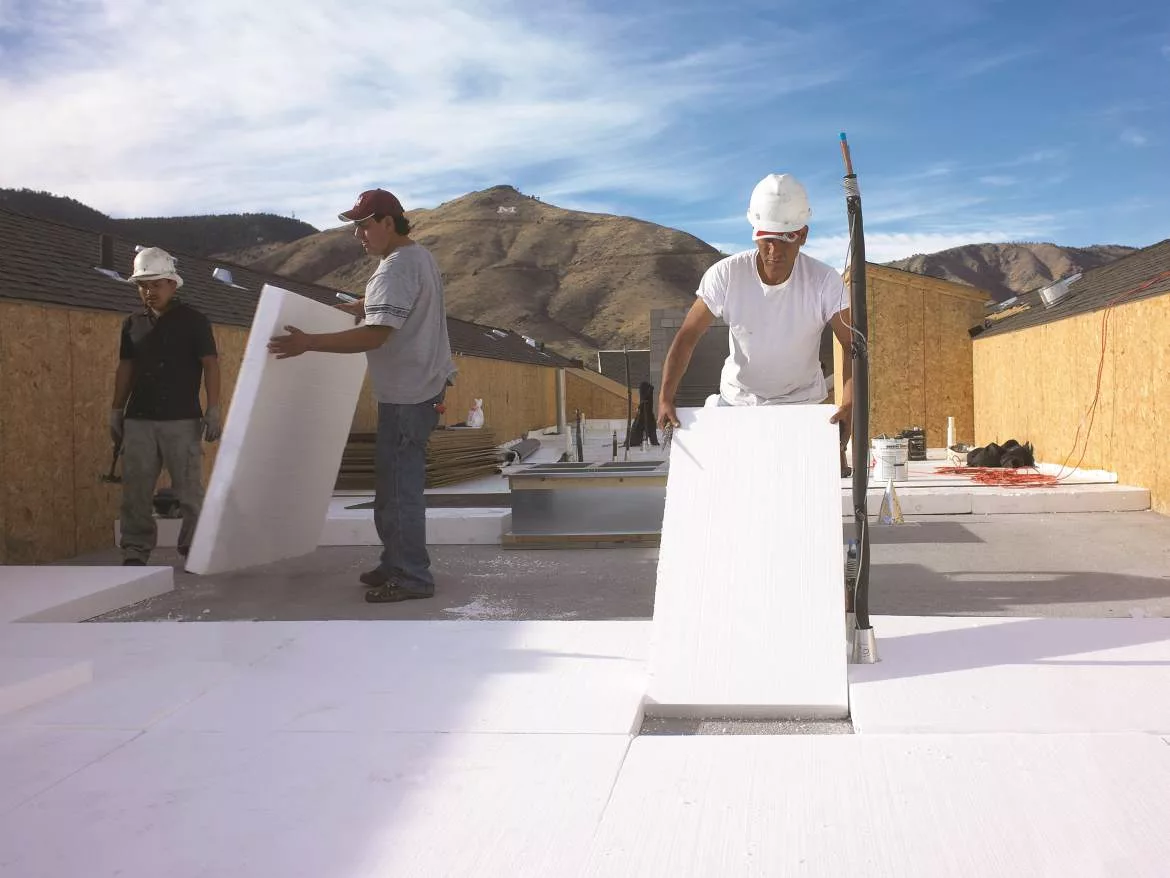
Much of a building’s heat transfer occurs through the roof, which is why efficient insulation plays such a critical role in reducing a structure’s energy consumption. Photo courtesy of Insulfoam.
As corporate commitments to sustainability initiatives continue to gain momentum across the globe, there’s a growing focus on energy conservation. As a result, design professionals face the challenge of meeting increasingly stringent standards to support energy-efficient building construction and operations.
To meet this pressing responsibility, more architects and designers are looking to the building envelope. As the physical and thermal barrier between external environments and internal conditioned spaces, the building envelope has a very close relationship with energy transfer and consumption. In application, it “plays a key role in determining levels of comfort, natural lighting, ventilation, and how much energy is required to heat and cool a building,” reports the Better Buildings U.S. Department of Energy.
In addressing building envelope performance, one way to keep heat transfer to a minimum is continuous insulation (CI)—insulation that is continuous across all structural members without thermal bridges other than fasteners and service openings. Creating CI is one of the most important steps design professionals can take to construct a nearly impenetrable building envelope. To underline this best practice, the International Energy Conservation Code (IECC) has required CI across building envelopes in most climate zones both commercially and residentially since 2012. In the pursuit of CI, architects and designers are specifying high-performance systems and building materials—including expanded polystyrene (EPS) rigid foam. A high-caliber insulation intended for roofs, walls and below-grade applications, EPS is becoming synonymous with CI.
Delivering Premium Performance to Roofs, Walls and Below-Grade Applications
EPS insulation is well known for its ability to provide high, stable thermal resistance throughout the building envelope, making it possible for design professionals to optimize a structure’s energy consumption. In general, the higher a material’s R-value, the better the product is at resisting the flow of heat or cold. EPS delivers R-values ranging from 3.6 to 4.2 per inch. With this level of thermal efficiency, it’s possible to achieve the desired R-value.
With respect to stability, the rigid foam consists of 98 percent air, which doesn’t leech out of the cellular structure over time. As confirmed by the EPS Industry Alliance (EPS-IA), EPS’ “insulation performance remains stable over its entire life.” This long-term performance also means the product doesn’t need to be adjusted for age, a key environmental attribute. This is a primary advantage as comparable foam insulation products use blowing agents that have a higher resistance to heat flow, causing the material to have an abnormally high R-value at the time of manufacture. It’s now known that these blowing agents will diffuse from the cellular structure of the material over the course of its lifetime, steadily releasing gases into the air. As the high R-value gases diffuse out of the cellular structure, the material can lose up to 30 percent of its original insulating capabilities.
The best way for design professionals to determine if an insulation product will experience this thermal drift is to review the manufacturer’s warranty. Leading EPS manufacturers will back their products with a 100 percent R-value warranty.
Throughout the Building Envelope
With its reliable thermal performance capabilities, EPS is an effective insulation option for all parts of the building envelope, including roofs, walls and below-grade areas. To better understand how EPS supports CI and energy conservation, here’s a look at how the product performs across each part of the building envelope.
Roofs
Much of a commercial building’s heat transfer occurs through the roof, which is why proper insulation plays such a critical role in reducing a structure’s energy consumption and supporting a comfortable environment for building occupants. On a 95-degree summer day, for example, the membrane of a typical commercial roof can heat up to as much as 158 degrees. It can take hours for it to cool off once the sun has set. In the meantime, the heat seeps throughout the building, forcing the air conditioning system to work overtime. A similar situation occurs during the winter months—just in reverse.
To sideline this heat transfer dilemma, project designers can employ ultra-lightweight EPS insulation across a commercial roof deck. Available in large blocks up to 40 inches thick, EPS can be cut to satisfy virtually any slope. The first-rate thermal performance and sheer size of EPS roof panels perform efficiently in application, and they also reduce thermal bridging throughout a roof system. By minimizing the number of breaks across a building envelope, designers can support a virtually impenetrable structure. As a result, the energy required to keep buildings cooler in the summer months and warmer in the fall and winter can decrease substantially.
Walls
While EPS insulation may have earned its reputation as a high-performance insulator in roofs, design professionals can also rely on it for exterior, interior and cavity walls, as well as CI sheathing. Structural insulated wall panels are also frequently made with an EPS insulating core.
Employing EPS across a building’s walls will help designers achieve ci and, in turn, maximize the performance of heating, ventilation and air conditioning (HVAC) systems put in place. In combination, EPS insulation and a properly designed HVAC system can also be an effective strategy for controlling condensation. EPS’ hydrophobic, closed-cell structure does not readily absorb moisture from the atmosphere, allowing it to provide excellent moisture resistance for wall cavities. This means EPS insulation can play a fundamental role in mitigating the risk of mold growth throughout a commercial building—a welcome benefit for commercial property owners down the line.
EPS’ resistance to moisture and inherent breathability also plays a critical role in maintaining its stable thermal performance. Just as a wet t-shirt is much less effective at keeping someone warm than a dry shirt is, damp isolation is much less effective at mitigating energy transfer and consumption. To a designer’s advantage, moisture-resistant EPS can also safeguard the building envelope from the threat of water vapor and compromised R-values, further supporting an energy-efficient structure.
Below-grade
In the continual push to forge more energy-efficient buildings, design professionals can leave no part of the building envelope unexamined—including below-grade areas like foundation walls and under slabs.
Consider this, uninsulated concrete provides a thermal bridge between a building’s heated interior and the relatively cooler earth surrounding the building, or through exposed slab edges to the outside air. Forgoing insulation in these areas can be costly to building owners down the line, as a lack of insulation on below-grade foundations, crawlspaces and under slabs accounts for up to 25 percent of a building’s total energy loss, according to the EPS Industry Alliance. Effectively blocking pathways for hot or cold air to travel into and out of the building with high-caliber EPS insulation is critical for creating a comfortable, energy-prudent building.
Meeting Increasingly Stringent Energy Standards
Given the number of high-profile companies pledging their commitment to global sustainability initiatives, it makes sense that energy conservation will only become a greater priority across the building industry. In the wake of this movement, architects and designers will be tasked with specifying high-performance building materials and systems that support energy-efficient building construction. With its reliable thermal performance and premium physical properties, employing EPS insulation across the building envelope can be an effective way to insulate new and retrofit commercial projects.
Looking for a reprint of this article?
From high-res PDFs to custom plaques, order your copy today!
.webp?height=740&t=1767036885&width=auto "Header - BE 1170x658 (002).png")

.webp?height=740&t=1755781744&width=auto "KEE(2).png")