Building Enclosure logo
search
cart
facebook twitter linkedin youtube instagram Spotify Podcasts Apple Podcasts Spotify Podcasts Apple Podcasts
  • Sign In
  • Create Account
  • Sign Out
  • My Account
Building Enclosure logo
  • NEWS
    • Breaking News
  • SECTIONS
    • Columns
    • Project Profiles
    • Trade Shows
    • Sponsor Insights
  • SYSTEM DESIGNS
    • Low-Slope Roofs
    • Pitched Roofs
    • Metal Roofing Materials
    • Waterproofing
    • Sustainability
    • Insulation
    • Exterior Claddings
    • Wall Systems
    • Building Envelope
  • BLOG
    • The BE Blog
  • MEDIA
    • Podcasts
    • Webinars
    • Quiz
    • Videos
    • Polls
    • Interactive Spotlights
    • Newsletter
    • Photo Galleries
  • DIRECTORIES
    • Directory: Blue Book
    • Directory: Roofing Resource
  • PRODUCTS
  • TECHNICAL
    • Codes
      • Waterproofing
      • Roofing
    • Details
      • Waterproofing
      • Roofing
  • CONTINUING ED
  • ABOUT
    • Advertise
      • Editorial Calendar
    • Contact
    • eMag Archive Issues
  • SIGN UP!
Exterior CladdingsProject Profiles

IMPs Clad New Airport Hangar
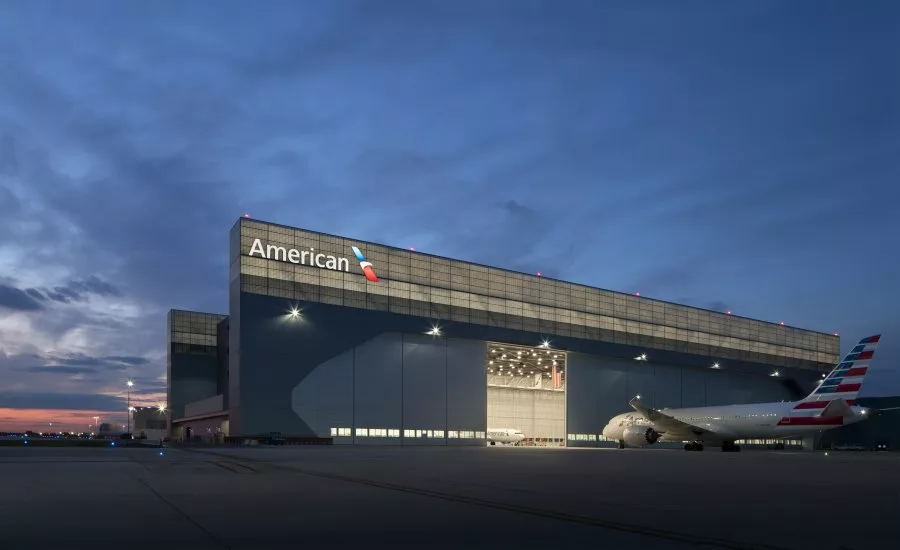
CENTRIA
Photo courtesy of CENTRIA.
February 12, 2021

Expanding Service

As American Airlines sought to improve operations and service its fleet efficiently, it embarked on the task of building a new double wide-body aircraft
maintenance hangar at Chicago O’Hare International Airport, the world’s sixth busiest airport. Dubbed Hangar 2, the 194,000-square-foot facility became the largest on the airfield at O’Hare, which is also the airline’s third-largest hub.

The longest-span structure for a maintenance hangar, Hangar 2 features dual entries and allows for more overnight workload capacity and daylight harvesting to reduce overhead lighting throughout the day. It also provides ancillary support functions, including a general back shop, component staging area, and storage areas.

Designers had to deliver a hangar that met the Chicago Department of Aviation’s Sustainable Airport Guidelines. In addition, the hangar needed to minimize impact on landing aircraft since it was to be built near active taxi lanes.

Light and Sustainability

Since the hangar would be in close proximity to a future runway, architects had to ensure the building maintained a low profile while still providing a 70-foot height clearance to accommodate aircraft being serviced. Designers selected CENTRIA’s Versawall insulated metal panels to serve as the external cladding for the lower 80 feet of the outer wall. Construction crews married the Versawall panels to translucent material for the upper 30 feet to minimize disturbance to aircraft landing systems and reduce light reflection for aircraft coming in on nearby runways. In addition to diminishing landing impact, the translucent panels allow natural daylight to enter the hangar.

“The CENTRIA panels’ durability and flexibility of length and thickness allowed us to create more than a big box and have visual details and an aesthetic exterior to make it a comfortable place for employees to come work,” said John Nimry, senior aviation architect with Ghafari Associates.

Nimry added that the building exceeds expectations by providing natural daylight from the translucent upper panels in a flexible, sustainable space – a critical piece in all new construction at O’Hare.

The Versawall panels from CENTRIA are engineered with thermally broken joint-to-joint connections, delivering consistent R-value throughout the vertical surface of the building. This contributes to lowering energy usage and energy costs over the long haul. In addition, the panels are approved by local authorities for fire and wind protection, which was critical for the facility given its location on the airfield.
    
“CENTRIA allowed us to accomplish unique details in our design and maintain panel integrity and all sustainability properties,” Nimry said. “The CENTRIA panels integrated well with the translucent panels, and having the CENTRIA team working with us from the start afforded us to extend parameters and reach the best solution for our design intent.”

While Versawall panels serve as the main exterior façade, architects chose Formawall Dimension Series insulated metal panels to emphasize the hangar doors and compliment the horizontal movements of the doors. In addition, IW-10A soffit panels align with Versawall panels and wrap under the canopy areas to maximize water protection.  

Delivering Protection and Clean Design

Versawall delivers aesthetics, performance, sustainability and value. The lightweight system is flexible in design and provides an effective air and vapor barrier for weather resistance. Versawall panels feature a thermal break between face and liner that saves energy.

Formawall Dimension Series insulated metal panels consolidate six wall components into one product, creating a distinct architectural wall profile. The panels feature pressure-equalized side joints to prevent water infiltration and integrate with most wall, window and louver systems.

IW Series metal rainscreen panels eliminate exposed fasteners for a clean aesthetic. The single-skin panels minimize moisture intrusion and feature a common lock-joint design.

Taking Flight

Planning and design of the new hangar began in September 2016. After 18 months of construction, the hangar opened for business in November 2018. American Airlines Hangar obtained the point ranking of “2 Green Airplanes” for sustainability efforts from the Chicago Department of Aviation.


KEYWORDS: cladding IMP (Insulated Metal Panels) metal panels

Share This Story

Looking for a reprint of this article?
From high-res PDFs to custom plaques, order your copy today!


Recommended Content

JOIN TODAY
to unlock your recommendations.

Already have an account? Sign In

  • bar graph shows LEED v4/LEED v5/LEED v6 in various colors

    When Will LEED v4 / v4.1 and LEED v5 Expire?

    The latest version of the LEED rating system, LEED v5, is...
    Sustainability
    By: Daniel Overbey
  • Celebrating Women In AEC-2026

    Celebrating Women in The AEC Industry Part 1

    A round-up of women in the design, engineering and...
    Sustainability
    By: Lindsay Lewis
  • KEE membrane application on a roof

    A Beginner’s Guide to Single-Ply Roofing Membranes

    While PVC and TPO appear extremely similar, the chemistry...
    Low-Slope Roofs
    By: Peter Gross
Manage My Account
  • Sign up for the Newsletter
  • Online Registration
  • Manage My Preferences
  • Registration Customer Service

More Videos

Sponsored Content

Sponsored Content is a special paid section where industry companies provide high quality, objective, non-commercial content around topics of interest to the Building Enclosure audience. All Sponsored Content is supplied by the advertising company and any opinions expressed in this article are those of the author and not necessarily reflect the views of Building Enclosure or its parent company, BNP Media. Interested in participating in our Sponsored Content section? Contact your local rep!

close
  • 2 construction workers and a DEXcell panel
    Sponsored byDEXcell Roof Boards

    Designing Low-Slope Roofs for Resilience

  • Bell Bank headquarters in Fargo, North Dakota
    Sponsored bySto Corp.

    Drained and Back-Ventilated Rainscreens vs Pressurized-Equalized Rainscreens

  • A construction worker using DEXcell roof boards
    Sponsored byDEXcell Roof Boards

    The Hidden Strength of Low-Slope Roof Systems: Why Roof Cover Boards Matter

Popular Stories

construction industry workers in hard hats stand around a city scape

Construction Industry Revolts Over New CSI Licensing Plan

Canalino Elementary School and Canalino Family School exterior

Daylighting Design to Support Rapidly Growing Trend in Modular Building Construction

construction workers on a roof, plane flies in background

Why Specifications Are Becoming the Next Critical Layer of Construction Compliance

Building Enclosure Newsletter

BE Poll

Events

June 17, 2025

Addressing Condensation in Low-Slope Roof Assemblies

Credits: 1 AIA LU/HSW; 0.1 ICC CEU; 1 IIBEC CEH; 0.1 IACET CEU

On Demand In modern roofing systems, vapor retarders and air barriers do more than just minimize air leakage—they’re essential to maximizing performance and longevity. This engaging course dives into the next generation of moisture control: permeable vapor retarders and air barriers. Discover how these cutting-edge technologies are transforming low-slope roofing assemblies by improving energy efficiency, managing moisture, and boosting wind uplift resistance.

April 9, 2026

Strategies for High-Performance Below-Grade Waterproofing

Credits: 1 AIA LU/HSW ; 1 IIBEC CEH; 0.1 IACET CEU

On-Demand Designing a high-performance building enclosure requires more than just surface-level protection; it demands a rigorous, performance-based mastery of below-grade water and gas mitigation. This discussion will provide an expert-level analysis of below-grade waterproofing within the comprehensive framework of the high-performance building enclosure.

View All Submit An Event

Products

Plaster and Drywall Assemblies Manual

Plaster and Drywall Assemblies Manual

This is a comprehensive manual that goes beyond codes and standards, providing expert guidance in design, detailing, material selection and troubleshooting for plaster and drywall.

See More Products

Related Articles

  • Buchanan Field Airport exterior

    IMPs Drive Long-Term Performance at New Airport Facility

    See More
  • DC Entertainment & Sports Arena

    Insulated Metal Panels Clad New Sports Arena

    See More
  • RHEINZINK_CA-WonderfulCareerCenter_fotoworksBennyChanArchitecturalPhotography1.jpg

    Architectural Zinc Wall Panels Clad New Career Center

    See More

Related Products

See More Products
  • 41G-JcZWT+L._SX342_SY445_.jpg

    The Architect's Studio Companion: Rules of Thumb for Preliminary Design, 7th Edition

  • 111890950X.jpg

    Architectural Graphic Standards, 12th Edition

  • interior design.jpg

    Building Cost Planning for the Design Team

See More Products

Events

View AllSubmit An Event
  • October 7, 2025

    Fit to Be Clad

    Credits: 1 AIA LU/HSW; 1 IIBEC CEH; 0.1 ICC CEUOn-Demand These factors include the different types of metal roof and wall systems, materials used in manufacturing, fastener types as well as environmental issues such as saltwater and wind speed. Structural issues including building framing, roof slope, curving, perforation and more are addressed. Finally, a review of cost assessment and how it’s affected by sustainability needs, installation concerns and jobsite best practices rounds out this course. 
View AllSubmit An Event
×

Enhance your expertise with unparalleled insights.

Join thousands of building professionals today. Shouldn’t you know what they know?

SUBSCRIBE TODAY!
  • RESOURCES
    • Advertise
    • Contact Us
    • Store
    • Want More
  • SIGN UP TODAY
    • Create Account
    • Newsletter
    • Customer Service
    • Manage Preferences
  • SERVICES
    • Marketing Services
    • Reprints
    • Market Research
    • List Rental
    • Survey/Respondent Access
  • STAY CONNECTED
    • LinkedIn
    • Facebook
    • Instagram
    • YouTube
    • X
  • PRIVACY
    • PRIVACY POLICY
    • TERMS & CONDITIONS
    • DO NOT SELL MY PERSONAL INFORMATION
    • PRIVACY REQUEST
    • ACCESSIBILITY

Copyright ©2026. All Rights Reserved BNP Media, Inc. and BNP Media II, LLC.

Design, CMS, Hosting & Web Development :: ePublishing