Building Combines Modern Design with Time-Tested Roofing, Cladding

Opened this summer, Oregon State University's new Gladys Valley Marine Studies Building (MSB) at Hatfield Marine Science Center expands marine science research, education, outreach and engagement for the region's coastal community. The 72,000-square-foot building combines modern architectural design, state-of-the-art engineering and time-tested natural RHEINZINK prePATINA Blue-Grey zinc roofing and wall cladding.
Located adjacent to Yaquina Bay in Newport, Oregon, the $61.7 million facility is part of the Oregon State University (OSU)'s Marine Studies Initiative 10-year strategic plan for 2016-2025. This new interdisciplinary program involves all 12 OSU colleges with a goal of providing "access to the sea" for all of its students, faculty and staff.
Currently, Hatfield Marine Science Center (HMSC) campus facilities accommodate more than 300 researchers and students, plus six state and federal agencies. Significantly expanding its existing capacity, the MSB added a three-story academic and research core connected to a two-story wing with community space, a 250-seat auditorium and an Innovation Lab.
The first of its kind on the coast, the MSB's design by Yost Grube Hall (YGH) Architecture fosters an environment for cross-disciplinary discovery, collaboration and expression, with a focus on integrating safety, sustainability and resiliency. The building is designed and built to meet the U.S. Green Building Council's LEED® Silver criteria, to withstand a 9+ earthquake, to survive an XXL tsunami event and to be repairable after a large (L) tsunami event.
"Even in this severe marine environment, RHEINZINK prePATINA Blue-Grey zinc can hold up to these harsh conditions, deliver a potential lifespan of up to 100 years or more, and at the end of its useful life on the building's exterior, it remains 100% recyclable," said Chip McGowan, president of RHEINZINK America, Inc.
"Illustrating the connection between our built and natural environments, the MSB's zinc roofing and cladding will develop a recognizable patina that will continuously evolve, uniquely shaped by the Yaquina Bay climate," McGowan continued. "This natural patination process gives the zinc material its self-healing, corrosion-resistant performance. The resilient performance and natural beauty of zinc has been demonstrated for more than 200 years in marine environments and coastal communities."
"The design is an iconic expression of form and function," stated Jack Barth, executive director of the Marine Studies Initiative (MSI), in describing the MSB. "The form clearly identifies the vertical evacuation (safety) mission of the building and efficiently provides premier spaces for innovation, academics, research and community – all hallmarks of HMSC and MSI."
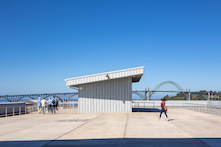
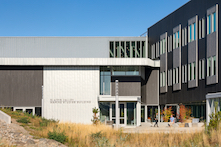
A ramp on the outside of the MSB leads from the ground level to the roof of the three-story structure, which offers an emergency assembly site for more than 900 people. This taller wing houses the offices, research laboratories, and "dry" and "wet" classrooms. At 47 feet high, the rooftop penthouses are clad entirely in RHEINZINK prePATINA Blue-Grey zinc. The upper stories of the MSB slightly overhang its pedestal base composition of glass and the same zinc material.
This attention to detail also can be viewed looking down from the ramp to the MSB's two-story auditorium building. Carefully fabricated, RHEINZINK prePATINA Blue-Grey zinc is installed on the roof, facia and wall cladding. The zinc exterior wall presents a distinctive backdrop for the building's nameplate, welcoming students, staff and visitors. The MSB's southern elevation nestles beneath the ramp and features two full stories of zinc wall cladding surrounding corner windows with sunset coastal views.
To meet the MSB's multiple design goals, Sheet Metal Supply Ltd. provided approximately 50,000 square feet of 0.07mm RHEINZINK prePATINA Blue-Grey zinc material to The Bryer Company, Inc. The Bryer Company fabricated the double-lock standing-seam wall cladding and roofing systems, as well as provided the documentation to support the MSB's sustainable and performance requirements.
The longevity and sustainability of RHEINZINK prePATINA zinc products support criteria for LEED and other green building programs. In contrast to some synthetic materials used in roofing and façade applications that can leach heavy metals into the soil or release them into the atmosphere, no such impurities are contained in RHEINZINK's architectural grade zinc alloys.
Zinc is efficient to produce and has almost no waste. It does not rot, rust or need repainting. Wall cladding and roofing systems fabricated from RHEINZINK prePATINA zinc require no hazardous cleaning chemicals and little effort to maintain. For aesthetic reasons, in marine climates, it is recommended to clean the surface of the material with clean water (not seawater) at least twice a year, depending on local conditions.
In marine environments that are susceptible to fires, zinc also offers a noncombustible solution. Installed properly, zinc roofing systems will resist corrosion, air and water infiltration, and withstand high winds. With respect to the Yaquina Bay area, The Bryer Company successfully tested the MSB's zinc panels and assemblies to meet ASTM E1592 structural performance and Exposure D category for wind loads up to 125 mph.
"This was a challenging project with the site proximity being so close to the Pacific ocean," said Peter Tuininga, vice president with The Bryer Company. "Not only are there extremely strong wind speeds, but the code required an exposure factor of 4, which made for phenomenally high uplift pressures. As a result, project-specific uplift testing of multiple mock-up assemblies was required prior to installation. Despite RHEINZINK being a softer material when compared to steel, the panels performed exceptionally well and we ultimately were able to meet allowable loads in all zones."
Working closely with The Bryer Company, Skyline Sheet Metal, Inc. installed the specified zinc wall cladding and roofing systems on the MSB. Production was carefully coordinated with installation and construction.
Tuininga explained that this included "a portion of the roof that had to be fabricated on-site because of panel lengths that ran almost 90 feet long. RHEINZINK has a high thermal coefficient factor, so custom clips were incorporated into the design to accommodate for expansion and contraction on the longer lengths. Skyline did a fantastic job with the installation. Having a highly skilled sheet metal contractor is critical when working with RHEINZINK."
The facility's construction schedule was managed in phases by general contractor Andersen Construction. In March 2018, a construction launch event was held at the HMSC. By the summer of 2020, staff had moved into the new building. According to Tuininga, The Bryer Company "had been working with RHEINZINK and the designers at YGH for over two years prior to the project breaking ground, so finally seeing the finished results was great."
YGH's Crystal Sanderson, AIA, NCARB, LEED AP BD+C, complimented the teamwork by RHEINZINK, The Bryer Company and Skyline Sheet Metal. She said, "We appreciate the Andersen Construction's attention to detail and Skyline Sheet Metal's excellent craftsmanship. RHEINZINK was the basis of design product selected for challenges associated with the coastal environment. RHEINZINK met our functional criteria and our design intent for materiality integrating well with the existing campus."
MSI executive director Barth added his praise: "Working with OSU Capital Planning and our terrific architecture and [construction] team, we have finished the design of a truly iconic building that boasts added safety features for HMSC and South Beach community."
Looking for a reprint of this article?
From high-res PDFs to custom plaques, order your copy today!
.webp?height=740&t=1767036885&width=auto "Header - BE 1170x658 (002).png")

.webp?height=740&t=1755781744&width=auto "KEE(2).png")