Building Enclosure logo
search
cart
facebook twitter linkedin youtube instagram Spotify Podcasts Apple Podcasts Spotify Podcasts Apple Podcasts
  • Sign In
  • Create Account
  • Sign Out
  • My Account
Building Enclosure logo
  • NEWS
    • Breaking News
  • SECTIONS
    • Columns
    • Project Profiles
    • Trade Shows
    • Sponsor Insights
  • SYSTEM DESIGNS
    • Low-Slope Roofs
    • Pitched Roofs
    • Metal Roofing Materials
    • Waterproofing
    • Sustainability
    • Insulation
    • Exterior Claddings
    • Wall Systems
    • Building Envelope
  • BLOG
    • The BE Blog
  • MEDIA
    • Podcasts
    • Webinars
    • Quiz
    • Videos
    • Polls
    • Interactive Spotlights
    • Newsletter
    • Photo Galleries
  • DIRECTORIES
    • Directory: Blue Book
    • Directory: Roofing Resource
  • PRODUCTS
  • TECHNICAL
    • Codes
      • Waterproofing
      • Roofing
    • Details
      • Waterproofing
      • Roofing
  • CONTINUING ED
  • ABOUT
    • Advertise
      • Editorial Calendar
    • Contact
    • eMag Archive Issues
  • SIGN UP!
Building EnvelopeWall SystemsWaterproofing

Designing for Cold Weather Requires Special Considerations

Don’t Let Winter Put a Freeze on Your Building Envelope
By Jason Peace
WRBs
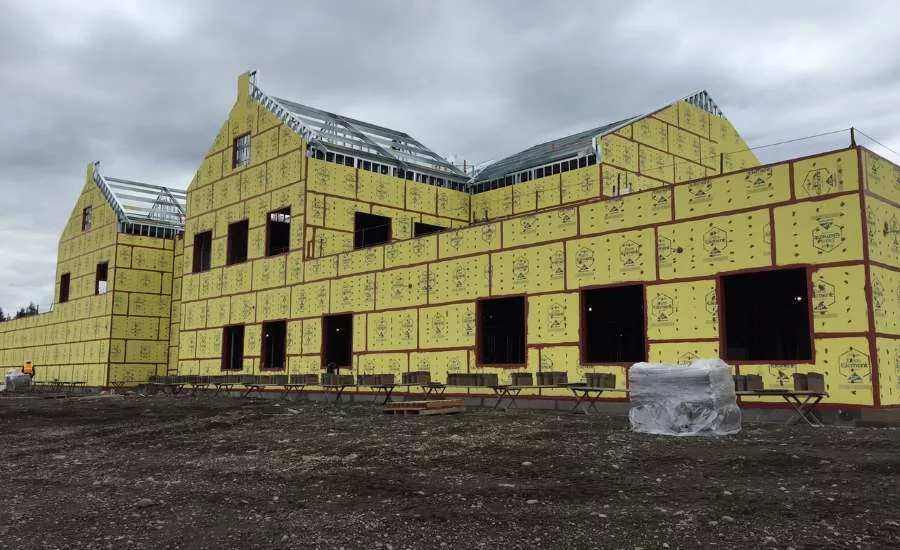
Photo courtesy of Georgia-Pacific Gypsum.
October 29, 2018

Cold weather regions pose unique challenges for architects and construction crews alike. Freezing temperatures and precipitation can lead to problems that harm both the structural integrity of the building envelope and the comfort of its occupants. Consequently, architects must take a variety of factors into consideration when drawing up plans and selecting materials for the building envelope, and construction crews need to take steps to ensure severe weather doesn’t cause costly delays. But with the proper considerations during both the planning and building phases, projects stakeholders can help ensure they create a building that will withstand the elements both on time and on budget.

Let’s start with the planning phase. Some in the AEC community feel that cold weather climates demand a vapor-impermeable water-resistive and air barrier (WRB-AB) as a component of the building envelope, but that isn’t actually the case. While a WRB-AB is necessary to keep the outside elements from making their way inside the building, choosing one that doesn’t allow vapor to escape can have a damaging effect on the health and structural integrity of the envelope.

The laws of physics dictate that moisture flows in specific ways to find equilibrium. It migrates from warm areas to cooler ones, from areas where it is dense to areas where it is sparse, and from areas of high pressure to low-pressure zones. As a result, frigid temperatures outside buildings located in cold-weather regions will create a vapor drive that causes the accumulated warmth and humidity inside a building to try to escape through the exterior walls. When the warm, moist air collects on those cool surfaces, it can condense into liquid water, which can lead to mold and mildew growth, peeling paint, and corrosion on metal assemblies. For this reason, it’s important to specify a WRB-AB that blocks bulk water but allows vapor to pass through, which will help to prevent the problems caused by condensation.

Ice buildup is also a major concern in cold climates. Since water expands as it freezes, ice can cause cracks in the façade and—if water makes its way inside the building envelope—structural damage to the building envelope. Accumulated snow and ice can also lead to thermal bridging, which allows heat to escape from inside the building through the thermal barrier, decreasing its energy efficiency. For these reasons, it’s important to spec a WRB-AB as part of the building envelope that will not only help keep water and cold air out, but also allow vapor to pass through from the interior to the exterior, which can help to help mitigate the problem of ice and snow formation on the outside of the building.

When it comes to the construction phase of any project, the main concern of building owners is that it's completed on time and on budget. Unfortunately, in cold-weather climates, weather can cause major schedule disruptions. Owners who are concerned with having the building occupied as soon as possible will encourage their architects to find solutions that allow for construction to stay on schedule regardless of how bad the weather gets. Consequently, these designers will traditionally specify products that are inherently capable of being applied in cold weather. This includes liquid-applied WRB-ABs that are silicone-based or contain curing enhancers such as anti-freeze additives, self-adhering membranes with “cold-weather adhesives” or bond enhancers, and building wraps.

But even with their special formulations that allow for cold-weather application, these products must be applied within a specific temperature range in order to be effective. They also don’t account for changes such as drops in ambient temperature and ice and snow accumulation on the envelope’s substrate that can occur overnight or due to weather delays—both of which create bond-inhibiting conditions for liquid-applied and self-adhering WRB-ABs, which can create application issues that can cause scheduling delays. For example, self-adhering membranes can require a primer if the temperature is below their application range. And if they’re applied when there is a layer of snow or ice on the sheathing, it can cause the adhesive to become brittle, or the product will bond with the snow or ice instead of the sheathing. 

Liquid-applied products flow more slowly in colder weather, reducing their efficacy and changing their curing and absorption profiles, which can affect the thickness of the application layer. While rolling these products on in cold weather is difficult, spraying is even more challenging and can also be dangerous for workers, since the product can atomize and be inhaled or absorbed through the skin. Ultimately, this could make additional coats necessary, which can delay the attachment of cladding and, in turn, the entire project.

To try to mitigate these circumstances and prevent costly delays, contractors often turn to tenting and heating to regulate the temperature around the envelope during the WRB-AB application process. But the cost to rent, erect and tear down the equipment and run the heaters can be exorbitant. On the other hand, sheathing with integrated WRB/ABs can be applied in cold weather conditions and remain exposed for longer durations, helping to alleviate concerns regarding temperature fluctuation and exposure to ice and snow.

Since these integrated systems only require sealing of the joints, fasteners, openings, penetrations and transitions with a liquid flashing membrane that can be applied to damp surfaces, they can be installed in cold, wet conditions, helping to keep weather delays to a minimum. This makes them an ideal solution for architects who know they need to specify a WRB-AB that can stand up to frigid conditions. And integrated sheathing solutions don’t require additional products such as primers or special preparation for application in cold weather. They can be installed without tenting and heating, and without worry about proper adhesion or coating thickness.

Cold weather climates present challenges for both architects and contractors, which is why taking the proper steps during both the design and construction process is so important. To ensure the long-term health of the building envelope, architects need to feel confident that the WRB-AB they specify can be applied smoothly and effectively in frigid conditions and will do an effective job of protecting the building envelope throughout its lifetime. In short, choosing the right high-performance WRB-AB system will help ensure the project is finished both on time and on budget, and that the final product is a building capable of withstanding the elements while keeping occupants both safe and comfortable.

KEYWORDS: building façade snow and ice water management WRB (weather resistant barrier)

Share This Story

Looking for a reprint of this article?
From high-res PDFs to custom plaques, order your copy today!


Jasonpeace web
Jason Peace is the Senior Director of Marketing and Product Management at Georgia-Pacific Gypsum. With over 19 years of experience at GP, his extensive background includes the conceptualization and launch of DensElement Barrier System, the latest innovation in the Georgia-Pacific Gypsum portfolio of Dens fiberglass mat gypsum panels. In most of Peace’s roles, much of his focus has been on new product development, process engineering, and driving market advantage through strategic positioning for the future.

Recommended Content

JOIN TODAY
to unlock your recommendations.

Already have an account? Sign In

  • bar graph shows LEED v4/LEED v5/LEED v6 in various colors

    When Will LEED v4 / v4.1 and LEED v5 Expire?

    The latest version of the LEED rating system, LEED v5, is...
    Sustainability
    By: Daniel Overbey
  • Celebrating Women In AEC-2026

    Celebrating Women in The AEC Industry Part 1

    A round-up of women in the design, engineering and...
    Sustainability
    By: Lindsay Lewis
  • KEE membrane application on a roof

    A Beginner’s Guide to Single-Ply Roofing Membranes

    While PVC and TPO appear extremely similar, the chemistry...
    Low-Slope Roofs
    By: Peter Gross
Manage My Account
  • Sign up for the Newsletter
  • Online Registration
  • Manage My Preferences
  • Registration Customer Service

More Videos

Sponsored Content

Sponsored Content is a special paid section where industry companies provide high quality, objective, non-commercial content around topics of interest to the Building Enclosure audience. All Sponsored Content is supplied by the advertising company and any opinions expressed in this article are those of the author and not necessarily reflect the views of Building Enclosure or its parent company, BNP Media. Interested in participating in our Sponsored Content section? Contact your local rep!

close
  • HITT Construction headquarters
    Sponsored byBuilding Composites® LLC

    Pushing the Envelope

  • 2 construction workers and a DEXcell panel
    Sponsored byDEXcell Roof Boards

    Designing Low-Slope Roofs for Resilience

  • Bell Bank headquarters in Fargo, North Dakota
    Sponsored bySto Corp.

    Drained and Back-Ventilated Rainscreens vs Pressurized-Equalized Rainscreens

Popular Stories

Open vs. closed cell foam in an attic

Open-Cell vs. Closed-Cell Spray Foam

graphic shows white arrows pointing to the right on a light green background

A Breakdown of Air Leakage Testing in LEED v5 BD+C

graphic shows a building destoryed by tornados with information on the amount of torandos in 2026 in the US

Record-Breaking Tornado Activity in Illinois Signals New Challenges for Architects

Building Enclosure Newsletter

BE Poll

Events

April 9, 2026

Strategies for High-Performance Below-Grade Waterproofing

Credits: 1 AIA LU/HSW ; 1 IIBEC CEH; 0.1 IACET CEU

On-Demand Designing a high-performance building enclosure requires more than just surface-level protection; it demands a rigorous, performance-based mastery of below-grade water and gas mitigation. This discussion will provide an expert-level analysis of below-grade waterproofing within the comprehensive framework of the high-performance building enclosure.

April 28, 2026

Roof Design Considerations That Prevent Installation Failures and Change Orders

Credit: 1 AIA LU/HSW; 1 IIBEC CEH; 0.1 ICC CEU

On-Demand This course provides visual examples of actual field conditions. Some good, some not so good; along with design suggestions that can cut installation costs and reduce construction change orders. Upon completion of this course, you will have a better understanding of the requirements the roofing contractor must meet to provide the specified roofing system warranty, and long-term value to the owner.

View All Submit An Event

Products

Plaster and Drywall Assemblies Manual

Plaster and Drywall Assemblies Manual

This is a comprehensive manual that goes beyond codes and standards, providing expert guidance in design, detailing, material selection and troubleshooting for plaster and drywall.

See More Products

Related Articles

  • Enhanced Impact Resistance and Cold Weather Handling

    See More
  • Hot & Cold Weather Stucco Applications

    See More
  • Verde Point Apartments

    Key Considerations in Designing for Accessibility

    See More

Related Products

See More Products
  • buildings.jpg

    Mechanical and Electrical Equipment for Buildings, 13th Edition

  • 41G-JcZWT+L._SX342_SY445_.jpg

    The Architect's Studio Companion: Rules of Thumb for Preliminary Design, 7th Edition

  • net zero.jpg

    Net Zero Energy Design: A Guide for Commercial Architecture

See More Products

Events

View AllSubmit An Event
  • September 24, 2025

    Understanding & Designing for Moisture Movement

    Credit: 1 AIA LU/HSW; 0.1 ICC CEU; 1 IIBEC CEU On-Demand This presentation will help designers better understand how moisture moves through airflow by diffusion. We will discuss permeability of materials and its impact on the performance of enclosure assemblies.
  • July 21, 2026

    Designing for Quiet

    Credit: Credit 1 AIA LU/HSW pending; 1 IIBEC CEH; 0.1 ICC CEUThis course examines the most common acoustic challenges encountered in commercial-to-residential adaptive reuse projects and pairs each challenge with practical, design-based solutions. With an emphasis on sound transmission through walls and the limitations of Sound Transmission Class (STC) ratings, the course explores how flanking paths, structure-borne noise, HVAC systems, and detailing influence real-world acoustic performance. 
View AllSubmit An Event
×

Enhance your expertise with unparalleled insights.

Join thousands of building professionals today. Shouldn’t you know what they know?

SUBSCRIBE TODAY!
  • RESOURCES
    • Advertise
    • Contact Us
    • Store
    • Want More
  • SIGN UP TODAY
    • Create Account
    • Newsletter
    • Customer Service
    • Manage Preferences
  • SERVICES
    • Marketing Services
    • Reprints
    • Market Research
    • List Rental
    • Survey/Respondent Access
  • STAY CONNECTED
    • LinkedIn
    • Facebook
    • Instagram
    • YouTube
    • X
  • PRIVACY
    • PRIVACY POLICY
    • TERMS & CONDITIONS
    • DO NOT SELL MY PERSONAL INFORMATION
    • PRIVACY REQUEST
    • ACCESSIBILITY

Copyright ©2026. All Rights Reserved BNP Media, Inc. and BNP Media II, LLC.

Design, CMS, Hosting & Web Development :: ePublishing