Continuous Insulation or is it Convoluted Insulation?
The struggle to define “continuous insulation” has incited manufacturers in the wall and ceiling industry to take the energy code officials to task.
If you have not heard about continuous insulation, then you must have been on the moon the last year. If you are reading this, you should know that impetus for CI was a strong reduction in the true R value of a steel framed wall. The premise that metal is a great conductor of energy led ASHRAE to re-calculate the presumptive R value used for decades. The new, improved science led us to use the U factor, which was far more accurate than simply stuffing the cavity with R-13 insulation and calling the wall R-13. The U factor looks at the heat loss or gain from all materials, including the framing members. And steel framing did not fare so well. The term is “thermal shorts or bridging” and refers to transfer of energy through the stud.
The steel framing industry was rightfully upset, as this was not good news for steel stud manufacturers that are competing against wood studs for market share. The continuous insulation issue was brought about by higher energy cost, the desire for more sustainable buildings and a push for green buildings. Because there was so much political push in the same direction, reversing the ASHRAE mandates was hopeful at best. True to many predictions, the energy codes have been morphing and changing faster than departmental agencies can print data.
GOOD NEWS, BAD NEWS
For the steel stud manufacturers there is both good and bad news. The bad news is that the ASHRAE committees have not given an inch on the thermal short issue and in fact made it more restrictive just a few years ago. What could be the good news? The wood framing industry thought they were immune and would have a market advantage as their product was exempt from CI. Well, the day has arrived and in California, framing both steel and wood framed walls will require CI. Steel may just require a little thicker or a more dense form of rigid foam sheathing. In addition, designers who are green-minded typically prefer steel framing as a more sustainable building product.
Even more good news is that when CI was first introduced, we had very little testing, and somewhat limited experience with plaster and plaster-like assemblies over rigid foam. But today, we have several projects completed with cement plaster over rigid foam and when good practices established by the Western Conference of Wall and Ceiling Institutes are followed, they work quite well. More information on cement stucco over rigid foam can be found at www.tsib.org.
DUH?
The statement that the industry had limited experience with plaster-like systems over rigid foam is not entirely true. The industry has two very special systems that have vast experience in CI over framed walls. The first is EIFS and was designed expressly to meet this CI-type need. In fact, it is the only cladding that is truly a continuous insulation. While some would like to make EIFS the only code-compliant CI, that is not likely to happen.
The building officials of the United States have little interest in mandating only one cladding for the country as a “legal” cladding. However, it is more than fair to say that no cladding is as effective at meeting the full intent of CI as an adhesively applied EIFS. There is no argument—it is simply fact. If designers and developers want the best CI possible, they would have to select an EIFS that is adhered to the sheathing. This has been the system of choice in Europe where energy costs have been at high levels for decades and while American builders at first failed to recognize the nuances of this system and adapt it to U.S- style construction, the EIFS manufacturers did take notice and made those modifications to fit very comfortably with our unique construction practices stateside. Today, every major EIFS manufacturer has a variety of systems that blend well with virtually all the substrates we can dish out. Visit www.eima.com for more information and a list of those major manufacturers.
The other well tested CI plaster is one coat. The term “one coat” is rather misleading, it is in reality a two coat system. One coat, like EIFS has proven to be, is very serviceable when designed and installed correctly. The one coat system was developed in the Southwest to meet the code changes that occurred from the “gas crisis” in the ’70s. For those old enough to remember the “odd-and-even” days in gas rationing, it was not fun to wait in lines three blocks long to fuel up your car. After waiting in endless lines, we found the building code was changed as a direct result of this energy crisis.
The one coat stucco was a 3/8-inch basecoat applied in one pass, in lieu of the traditional scratch and brown coats totaling a 3/4-inch basecoat applied in two passes—thus the name one coat. The new one coat allowed builders to continue using a 2x4 stud rather than a 2x6 to meet the higher R value requirements. The one coat system has typically been applied to foam sheathing over open framing in the Southwest. One coat had nothing to do with this 1970s energy-related code change but it does meet the definition for CI as established by ASHRAE where only the fasteners used to attach the cladding can penetrate the CI. For more information on one coat stucco, visit www.nocsa.org.
“Z-Z” TOP
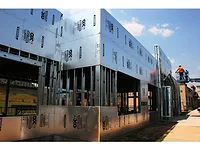
For those in the CI world, you may have noticed various panels, assemblies or systems that incorporate a “Z” girt or furring type channel; the Western Conference has one such assembly in its brochure. How is this possible if only fasteners are allowed to disrupt the CI?
While the future for these types of assemblies is up in the air, they are being done and being accepted by code authorities as compliant with energy codes for CI. This may change in the future (some metal panel manufacturers are pushing for a revision in the ASHRAE definition of CI to allow for Z type furring; others are pushing to have the Z furring banned entirely). The Western Conference decided that Z furring was acceptable as long as the Z is thermally broken at both termination points (meaning the inside and outside face). The energy code officials have accepted this as a reasonable approach to save energy. But that could change, as the evolution in convoluted insulation seems continuous.
Watch the W&C Architect Webinar on CI May 31. The event is presented by the WWCCA’s Albert Carrillo. Register at webinars.wconline.com.
Looking for a reprint of this article?
From high-res PDFs to custom plaques, order your copy today!
.webp?height=740&t=1767036885&width=auto "Header - BE 1170x658 (002).png")

.webp?height=740&t=1755781744&width=auto "KEE(2).png")