Continuous Insulation: A Modern, Energy-Efficient Solution for Builders and Building Owners
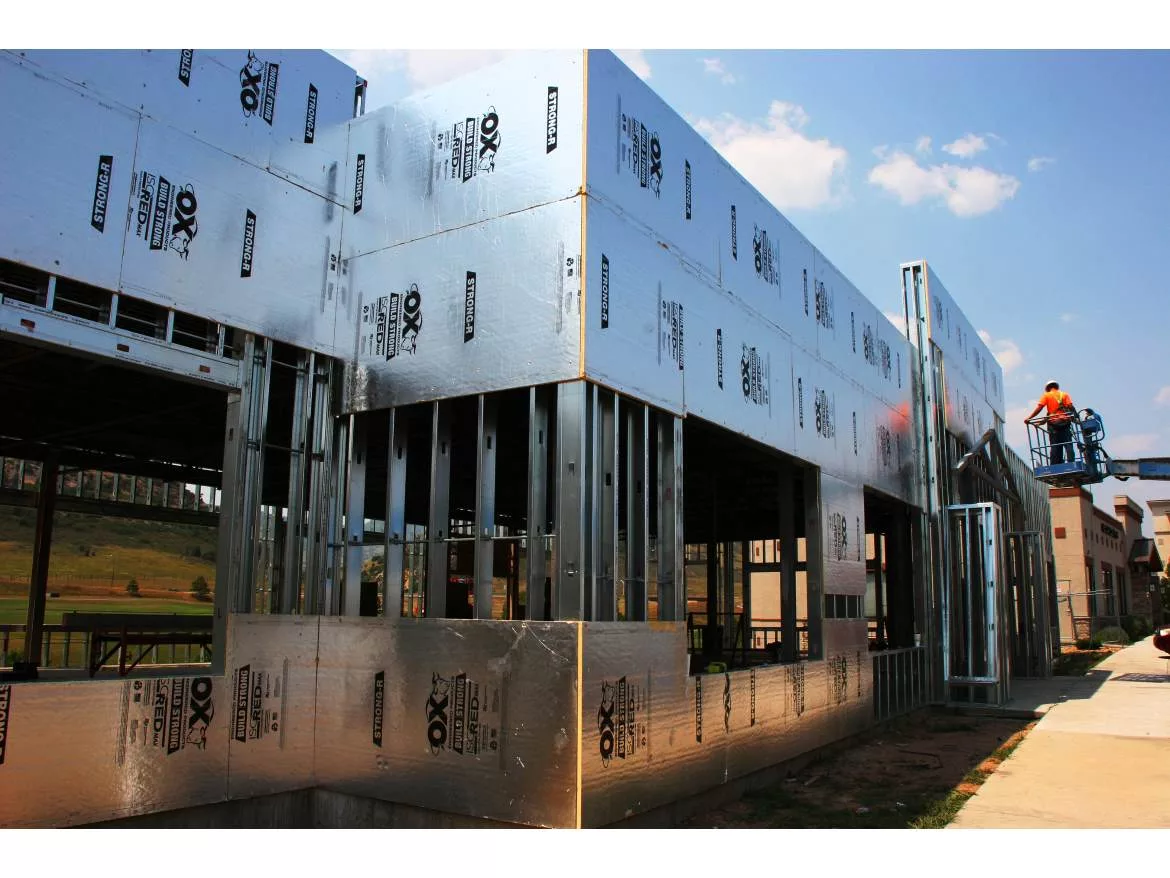
Structural continuous insulation covers gaps in traditional building insulation to increase energy efficiency in the long term. Photo courtesy of author.
Continuous insulation is the last (and most important) line of defense when it comes to keeping heat inside a structure. Heat is transferred through studs, so if insulation is not installed continuously across the building envelope, a structure is not living up to its potential in terms of thermal performance.
When combatting internal temperature fluctuations, certain factors cannot be controlled, such as our seasonal distance from the sun, or the warm and cold fronts that make up part of the daily forecast.
This means that for building owners of every kind, maintaining a comfortable interior temperature is a yearlong challenge that requires constant adjustment—opening or closing the blinds, adjusting the thermostat for the HVAC system, or opening the windows.
The long-term impact on this changing equation begins with the construction of the building. Smart insulation makes a discernible difference, and it starts at the exterior of the structure.
Making the right choice during the construction process impacts code compliance, and it can also lead to greater efficiencies when it comes to project completion.
A Single, Fully Integrated Method
When builders of multi-family or light commercial structures are seeking continuous insulation products to complete the structure’s exterior wall system, fully integrated products can change the dynamic. For example, some continuous insulation products require an additional layer of structural sheathing to complete the wall system. Structural sheathing, of course, is a necessary wall component that allows for the installation of exterior finishing materials like brick or siding.
Products that combine these two key wall components—structural sheathing and continuous insulation—into a single solution can deliver time and cost savings to builders. This is especially true for builders charged with constructing larger-scale buildings like restaurants, apartment complexes, or low-rise office buildings.
Furthermore, some continuous insulation products even feature a built-in air barrier and water-resistive barrier. In fact, manufacturers such as Ox Engineered Products have developed 4-in-1 product solutions that combine all of the necessary components that need to be installed behind the builder’s cladding of choice.
These products include four key elements:
• Structural sheathing
• Continuous insulation
• Air barrier
• Water-resistive barrier
Integrated continuous insulation products such as these ease the installation burden for installers, allowing them to complete construction of the building envelope in much less time and with less effort.
Solving the R-Value Equation
Ever-changing building code requirements are forcing builders to choose products that meet a particular standard. Climate change and energy conservation continue to be hot-button issues, and more and more jurisdictions are requiring specific R-values for to-be-built homes and commercial structures.
It is all about the end number. Depending on thickness, integrated structural continuous insulation products can deliver R-values of 7.5 up to 13 when installed. That is before cavity insulation or other means of insulating a building are even considered.
According to the International Energy Conservation Code (IECC), R-values for wood-framed structures in climate zone 1 require a value of R-20. That means that continuous insulation with a value of R-13 gets builders more than halfway to the desired final sum for a large portion of new builds throughout the United States, including the northernmost states. Of course, this number changes depending on climate zone, but continuous insulation is a viable option to help builders solve the R-value equation regardless of location.
A Command Performance
Choosing continuous insulation can pay dividends for building owners and occupants by keeping spaces comfortable: Cool in the summer, and warm in the winter. In addition, because continuous insulation keeps interiors at the right temperature for longer, reliance on HVAC systems and overall energy consumption are reduced. This carbon footprint reduction in a commercial or multi-family building can go a long way to meeting code and supporting a healthy built environment. It also saves building owners money on monthly energy bills.
Thermal bridging and moisture build-up are two of the biggest concerns when it comes to exterior walls, and continuous insulation products are manufactured specifically to overcome these challenges.
Thermal bridging occurs when heat is transferred through an uninsulated material such as a wall stud. This occurs in wood and steel frame construction, but more so in steel because it is much more conductive than wood.
Exterior continuous insulation prevents thermal bridging (and therefore thermal loss) by providing an uninterrupted barrier that is installed outside of the studs. This allows builders to deliver high R-values even in 2x4 construction, which results in a thinner wall that still delivers on long-term performance. For the owner, that means less money spent to consistently maintain a comfortable interior temperature, curbing the overall energy needs of the building.
Clearly, thermal loss can negatively impact the comfort of interior environments and energy consumption, but moisture penetration is potentially an even greater concern that can cause permanent damage to structural components. If it is a multi-family residential building or a high-use office building, repairs for moisture and water damage could lead to interrupted living arrangements or work schedules and headaches for ownership.
Continuous insulation, however, is installed outboard of the studs, which moves the dew point from inside the wall cavity to the outer side of the sheathing. As a result, the opportunity for condensation to form within the wall cavity is dramatically reduced. This significantly decreases the risk of mold growth as well as defending against structural rot. In addition, 4-in-1 continuous insulation products are manufactured with a built-in water-resistive barrier on the material’s outer surface to keep moisture and water out. By nature of being continuous, when installed properly with high-performance seam tape, this type of insulation provides a weathertight barrier installed to produce long-term building envelope performance.
Ultimately, structural continuous insulation maintains the integrity of your building to keep it and its occupants healthy.
Time is Money
Performance-wise, structural continuous insulation is the optimal solution when assembling and constructing the exterior wall of any building. However, the solution also delivers time and cost savings on the jobsite. Structural continuous insulation is typically one-third the weight of traditional OSB. This allows for more efficient use of labor, requiring less hands on deck.
In addition to structural and insulating components, these products feature an integrated water-resistive barrier as well as an air barrier. In typical construction, OSB or another sheathing product must be installed first, then a weather-resistive barrier, and finally a layer of continuous insulation. For a commercial structures, eliminating these extra steps with a single, integrated product can dramatically reduce the amount of time crews need to spend on the job site.
The Total Package
Between choosing the right high-performance materials, meeting code, and working efficiently to finish the job within the established timeline and budget, construction can be a balancing act for crews. At the same time, they must deliver on the mandate from the eventual owners and occupants of a building – a safe, comfortable structure that is built to last.
In terms of performance, integrated structural continuous insulation provides a solid defense against hot/cold air transfer, moisture accumulation, mold growth, and structural rot. It is the ultimate solution for the long term. At the same time, 4-in-1 continuous insulation products are designed with code requirements in mind. Manufacturers such as Ox Engineered Products are constantly innovating new designs to remain on the cutting edge of building material innovation.
Looking for a reprint of this article?
From high-res PDFs to custom plaques, order your copy today!
.webp?height=740&t=1767036885&width=auto "Header - BE 1170x658 (002).png")

.webp?height=740&t=1755781744&width=auto "KEE(2).png")
.webp?height=200&t=1637160452&width=200 "Ox")