Building Enclosure logo
search
cart
facebook twitter linkedin youtube instagram Spotify Podcasts Apple Podcasts Spotify Podcasts Apple Podcasts
  • Sign In
  • Create Account
  • Sign Out
  • My Account
Building Enclosure logo
  • NEWS
    • Breaking News
  • SECTIONS
    • Columns
    • Project Profiles
    • Trade Shows
    • Sponsor Insights
  • SYSTEM DESIGNS
    • Low-Slope Roofs
    • Pitched Roofs
    • Metal Roofing Materials
    • Waterproofing
    • Sustainability
    • Insulation
    • Exterior Claddings
    • Wall Systems
    • Building Envelope
  • BLOG
    • The BE Blog
  • MEDIA
    • Podcasts
    • Webinars
    • Quiz
    • Videos
    • Polls
    • Interactive Spotlights
    • Newsletter
    • Photo Galleries
  • DIRECTORIES
    • Directory: Blue Book
    • Directory: Roofing Resource
  • PRODUCTS
  • TECHNICAL
    • Codes
      • Waterproofing
      • Roofing
    • Details
      • Waterproofing
      • Roofing
  • CONTINUING ED
  • ABOUT
    • Advertise
      • Editorial Calendar
    • Contact
    • eMag Archive Issues
  • SIGN UP!
Insulation

What Do Model Energy Codes Mean for Continuous Insulation?

By Justin Koscher
PIMA
May 15, 2017

Recent improvements to model energy codes are boosting advances in the use of insulation for commercial and residential building envelopes. These changes are helping to offset energy costs, and improve the durability and resiliency of buildings. As a result, the methods and materials design professionals specify for thermal management in building projects are also changing.

In 2012, the International Code Council (ICC) published an updated International Energy Conservation Code (IECC) that called for a 30 percent increase over the 2006 code in building energy savings, the single largest efficiency increase in the history of the model energy code. Along with upgrading commercial roof insulation to current R-value code requirements, the 2012 IECC highlights continuous insulation (CI) systems as an effective design to increase thermal efficiency.

Continuous Insulation in Walls
In the ASHRAE 90.1 standard, Energy Standard for Buildings Except Low-rise Residential Buildings, CI is defined as:
"Insulation that is continuous across all structural members without thermal bridges other than fasteners and service openings. It is installed on the interior, exterior, or is integral to any opaque surface of the building envelope."

While this insulation approach is not new—it is quite common in low-slope roofing assemblies—its use on both residential and commercial building walls is changing the way builders and design professionals look at the building envelope. As cost and carbon footprint become more of a factor, model energy codes are emphasizing higher-performing wall assemblies, including those using CI. Like any construction material, insulation used in CI applications must be properly specified to ensure its intended performance and appropriate use.


Materials: Function and Versatility
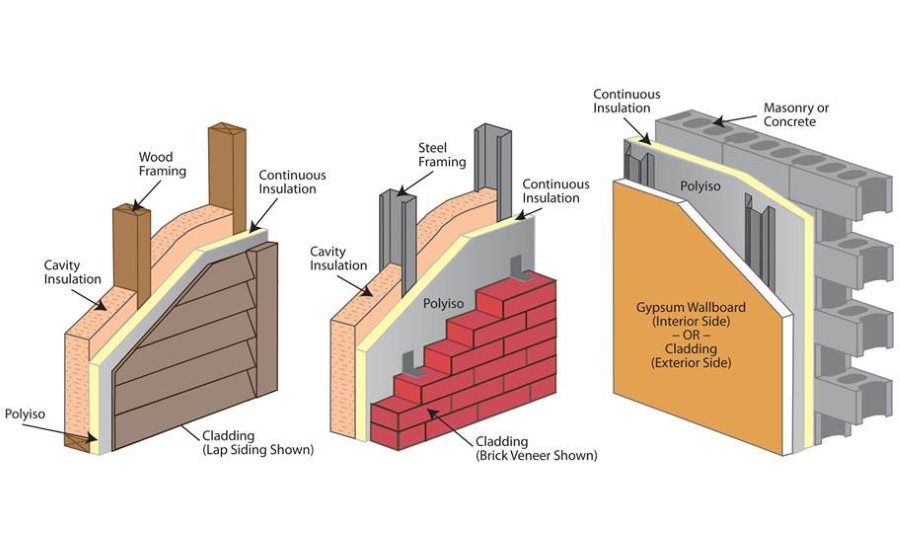
As the illustration shows, CI can be used with various residential and commercial wall structural systems and cladding materials like:

  • Cement board
  • Portland cement stucco
  • Wood lap
  • Brick veneer
  • Stone
  • Vinyl siding

In these applications, the primary function of CI is to improve energy performance and provide a cost-effective compliance option for  more rigorous building energy code requirements. The benefits of CI extend beyond energy savings. Properly qualified and installed ci products can also serve as air- and water-resistant barriers. When laminated to structural materials, certain ci products can even improve the structural integrity of walls.

A variety of insulation materials can be relied upon to create continuous wall insulation, including:

  • Polyisocyanurate (polyiso) foam
  • Expanded polystyrene (EPS)
  • Extruded polystyrene (XPS)

Each product type has different thermal performance properties and other physical properties that will influence a builder or design professional’s selection. Polyiso foam insulation has been relied upon for years as the go-to solution for energy-efficient low-slope commercial roofs, providing a ci solution for over 70 percent of commercials roofs. The many benefits of polyiso that have made the product a trusted solution for roofs can translate to residential and commercial walls.

Polyiso offers a high R-value per inch that allows designers to meet thermal envelope requirements with less material. The product’s light-weight boards make installation easier and certain polyiso products can be used as air and water-resistant barriers. These performance benefits can help lower material and labor costs for many projects.

Modern Energy and Building Code Requirements
CI is one of the most thermally efficient ways of complying with modern energy codes and mitigates heat loss due that commonly results from thermal bridging.

The performance of CI extends beyond energy savings. Testing has shown that CI systems can enchased the wind pressure resistance of wall assemblies when compared to assemblies that use only traditional materials. Many CI products can also be used as a water-resistive barrier behind cladding, offering water protection and thermal performance in one product. Design professionals also have the option to apply separate vapor barriers to walls with CI.

During installation, direct attachment of cladding through the CI system or furring placed over and attached through the CI can minimize thermal bridging from cladding connections. Properly matching the R-value of insulation to different climates and using adequate vapor retardants can prevent condensation by keeping walls above the dew point and allow seasonal drying capability.

Construction Detailing
Clear and detailed instructions for using continuous insulation (ci) in walls and roofs are critical to their successful use. Construction details to consider include:

  • Envelope component attachments;
  • Integration of flashing and water-resistant barriers;
  • Integration of furring (if used) around wall penetrations and flashing;
  • Attachment of cladding to wall framing through ci or to furring;
  • Details for cladding attachments through ci at inside and outside corners; and
  • Installation detailing per NFPA 285 tested assembly when required.

Continuous insulation is a high-performance building solution that can deliver multiple benefits to almost any residential or commercial project. It provides long-term thermal performance for the building while protecting against air infiltration and moisture, saves money on energy costs, and can improve the indoor conditions and comfort for building occupants. 

KEYWORDS: CI (continuous insulation) commercial roofing energy codes

Share This Story

Looking for a reprint of this article?
From high-res PDFs to custom plaques, order your copy today!


Justin koscher
Justin Koscher is the President of the Polyisocyanurate Insulation Manufacturers Association (PIMA). Prior to joining PIMA, Koscher was Director of Polyurethanes Markets at American Chemistry Council’s Center for Polyurethanes Industry (CPI) for three years and he spent four years as Vice President of Public Policy and Staff Counsel for Environmental Innovation in Roofing. Koscher holds a law degree for DaPaul University College of Law. Koscher’s email is koscher@pima.org.

Recommended Content

JOIN TODAY
to unlock your recommendations.

Already have an account? Sign In

  • bar graph shows LEED v4/LEED v5/LEED v6 in various colors

    When Will LEED v4 / v4.1 and LEED v5 Expire?

    The latest version of the LEED rating system, LEED v5, is...
    Sustainability
    By: Daniel Overbey
  • Celebrating Women In AEC-2026

    Celebrating Women in The AEC Industry Part 1

    A round-up of women in the design, engineering and...
    Building Envelope
    By: Lindsay Lewis
  • KEE membrane application on a roof

    A Beginner’s Guide to Single-Ply Roofing Membranes

    While PVC and TPO appear extremely similar, the chemistry...
    Low-Slope Roofs
    By: Peter Gross
Manage My Account
  • Sign up for the Newsletter
  • Online Registration
  • Manage My Preferences
  • Registration Customer Service

More Videos

Sponsored Content

Sponsored Content is a special paid section where industry companies provide high quality, objective, non-commercial content around topics of interest to the Building Enclosure audience. All Sponsored Content is supplied by the advertising company and any opinions expressed in this article are those of the author and not necessarily reflect the views of Building Enclosure or its parent company, BNP Media. Interested in participating in our Sponsored Content section? Contact your local rep!

close
  • HITT Construction headquarters
    Sponsored byBuilding Composites® LLC

    Pushing the Envelope

  • 2 construction workers and a DEXcell panel
    Sponsored byDEXcell Roof Boards

    Designing Low-Slope Roofs for Resilience

  • Bell Bank headquarters in Fargo, North Dakota
    Sponsored bySto Corp.

    Drained and Back-Ventilated Rainscreens vs Pressurized-Equalized Rainscreens

Popular Stories

graphic shows white arrows pointing to the right on a light green background

A Breakdown of Air Leakage Testing in LEED v5 BD+C

graphic shows a building destoryed by tornados with information on the amount of torandos in 2026 in the US

Record-Breaking Tornado Activity in Illinois Signals New Challenges for Architects

Patient room doors with flexible privacy features widens possible uses within these spaces and improves patient comfort

Acoustics and Aesthetics: The Value of Integrated Opening Systems

Building Enclosure Newsletter

BE Poll

Events

April 9, 2026

Strategies for High-Performance Below-Grade Waterproofing

Credits: 1 AIA LU/HSW ; 1 IIBEC CEH; 0.1 IACET CEU

On-Demand Designing a high-performance building enclosure requires more than just surface-level protection; it demands a rigorous, performance-based mastery of below-grade water and gas mitigation. This discussion will provide an expert-level analysis of below-grade waterproofing within the comprehensive framework of the high-performance building enclosure.

April 28, 2026

Roof Design Considerations That Prevent Installation Failures and Change Orders

Credit: 1 AIA LU/HSW; 1 IIBEC CEH; 0.1 ICC CEU

On-Demand This course provides visual examples of actual field conditions. Some good, some not so good; along with design suggestions that can cut installation costs and reduce construction change orders. Upon completion of this course, you will have a better understanding of the requirements the roofing contractor must meet to provide the specified roofing system warranty, and long-term value to the owner.

View All Submit An Event

Products

Plaster and Drywall Assemblies Manual

Plaster and Drywall Assemblies Manual

This is a comprehensive manual that goes beyond codes and standards, providing expert guidance in design, detailing, material selection and troubleshooting for plaster and drywall.

See More Products

Related Articles

  • Tubelite400SS-SGcurtainwall

    Tubelite Curtainwall Offers Shop-Glazed Solution for Model Energy Codes

    See More
  • EnergyShield xr

    Expanded Fire Performance Approvals for EnergyShield XR Continuous Insulation

    See More
  • Hurricane Katrina

    The Power of Building and Energy Codes

    See More

Related Products

See More Products
  • net zero.jpg

    Net Zero Energy Design: A Guide for Commercial Architecture

  • building codes illustated.jpg

    Building Codes Illustrated: A Guide to Understanding the 2021 International Building Code, 7th Edition

  • energy modeling.jpg

    Energy Modeling and Computations in the Building Envelope

See More Products
×

Enhance your expertise with unparalleled insights.

Join thousands of building professionals today. Shouldn’t you know what they know?

SUBSCRIBE TODAY!
  • RESOURCES
    • Advertise
    • Contact Us
    • Store
    • Want More
  • SIGN UP TODAY
    • Create Account
    • Newsletter
    • Customer Service
    • Manage Preferences
  • SERVICES
    • Marketing Services
    • Reprints
    • Market Research
    • List Rental
    • Survey/Respondent Access
  • STAY CONNECTED
    • LinkedIn
    • Facebook
    • Instagram
    • YouTube
    • X
  • PRIVACY
    • PRIVACY POLICY
    • TERMS & CONDITIONS
    • DO NOT SELL MY PERSONAL INFORMATION
    • PRIVACY REQUEST
    • ACCESSIBILITY

Copyright ©2026. All Rights Reserved BNP Media, Inc. and BNP Media II, LLC.

Design, CMS, Hosting & Web Development :: ePublishing