Calculating the Costs of Solar
As homeowners, commercial entities and other organizations look to “go green” to reduce their energy consumption, costs and overall carbon footprint, solar power has emerged as an attractive form of alterative energy.

As homeowners, commercial entities and other organizations look to “go green” to reduce their energy consumption, costs and overall carbon footprint, solar power has emerged as an attractive form of alterative energy.
Thanks to improvements in technology performance and installation best practices - along with decreased costs, robust financial incentives and creative financing options like a power purchase agreement - installing a solar energy systems is more feasible than ever before. As a result, solar will be in high demand for both retrofit projects and new construction, and roofing professionals must consider the cost of designing a building or other structure so it can safely hold the weight of a solar installation should the owner decide to implement a solar energy system.
In the early 1980s, it was customary to use some simple comparative ratios to evaluate the economics of various schematic roof designs, and use this data to prepare early estimates of building component quantities - specifically, the quantity and weight of steel.
 Engineers
provided these schematic values to construction managers so they could start to
build and determine their initial construction budgets early on. And the data
had to be accurate - even the slightest discrepancy in costs of just a few
cents could sometimes mean thousands of dollars in overruns later on. Today, a
similar approach can be taken when designing projects to support a solar
photovoltaic system.
Engineers
provided these schematic values to construction managers so they could start to
build and determine their initial construction budgets early on. And the data
had to be accurate - even the slightest discrepancy in costs of just a few
cents could sometimes mean thousands of dollars in overruns later on. Today, a
similar approach can be taken when designing projects to support a solar
photovoltaic system.
The accurate calculations of costs in pre-design for new construction projects are extremely critical because solar impacts the loads of a soon-to-be-built structure. Generally speaking, architects, designers and contractors are not accurately accounting for the true costs of the structural requirements for solar in the early stages, and projects are moving forward without solar or making it more expensive to install later on.
Almost all typical solar energy solutions involve the following components: solar modules (commonly referred to as panels), racking systems (the structure connected to the roof and where the modules are fastened and secured) and inverters (the piece of equipment that converts direct current [DC] electricity into alternating current [AC] electricity). Depending on the roof structure and membrane, there may be a few additional bells and whistles, but these comprise the majority of the weight associated with a solar installation.
 Historically,
preliminary designs called for approximately five to six pounds of roof steel
per square foot of roof area. This includes joists, beams and columns. Five to
six pounds of steel typically supports a total roof load of approximately 50
pounds per square foot. This is the sum of a 20-pounds-per-square-foot dead
load (including a ballasted membrane roof, which was typical for the roofs of
the shopping centers in the early 1980s, for example), and a roof live load (or
snow load in some areas of the country) of approximately 30 pounds per square
foot. Using these figures, it is possible to estimate that it takes about one
pound of steel to support every 10 pounds of design roof load.
Historically,
preliminary designs called for approximately five to six pounds of roof steel
per square foot of roof area. This includes joists, beams and columns. Five to
six pounds of steel typically supports a total roof load of approximately 50
pounds per square foot. This is the sum of a 20-pounds-per-square-foot dead
load (including a ballasted membrane roof, which was typical for the roofs of
the shopping centers in the early 1980s, for example), and a roof live load (or
snow load in some areas of the country) of approximately 30 pounds per square
foot. Using these figures, it is possible to estimate that it takes about one
pound of steel to support every 10 pounds of design roof load.
Given this historical data, and assuming this comparative analysis remains generally reasonable, the weight of a ballasted photovoltaic solar system is approximately four-and-a-half to six pounds per square foot. The actual weight depends on the location on the roof of the installation, the tilt of the modules (typically 18 degrees) and the height above the ground. Another way to interpret this data is to say that a typical or traditional solar installation (i.e., not thin film) will require approximately half a pound of roof steel per square foot. Thin film solar weighs quite a bit less, but it is less efficient and therefore a much greater quantity is required.
As for variables, it is true that cost of steel tends to fluctuate significantly across the different regions of the country. There are also variables in fabrication, delivery and erection of steel that can increase the costs. If architects and designers assume that the added cost of steel needed to support a solar power installation is based on the raw cost of steel, it might be reasonable to make the following analysis to determine the cost impact associated with designing the roof structure to support the future installation of a photovoltaic system.
 Estimating
the cost of structural steel at $1,500 per ton ($0.75 per pound) and further
estimating that the raw cost of the steel is approximately 45 percent of the
total cost (the rest being engineering, fabrication, shipping and erection), it
can be assumed that the actual cost of the steel to be approximately $0.34 per
pound.
Estimating
the cost of structural steel at $1,500 per ton ($0.75 per pound) and further
estimating that the raw cost of the steel is approximately 45 percent of the
total cost (the rest being engineering, fabrication, shipping and erection), it
can be assumed that the actual cost of the steel to be approximately $0.34 per
pound.
This would indicate that it costs approximately $0.17 per square foot to design a facility with the capability to subsequently support a solar photovoltaic installation. Expecting that the overall building development costs probably range from $35 to $200 per square foot of building constructed or more depending on the use, type, location and other factors, solar represents just a small fraction of overall cost.
Based on these calculations, it becomes extremely cost-effective to pre-design a project so that it can subsequently support a solar energy system should be owner elect to install one. For roofing contractors and other industry professionals, the ability to design a roof for these purposes and explain the overall costs to customers yields a tremendous competitive advantage, especially as more and more organizations look to adopt renewable energy.
As homeowners, commercial entities and other organizations look to “go green” to reduce their energy consumption, costs and overall carbon footprint, solar power has emerged as an attractive form of alterative energy.
Thanks to improvements in technology performance and installation best practices - along with decreased costs, robust financial incentives and creative financing options like a power purchase agreement - installing a solar energy systems is more feasible than ever before. As a result, solar will be in high demand for both retrofit projects and new construction, and roofing professionals must consider the cost of designing a building or other structure so it can safely hold the weight of a solar installation should the owner decide to implement a solar energy system.
In the early 1980s, it was customary to use some simple comparative ratios to evaluate the economics of various schematic roof designs, and use this data to prepare early estimates of building component quantities - specifically, the quantity and weight of steel.
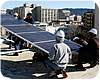
Borrego
solar workers install a solar energy system. Photos courtesy of Borrego Solar.
The accurate calculations of costs in pre-design for new construction projects are extremely critical because solar impacts the loads of a soon-to-be-built structure. Generally speaking, architects, designers and contractors are not accurately accounting for the true costs of the structural requirements for solar in the early stages, and projects are moving forward without solar or making it more expensive to install later on.
Almost all typical solar energy solutions involve the following components: solar modules (commonly referred to as panels), racking systems (the structure connected to the roof and where the modules are fastened and secured) and inverters (the piece of equipment that converts direct current [DC] electricity into alternating current [AC] electricity). Depending on the roof structure and membrane, there may be a few additional bells and whistles, but these comprise the majority of the weight associated with a solar installation.
Accurate
cost calculations in pre-design for new construction projects are critical
because solar systems impact the loads of a structure.
Given this historical data, and assuming this comparative analysis remains generally reasonable, the weight of a ballasted photovoltaic solar system is approximately four-and-a-half to six pounds per square foot. The actual weight depends on the location on the roof of the installation, the tilt of the modules (typically 18 degrees) and the height above the ground. Another way to interpret this data is to say that a typical or traditional solar installation (i.e., not thin film) will require approximately half a pound of roof steel per square foot. Thin film solar weighs quite a bit less, but it is less efficient and therefore a much greater quantity is required.
As for variables, it is true that cost of steel tends to fluctuate significantly across the different regions of the country. There are also variables in fabrication, delivery and erection of steel that can increase the costs. If architects and designers assume that the added cost of steel needed to support a solar power installation is based on the raw cost of steel, it might be reasonable to make the following analysis to determine the cost impact associated with designing the roof structure to support the future installation of a photovoltaic system.
This would indicate that it costs approximately $0.17 per square foot to design a facility with the capability to subsequently support a solar photovoltaic installation. Expecting that the overall building development costs probably range from $35 to $200 per square foot of building constructed or more depending on the use, type, location and other factors, solar represents just a small fraction of overall cost.
Based on these calculations, it becomes extremely cost-effective to pre-design a project so that it can subsequently support a solar energy system should be owner elect to install one. For roofing contractors and other industry professionals, the ability to design a roof for these purposes and explain the overall costs to customers yields a tremendous competitive advantage, especially as more and more organizations look to adopt renewable energy.
Looking for a reprint of this article?
From high-res PDFs to custom plaques, order your copy today!
.webp?height=740&t=1767036885&width=auto "Header - BE 1170x658 (002).png")

.webp?height=740&t=1755781744&width=auto "KEE(2).png")
