The Value of Solar
The Arlington Grove neighborhood in north St. Louis has seen its share of hard times in recent years, but through the efforts of the community’s dedicated church officials, residents and aldermen, plus developer McCormack Baron Salazar, KAI Design & Build, the City of St. Louis and the St. Louis Housing Authority, its future is looking brighter and greener.
The Arlington Grove neighborhood in north St. Louis has seen its share of hard times in recent years, but through the efforts of the community’s dedicated church officials, residents and aldermen, plus developer McCormack Baron Salazar, KAI Design & Build, the City of St. Louis and the St. Louis Housing Authority, its future is looking brighter and greener.
The $41 million Arlington Grove redevelopment project is considered one of the first mixed-income developments in the country designed to Enterprise Green Communities (EGC) criteria, and it is a first for Missouri and the City of St. Louis. A unique aspect of the development’s design is the specification of photovoltaic panels and highly reflective shingles to reduce energy consumption.
Plans for the development include 112-mixed finance, mixed-income rental units in garden apartments, townhouses, semi-detached housing, a new mixed-use building and the rehabilitation of the historic Arlington Elementary School for a total gross residential square footage of 162,000 and 5,000 square feet of commercial/retail. Plans for the school renovation and surrounding block include 21 apartments and 91 new construction townhomes and garden apartments designed to meet mandatory EGC criteria and were required by the Capital Fund Recovery Competition (CFRC) grant, a stimulus-related grant awarded by the Department of Housing and Urban Development (HUD).

The majority of the buildings in the development, including the elementary school building, will feature highly reflective, ENERGY STAR-qualified shingles. According to the EPA, solar reflectance is the most important characteristic of a roof product in terms of yielding the highest energy savings during warmer months. The higher the solar reflective value, the more efficient the product is in reflecting sunlight and heat away from the building and reducing roof temperature.
The EPA estimates that about $40 billion is spent annually in the U.S. to air condition buildings - one sixth of all electricity generated in a year. ENERGY STAR-qualified roof products can lower roof surface temperatures by up to 100 degrees Fahrenheit, decreasing the amount of heat transferred into a building. According to the EPA, ENERGY STAR-qualified roof products can help reduce the amount of air conditioning needed in buildings and can reduce peak cooling demands by 10 to 15 percent, which may allow the home or building owner to purchase a smaller, less expensive and more efficient cooling system. These roof products may also maintain a more constant temperature, therefore reducing thermal shock and helping to extend the life of the roof.
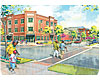
PV panels and ENERGY STAR shingles will top the Arlington Grove development. Rendering courtesy of KAI Design & Build.
The Arlington Grove neighborhood in north St. Louis has seen its share of hard times in recent years, but through the efforts of the community’s dedicated church officials, residents and aldermen, plus developer McCormack Baron Salazar, KAI Design & Build, the City of St. Louis and the St. Louis Housing Authority, its future is looking brighter and greener.
The $41 million Arlington Grove redevelopment project is considered one of the first mixed-income developments in the country designed to Enterprise Green Communities (EGC) criteria, and it is a first for Missouri and the City of St. Louis. A unique aspect of the development’s design is the specification of photovoltaic panels and highly reflective shingles to reduce energy consumption.
Plans for the development include 112-mixed finance, mixed-income rental units in garden apartments, townhouses, semi-detached housing, a new mixed-use building and the rehabilitation of the historic Arlington Elementary School for a total gross residential square footage of 162,000 and 5,000 square feet of commercial/retail. Plans for the school renovation and surrounding block include 21 apartments and 91 new construction townhomes and garden apartments designed to meet mandatory EGC criteria and were required by the Capital Fund Recovery Competition (CFRC) grant, a stimulus-related grant awarded by the Department of Housing and Urban Development (HUD).
Anthony J. Summers, LEED AP
PV Panels and ENERGY STAR Shingles
Photovoltaic panels are expected to provide at least 10 percent of the development’s total energy demands. The panels are specified for the roof of the new mixed-use building and other flat-roof buildings in the development. Any power generated by the panels will be fed back to the local utility. The utility company will then “buy back” electrical energy from the building, the simplest option for most owners. Utility companies generally buy the energy back at a lower rate than normally billed by the user.The majority of the buildings in the development, including the elementary school building, will feature highly reflective, ENERGY STAR-qualified shingles. According to the EPA, solar reflectance is the most important characteristic of a roof product in terms of yielding the highest energy savings during warmer months. The higher the solar reflective value, the more efficient the product is in reflecting sunlight and heat away from the building and reducing roof temperature.
The EPA estimates that about $40 billion is spent annually in the U.S. to air condition buildings - one sixth of all electricity generated in a year. ENERGY STAR-qualified roof products can lower roof surface temperatures by up to 100 degrees Fahrenheit, decreasing the amount of heat transferred into a building. According to the EPA, ENERGY STAR-qualified roof products can help reduce the amount of air conditioning needed in buildings and can reduce peak cooling demands by 10 to 15 percent, which may allow the home or building owner to purchase a smaller, less expensive and more efficient cooling system. These roof products may also maintain a more constant temperature, therefore reducing thermal shock and helping to extend the life of the roof.
Looking for a reprint of this article?
From high-res PDFs to custom plaques, order your copy today!
.webp?height=740&t=1767036885&width=auto "Header - BE 1170x658 (002).png")

.webp?height=740&t=1755781744&width=auto "KEE(2).png")